1. Nature of the Metro Expansion and Why It Matters
Chennai Metro Phase II – Corridor Influence
Porur is part of Corridor 4 (Light House – Poonamallee Bypass). This corridor is not a feeder line; it is a cross-city connector, linking:
- West Chennai
- Central Chennai
- Southern residential and employment zones
Why this is critical:
Earlier, Porur depended almost entirely on roads. Once Metro connectivity is added, Porur becomes part of Chennai’s primary transit grid, not a peripheral extension.
This changes how the real estate market values the location.
2. Price Growth Explained Step by Step
Stage 1: Announcement Phase
- Market reacts to future connectivity
- Landowners and developers revise expectations
- Transaction prices begin firming up
Result:
Early appreciation is driven by anticipation, not speculation.
Stage 2: Construction Phase
- Temporary inconvenience, but:
- Institutional buyers enter
- Larger developers acquire land
- Smaller standalone projects reduce
Result:
Prices rise steadily because supply becomes more organised and costlier.
Stage 3: Near-Operational Phase
-
End-users dominate demand
- Rental enquiries increase
- Ready and near-ready homes gain liquidity
Observed growth:
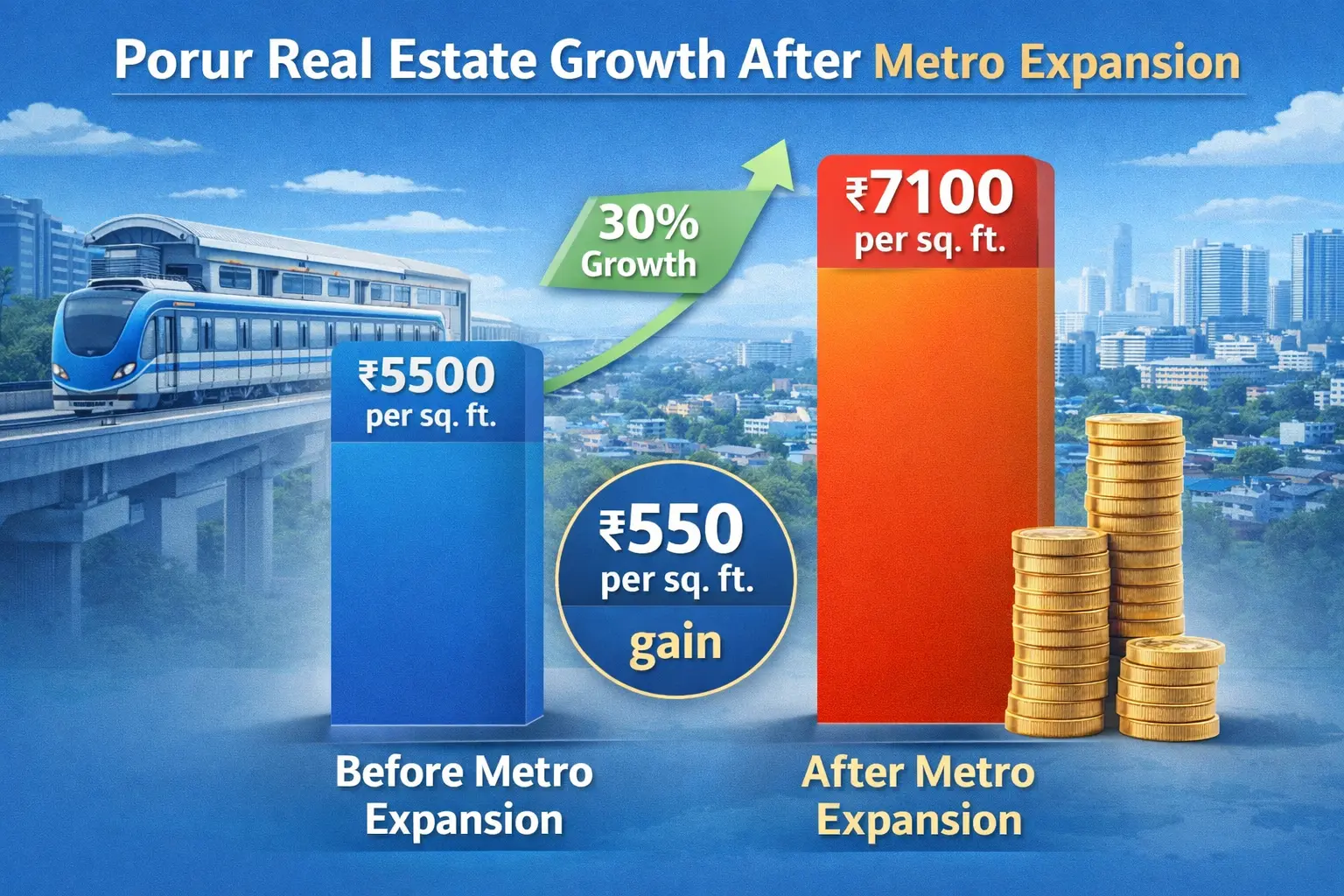
Overall 25–35% appreciation over the Metro development cycle, with higher premiums closer to stations.
3. Micro-Market Restructuring in Porur
Change in Housing Typology
Before Metro:
- Low-rise buildings
- Plot-based developments
- Limited amenities
After Metro:
- Gated communities
- Structured apartment projects
- Amenity-driven layouts
Impact on prices:
Buyers pay more for predictability, maintenance, and long-term livability.
Land Value Transformation
- Metro corridors restrict new land supply
- Redevelopment replaces vacant land
- Older properties gain latent value
Key insight:
Porur’s growth is supply-constrained, which supports price stability.
4. Rental Market Transformation
Tenant Profile Shift
Earlier tenants:
- Local workers
- Short-term renters
Post-Metro tenants:
- IT professionals
- Hospital and institutional staff
- Families seeking long-term rentals
Rental Behaviour
- Rents increase gradually, not abruptly
- Vacancy periods shorten
- Demand becomes less seasonal
Why:
Metro access reduces commute uncertainty, a key concern for salaried tenants.
5. Traffic, Accessibility, and Livability Impact
During Construction
- Congestion increased
- Road usability reduced
- Short-term inconvenience suppressed some demand
Post-Metro Reality
- Peak-hour road traffic reduces
- Public transport dependency improves
- Internal roads regain usability
Effect on real estate:
Livability improvements directly correlate with buyer confidence and resale value.
6. Buyer Behaviour Changes
End-User Dominance
- Buyers focus on:
- Commute time
- School & hospital access
- Long-term residence
Lower Speculative Risk
- Limited investor flipping
- Prices supported by actual occupancy
- Reduced volatility during market slowdowns
Outcome:
Porur becomes a low-risk residential market, not a speculative corridor.
7. Commercial & Ancillary Development
Retail and Office Growth
- Increased footfall near Metro zones
- Small offices and clinics increase
- Daily-use retail expands
Effect:
Porur evolves into a self-contained residential ecosystem, reducing dependency on distant commercial hubs.
Also Read: Why Property Prices Are Rising in Ashok Nagar
8. Long-Term Structural Impact
| Factor | Change After Metro |
| Market Identify | From peripheral suburb to core urban zone |
| Price Behaviour | Gradual, sustained appreciation |
| Rental Stability | Strong and Predictable |
| Supply Quality | Higher, more regulated |
| Buyer Confidence | Significantly improved |
The Metro converts Porur’s growth from cyclical to structural.
Conclusion
Porur’s real estate growth after the Metro expansion is driven by:
- Structural connectivity improvement
- Supply discipline
- End-user-led demand
- Better livability and rental stability
The Metro does not create artificial price inflation.
It removes structural limitations, allowing Porur’s inherent location advantages to fully reflect in property values.
FAQS
Q1. Why does Metro connectivity increase property prices even before operations begin?
Because real estate pricing is forward-looking. Buyers pay for future time savings, not current conditions.
Q2. Will price growth stop once the Metro starts running?
No. Growth usually slows but becomes more stable, supported by real usage rather than expectation.
Q3. Do interior areas of Porur benefit as much as Metro-facing zones?
Interior areas benefit indirectly through:
- Reduced congestion
- Higher overall demand
- Improved neighbourhood perception
However, Metro-proximate properties command higher premiums.
Q4. Is Porur’s growth comparable to older Metro-connected areas?
Yes in pattern, but Porur shows better balance between affordability and infrastructure readiness.
Q5. Does Metro connectivity change resale liquidity?
Yes. Homes in Metro-connected localities sell faster due to broader buyer appeal.
Q6. Can oversupply reduce prices in the future?
Unlikely in the short to medium term due to:
- Limited land availability
- Strong end-user absorption
- Redevelopment replacing vacant land
https://www.livehomes.in/blogs