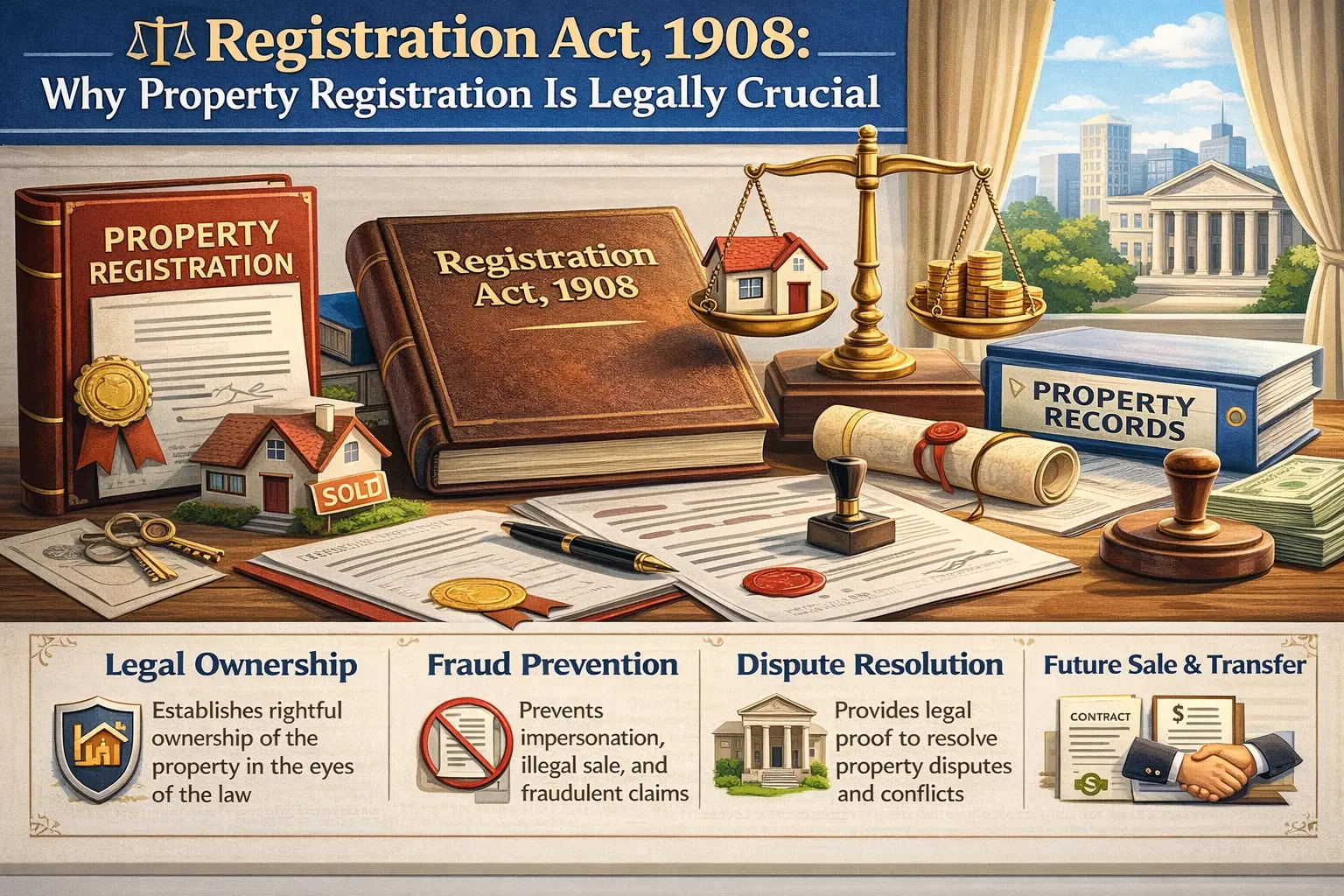
Property ownership is not just about possession or payment of money. In the eyes of law, ownership is valid only when it is legally documented and registered. The Registration Act, 1908 plays a central role in defining how property transactions gain legal recognition and protection in India. This Act ensures that property dealings are transparent, verifiable, and enforceable, safeguarding the rights of individuals and preventing disputes.
1. Historical Background of the Registration Act, 1908
Before the Registration Act came into force, property transactions were often informal and undocumented. This led to:
- Frequent land disputes
- Forged documents
- Multiple claims over the same property
- Difficulty in proving ownership
To address these issues, the British Indian Government introduced the Registration Act in 1908, creating a systematic public registry for property-related documents. This system continues to be the backbone of modern property law in India.
2. Legal Meaning of “Registration” Under the Act
Registration refers to the official recording of a document by a government authority (Sub-Registrar) after:
- Verifying identities of parties
- Ensuring payment of stamp duty
- Confirming voluntary execution of the document
Once registered, the document becomes:
- A permanent public record
- A legally recognized transaction
- Strong evidence of rights over property
3. Types of Property Covered Under the Act
The Registration Act mainly applies to immovable property, which includes:
- Land
- Residential houses
- Flats and apartments
- Commercial buildings
- Shops and offices
Any transaction affecting rights, title, or interest in such property must comply with the Act.
4. Compulsory Registration: Legal Obligation
Section 17 – Mandatory Registration
The law makes registration compulsory for documents that:
- Transfer ownership
- Create or extinguish rights
- Affect possession of property
Examples include:
- Sale deeds
- Gift deeds
- Partition deeds
- Mortgage deeds
- Long-term lease deeds
- Settlement deeds
Failure to register such documents results in loss of legal validity.
5. Optional Registration and Its Benefits
Certain documents like wills or short-term agreements are optional to register. However, voluntary registration:
- Reduces disputes
- Strengthens legal standing
- Makes enforcement easier
Even when not compulsory, registration adds credibility and authenticity.
6. Why Registration Is Essential for Ownership Rights
6.1 Transfer of Title
A property sale is legally complete only after registration. Payment alone does not transfer ownership.
Example:
- Paying full price + possession = Not ownership
- Registered sale deed = Legal ownership
6.2 Protection Against Competing Claims
Registration ensures:
- No secret or duplicate sale
- Buyers are protected from fraud
- Ownership history is traceable
A registered document has priority over unregistered claims.
6.3 Public Notice to Society
Registration acts as notice to the world that ownership has changed. Anyone dealing with the property in future is deemed to have knowledge of the registered transaction.
7. Legal Consequences of Non-Registration
Section 49 – Effect of Non-Registration
An unregistered document:
- Does not create legal rights
- Cannot be used as evidence in court
- Cannot affect property title
This means:
- Buyer cannot claim ownership
- Property cannot be sold again legally
- No protection in disputes
8. Role of Sub-Registrar Under the Act
The Sub-Registrar is a statutory authority who:
- Examines documents
- Verifies identities
- Confirms free consent
- Records transactions
- Preserves documents permanently
This official verification reduces impersonation and fraud.
9. Importance for Home Loans and Financial Institutions
Banks and housing finance companies rely entirely on registered documents.
Without registration:
- Home loans are rejected
- Property cannot be mortgaged
- Investment value is zero in banking terms
Registration transforms property into a financially usable asset.
10. Registration and Property Dispute Resolution
In property litigation:
- Registered documents carry high evidentiary value
- Courts presume registered deeds to be genuine
- Burden of proof lies on the person challenging registration
This makes registered ownership far stronger in disputes.
11. Stamp Duty and Registration: Legal Connection
Registration is inseparable from stamp duty:
- Stamp duty validates the document
- Registration records the transaction
A document without proper stamp duty:
- Cannot be registered
- Cannot be enforced
Both are legally mandatory for valid property transfer.
12. Importance of Registration in Urban Development
Modern systems like:
- Digital land records
- Online encumbrance certificates
- RERA compliance
- Smart city planning
All depend on registered property records. Without registration, properties remain outside the legal system.
13. Common Myths About Property Registration
- Possession equals ownership
- Agreement to sell is enough
- Not needed for family property
- Can register later anytime
Law recognizes only registered conveyance
14. Registration and Future Transactions
Only registered properties can be:
- Sold legally
- Gifted
- Mortgaged
- Inherited smoothly
- Developed further
Registration ensures continuity of title across generations.
15. Registration as a Tool for Transparency and Governance
The Registration Act:
- Supports urban planning
- Prevents black money circulation
- Improves government revenue
- Enables accurate property records
Thus, it benefits both individuals and society.
16. Conclusion
The Registration Act, 1908 is not merely procedural law—it is the legal backbone of property ownership in India. Registration transforms a private agreement into a legally enforceable right, protects buyers from fraud, enables financial usage, and ensures long-term security.
https://www.livehomes.in/blogs