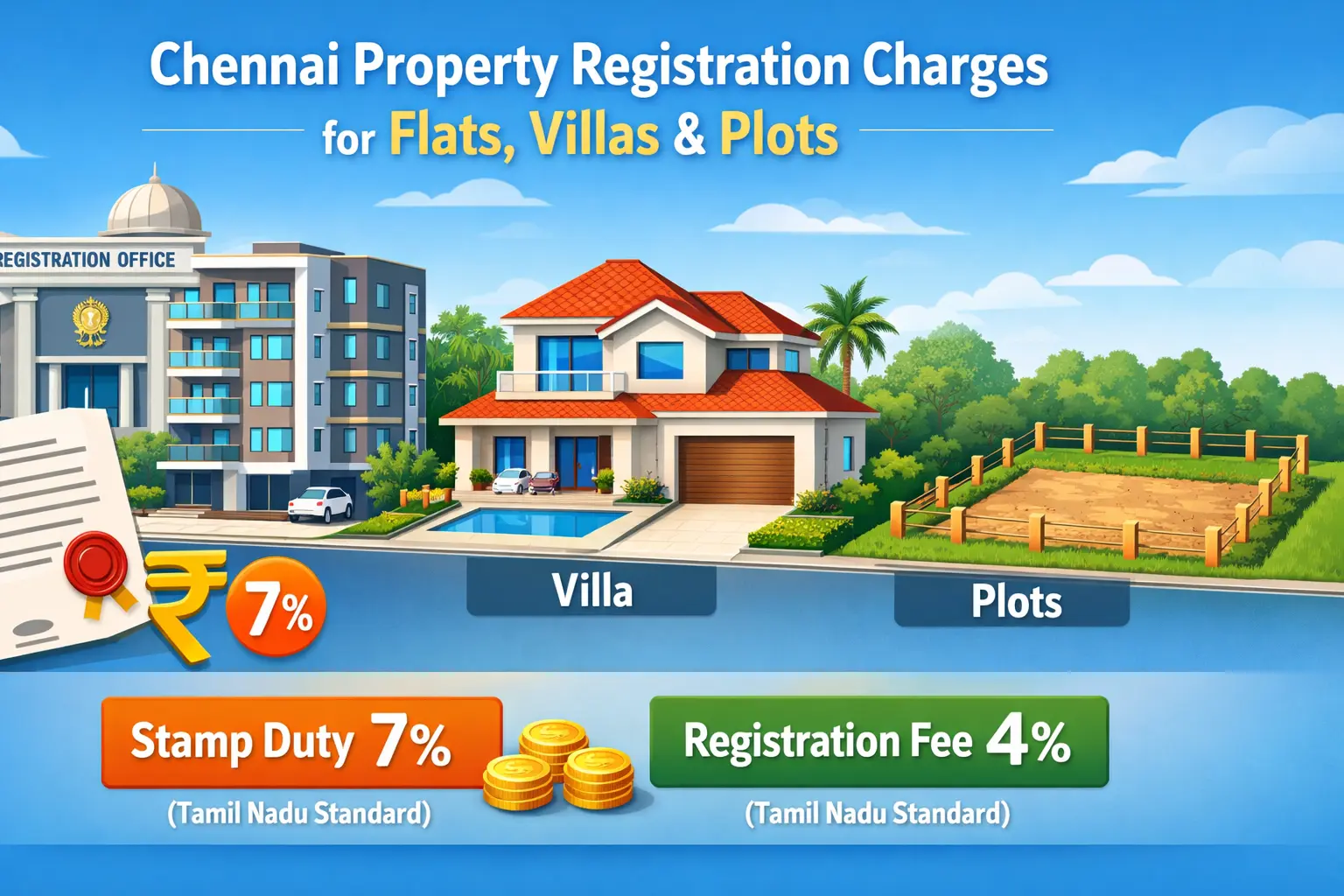
Property registration in Chennai is governed by the Registration Department of Tamil Nadu. Registration legally transfers ownership of immovable property (flat, villa, or plot) from seller to buyer and records it in government land records. Without registration, ownership is not legally valid, even if payment is completed.
1. What Are Property Registration Charges?
Property registration charges are statutory government fees paid during property purchase. They consist of two compulsory components:
A. Stamp Duty
Stamp duty is a state tax imposed on property transactions.
- Makes the sale deed legally enforceable
- Proves that the transaction has been executed
- Paid to the Tamil Nadu Government
Without stamp duty, the document has no legal validity in court.
B. Registration Fee
Registration fee is charged to record the transaction in government records.
- Paid at the Sub-Registrar Office
- Ensures buyer’s name is officially entered in land records
- Protects ownership rights against disputes
Stamp duty validates the document, while registration records ownership.
2. Current Stamp Duty & Registration Rates in Chennai
For all property types in Chennai:
| Charge | Rate |
| Stamp Duty | 7% |
| Registtration Fee | 4% |
| Total Government Charges | 11% |
These rates apply uniformly to:
3. How Property Value Is Determined
Charges are not always calculated on the sale price.
Tamil Nadu law mandates calculation based on the higher of:
- Sale consideration value (price mentioned in sale deed), OR
- Government guideline value
Guideline value is fixed locality-wise and street-wise and published on TNREGINET.
If the sale price is lower than guideline value, the government ignores the sale price and charges fees on guideline value.
4. Detailed Charges by Property Type
A. Flats / Apartments
Applies to:
- New flats
- Under-construction flats
- Ready-to-move flats
- Resale flats
Charges
- Stamp Duty: 7%
- Registration Fee: 4%
Calculation Basis
- Higher of agreement value or guideline value of UDS (undivided share) + building value
Example
Flat value: Rs 75,00,000
- Stamp Duty (7%) = Rs 5,25,000
- Registration Fee (4%) = Rs 3,00,000
- Total = Rs 8,25,000
B. Villas / Independent Houses
Applies to:
- Individual houses
- Duplex / triplex villas
- Gated community villas
Tamil Nadu follows composite registration, meaning:
- Land value and building value are registered together
- Buyer pays stamp duty once, not separately
Charges
- Stamp Duty: 7%
- Registration Fee: 4%
Example
Villa value: Rs 1,20,00,000
- Stamp Duty = Rs 8,40,000
- Registration Fee = Rs 4,80,000
- Total = Rs 13,20,000
C. Plots / Vacant Land
Applies to:
- Residential plots
- Approved layouts
- Unapproved plots (if allowed for registration)
Charges
- Stamp Duty: 7%
- Registration Fee: 4%
Value Calculation
- Based on guideline value per sq.ft / per ground
- Layout approval does not change the rate
Example
Plot value: Rs 40,00,000
- Stamp Duty = Rs 2,80,000
- Registration Fee = Rs 1,60,000
- Total = Rs 4,40,000
5. Concession for Women Buyers
Tamil Nadu provides limited benefit for women buyers:
- Registration fee reduced from 4% to 3%
- Applicable only if property value ≤ Rs 10 lakh
- Buyer must be sole female owner
- Stamp duty remains 7%
For properties above Rs10 lakh, no concession applies.
6. When and How Registration Is Done
Time Limit
- Property must be registered within 4 months from execution of sale deed
Place
- Jurisdictional Sub-Registrar Office where property is located
Basic Process
- Stamp duty payment
- Online appointment booking
- Document verification
- Biometric verification
- Registration and scanning
- Issue of registered document copy
Also Read: Stamp Duty and Registration Charges in Chennai Latest Update
7. Additional Minor Government Fees
Besides stamp duty and registration fee, buyers may incur:
- Encumbrance Certificate fee
- Certified copy fee
- Scanning charges
- Computerisation charges
These are small fixed amounts, not percentage-based.
8. Legal Importance of Registration Charges
- Ensures legal ownership
- Prevents duplicate sale or fraud
- Required for resale, inheritance, or loan
- Mandatory for property mutation and tax records
Failure to pay proper charges can result in:
- Penalties
- Rejection of registration
- Legal disputes
Conclusion
In Chennai, buyers of flats, villas, or plots must pay approximately 11% of the property value as government registration charges. These charges are uniform, legally mandated, and unavoidable, and are calculated strictly based on government guideline values or sale value—whichever is higher. Understanding these charges in advance ensures financial planning, legal safety, and smooth ownership transfer.
Frequently Asked Questions (FAQs)
1. Are registration charges compulsory?
Yes. Property ownership is invalid without registration.
2. Are charges different for resale properties?
No. Rates are the same for new and resale properties.
3. Is GST part of registration charges?
No. GST is separate and applies only to under-construction flats.
4. Can stamp duty be avoided by paying cash?
No. Charges are based on guideline value, not payment mode.
5. Is registration mandatory for plots?
Yes. Vacant land must also be registered.
6. Are charges refundable?
Refunds are allowed only in rare cases such as document cancellation before registration.
7. Do joint owners pay extra?
No. Charges depend only on property value, not number of buyers.
8. What happens if registration is delayed beyond 4 months?
Penalty and additional procedures are required for late registration.
9. Is Aadhaar mandatory for registration?
Yes. Aadhaar authentication is compulsory.
10. What confirms successful registration?
- Registered sale deed
- Document number
- Digital storage in government records
https://www.livehomes.in/blogs