1. What Is Capital Gains Tax?
When you buy a property and later sell it for more money, the extra money you make is called profit.
- The government calls this profit a capital gain.
- The tax charged on this profit is called Capital Gains Tax (CGT).
Simple idea:
If property makes you money, the government takes a portion of that money as tax.
2. When Do You Pay Capital Gains Tax?
You do NOT pay capital gains tax:
- When you buy a property
- While you are owning it
- When property value increases on paper
- When you inherit or receive it as a gift
You ONLY pay CGT when you SELL the property and make a profit.
3. What Is Considered a Property?
Capital gains tax applies to:
- Residential houses
- Flats or apartments
- Land or plots
- Commercial property
- Shops, offices
- Inherited or gifted property (when sold)
4. How Is Capital Gain Calculated?
The government looks at three things:
- Selling Price – how much you sold the property for
- Buying Cost – how much you originally paid
- Expenses – money spent to buy, improve, or sell
Formula (Simple)
Capital Gain = Selling Price – (Buying Cost + Expenses)
What Expenses Are Allowed?
You can subtract:
- Stamp duty
- Registration charges
- Brokerage / agent fees
- Legal fees
- Renovation & improvement costs
- Advertisement expenses
- Transfer charges
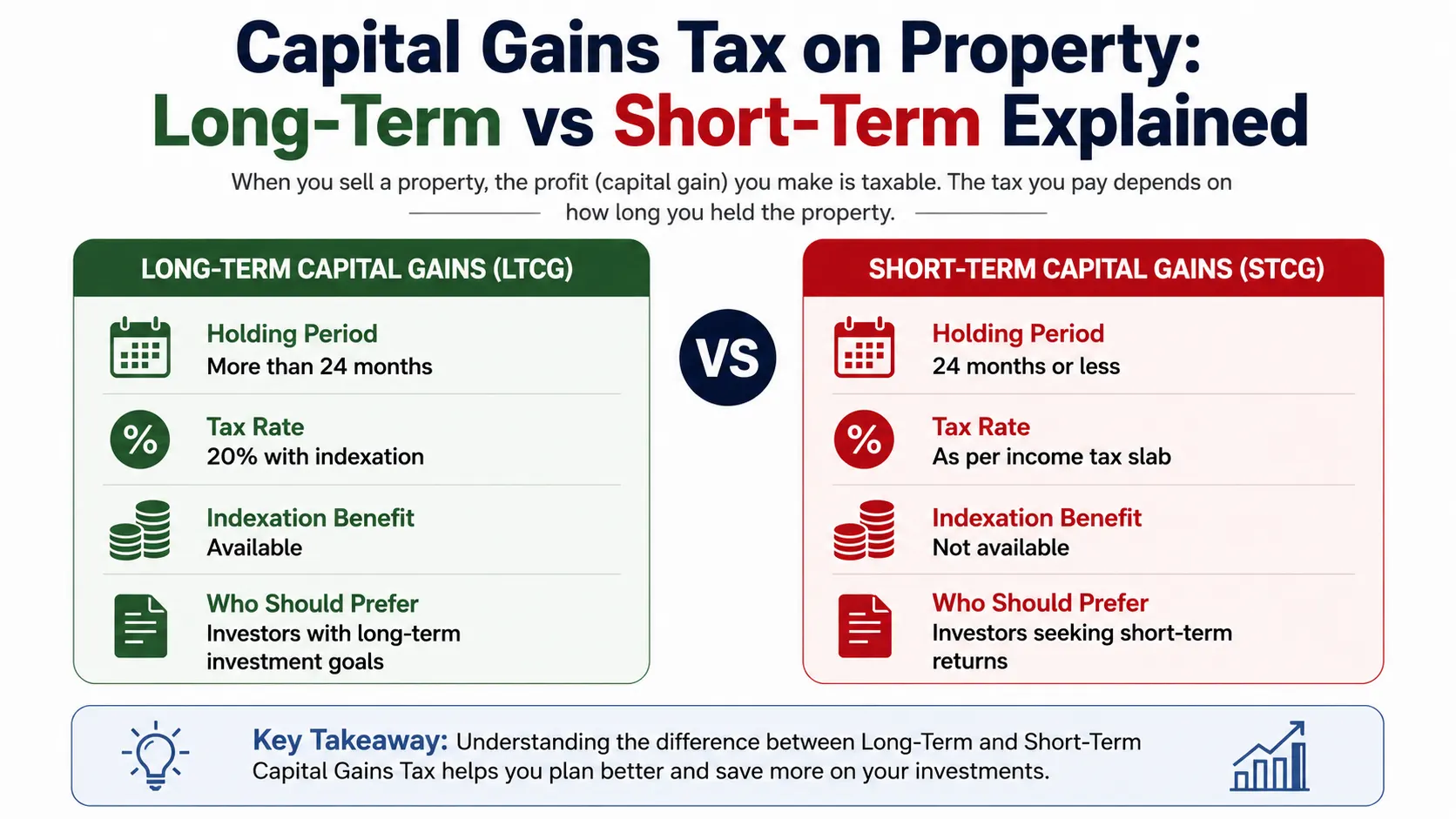
5. Two Types of Capital Gains (Very Important)
Capital gains are divided based on how long you owned the property before selling it.
The Two Types:
- Short-Term Capital Gains (STCG)
- Long-Term Capital Gains (LTCG)
6. What Is Short-Term Capital Gain (STCG)?
Meaning (In Simple Words)
If you buy a property and sell it quickly, the profit is called short-term capital gain.
“Quickly” means within a short holding period (this period depends on country laws).
How Is STCG Taxed?
Short-term gains are:
- Added to your regular income
- Taxed at your normal income tax rate
That means:
- Salary + Business income + STCG = Total taxable income
- Higher income = Higher tax
- No inflation benefit
- Very few exemptions
- Usually high tax
7. What Is Long-Term Capital Gain (LTCG)?
Meaning
If you hold the property for many years and then sell it, the profit is called long-term capital gain.
Governments encourage long-term ownership, so they offer tax benefits.
Benefits of LTCG
Long-term capital gains usually have:
- Lower tax rates
- Inflation adjustment
- Tax exemptions if you reinvest
- Less overall tax burden
8. Inflation Adjustment
Money loses value over time due to inflation.
So the government allows you to:
- Increase your purchase price to today’s value
- This reduces your taxable profit
This benefit is usually available only for long-term gains.
9. Can Capital Gains Tax Be Reduced? (Legally)
Yes. Many people plan their sale to reduce tax.
Common Legal Ways:
- Holding property long enough to become long-term
- Keeping all purchase & renovation bills
- Reinvesting gains into another property
- Investing gains into approved bonds
- Using capital losses to offset gains
10. What If You Sell Property at a Loss?
If:
- Selling price < buying cost
Then:
- No capital gains tax
- Loss may be carried forward to reduce future gains (rules apply)
11. Inherited Property (Very Common Doubt)
When You Inherit Property:
- No tax at the time of inheritance
- No income tax
- No capital gains tax
When You Sell Inherited Property:
- Capital gains tax applies
- Holding period usually includes previous owner’s holding
- Purchase cost is usually original owner’s cost
12. Gifted Property
- No tax when you receive the gift (in many countries)
- Capital gains tax applies when you sell
- Original purchase price is used for calculation
13. When Do You Pay Capital Gains Tax?
Usually:
- In the year you sell the property
- Sometimes advance tax is required
- Delay can cause interest or penalties
Conclusion
- Sell property → Make profit → Capital gains tax applies
- Sell quickly → Higher tax
- Hold long → Lower tax + benefits
- Good planning = Less tax
FAQs
1. Is capital gains tax the same as income tax?
No. It applies only to profit from selling assets.
2. Do I pay CGT if the property price increases but I don’t sell?
No. Tax applies only on sale.
3. Can capital gains tax be zero?
Yes, in some cases, through exemptions and reinvestment.
4. Is land treated differently than house?
Holding periods may differ, but the CGT concept is the same.
5. Are renovation costs allowed?
Yes, if they increase property value and are documented.
6. Can losses be adjusted?
Yes, subject to rules.
7. Is CGT same in all countries?
No. Rules vary by country.
8. Do senior citizens get special CGT benefits?
Rarely. Benefits depend more on holding period than age.
9. Is capital gains tax compulsory?
Yes, if applicable. Avoiding it illegally can cause penalties.
10. Should I plan before selling property?
Absolutely. Planning can save large amounts of tax.