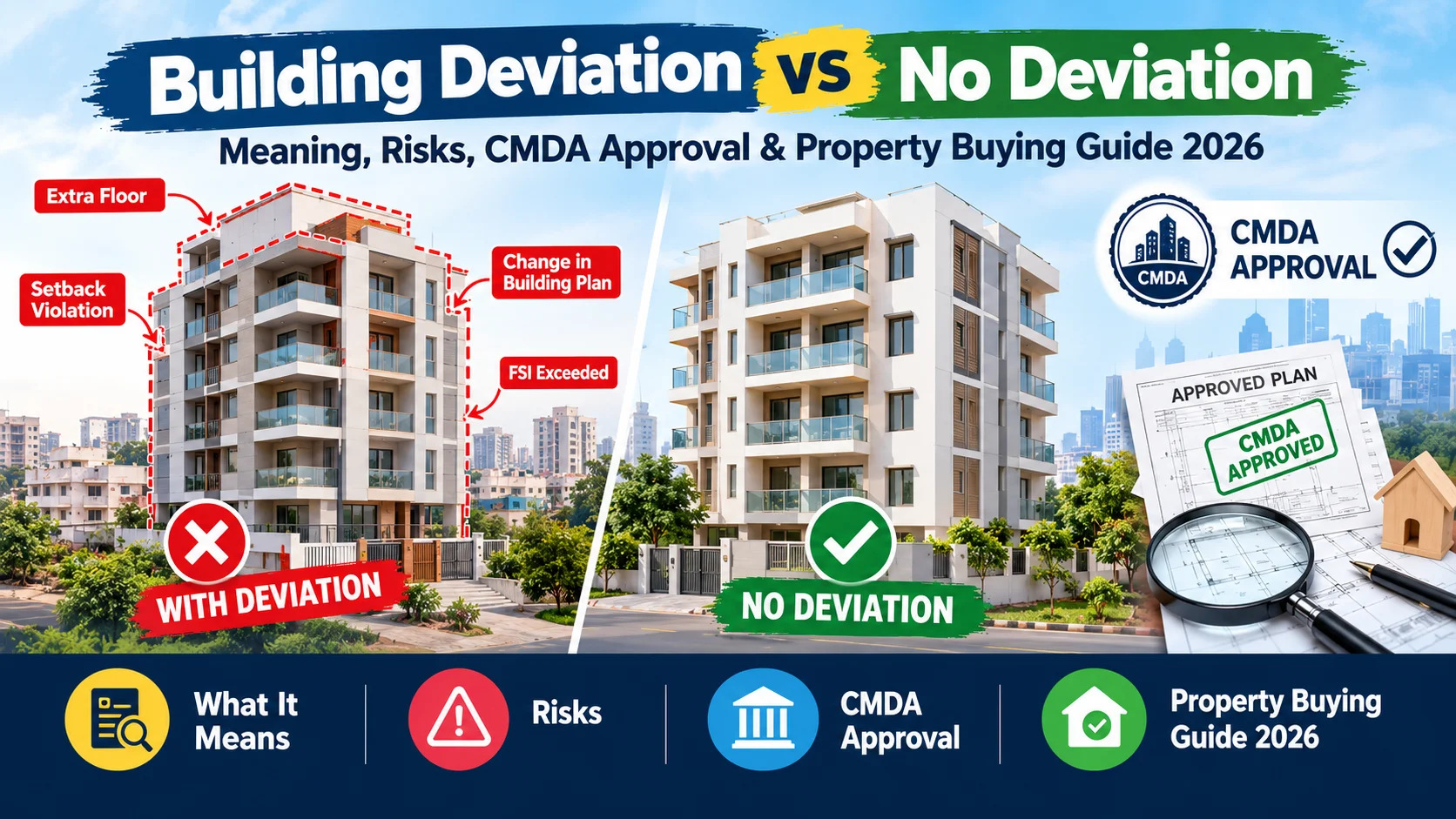
When buying a flat for sale in Chennai or a builder floor apartment, most buyers focus on location, price, carpet area, amenities, and connectivity. But there is another important factor that deserves equal attention—whether the actual construction matches the approved building plan. A difference between the sanctioned plan and the building constructed at the site is generally referred to as a building deviation. Depending on what has been changed, such deviations can create additional legal, approval, loan, or resale-related questions. On the other hand, a property where the construction follows the approved plan and applicable development regulations provides greater clarity during property verification. This guide explains building deviation vs. no deviation, how to identify deviations, the role of CMDA approval, possible risks, and the checks a homebuyer should complete before purchasing a property in Chennai in 2026.
What Is Building Deviation?
A building deviation occurs when the construction completed at the property does not correspond with the approved building plan.
The approved plan normally specifies important details such as
- Building dimensions
- Floor configuration
- Setbacks
- Built-up area
- Parking arrangements
- Staircase and access
- Balconies and projections
- Other approved construction details
If the building constructed at the site differs from these approved details, the buyer should investigate the difference before proceeding.
What Does No Deviation Mean?
A no-deviation property generally means that the building constructed on the site corresponds with the approved/sanctioned plan and applicable development requirements.
In simple terms:
Approved Plan → Actual Construction
The number of floors, building footprint, relevant setbacks, floor areas, and other approved features should correspond with the sanctioned documents. However, buyers should remember that “no deviation” is a claim that should be verified, not simply accepted from a property advertisement.
Building Deviation vs. No Deviation
Understanding the difference is especially important when purchasing an independent floor or builder floor apartment.
| Property Aspect | Deviation | No Deviation |
| Approved plan | Actual construction differs | Actual construction follows approval. |
| Number of Floors | May differ from approval | Matches approved plan |
| Setbacks | Maybe different | Follows approved requirements |
| Construction area | May exceed approved area | Corresponds with approval |
| Parking | May differ from approval arrangements | Matches approved details |
| Verification | Requires closer investigation | Generally easier to verify |
| Resale due diligence | May invlove additional questions | Usually more straightforward |
The table is a general comparison. The actual legal significance of a deviation depends on the property and applicable regulations.
Why Is Building Deviation Important for Homebuyers?
A home is not just a physical structure. It is also a legally documented asset. When the actual construction differs from the approved plan, the buyer may need to investigate several issues.
1. Approval Compliance
The first question is whether the construction complies with the applicable planning and building regulations.
2. Future Resale
When the property is sold later, the next buyer may compare the approved documents with the physical building.
3. Bank Loan
A lender may conduct legal and technical due diligence before approving a home loan. A mismatch between documents and actual construction can result in additional scrutiny.
4. Property Documentation
A buyer should ensure that the documents presented for the transaction accurately relate to the property being purchased.
5. Future Modifications
If the owner plans to make further construction changes, existing deviations may create additional complications depending on the proposed work and applicable rules.
Common Building Deviations Found in Properties
Not every deviation looks obvious during a normal property visit. Some require a technical comparison between the approved drawing and the physical building.
1. Excess Construction
The actual building may have more constructed area than shown in the approved plan. For example, an open area may have been converted into an enclosed room.
2. Setback Changes
The actual distance between the building and the plot boundary may differ from the approved plan. Setbacks are an important part of development and building requirements.
3. Additional Floor
One of the more significant differences is construction of an additional floor or portion that is not shown in the approved plan.
4. Parking Alteration
An area shown as parking in the approved plan may be used differently in the completed building. Buyers should verify whether the parking arrangement shown in the documents matches what is actually provided.
5. Balcony Extension
A balcony may be extended, enclosed, or altered compared with the approved drawing. Although it may appear to be a small modification, its regulatory implications should be checked.
6. Changes to the Floor Layout
The internal configuration may differ from the sanctioned drawing.
For example:
- A room may have been added.
- A wall may have been shifted.
- An approved open space may have been enclosed.
- A utility area may have been altered.
- The significance of each modification depends on the specific circumstances.
What Is CMDA Approval?
For properties within the applicable Chennai Metropolitan Area planning jurisdiction, the Chennai Metropolitan Development Authority (CMDA) is an important planning authority. CMDA-related planning permission is intended to ensure that development follows applicable planning requirements. However, buyers should understand that property approval is not always represented by one single document. Depending on the property, development, and authority involved, there may be different planning, building, and completion-related documents.
CMDA Approval and Actual Construction
One of the most important checks is to compare the approved plan with the completed building.
For example, suppose the approved drawing shows:
- Two floors
- Specific setbacks
- Four parking spaces
- A particular built-up area
But the actual building contains:
- Three floors
- Reduced setback
- Different parking arrangement
- Larger constructed area
The buyer should investigate these differences before purchasing. Approval of a plan does not automatically mean every subsequent alteration is approved.
How to Check Building Deviation Before Buying
A buyer can follow a simple verification process.
Step 1: Obtain the Approved Building Plan
Ask the builder or seller for the sanctioned building plan.
Do not depend only on:
- Brochures
- WhatsApp messages
- Advertisements
- Verbal promises
Step 2: Compare the Number of Floors
Check whether the number of floors actually constructed corresponds with the approved documents.
Step 3: Compare the Building Area
Check the approved construction area against the actual building.
Also compare the area mentioned in the
- Agreement
- Sale deed
- Property documents
- Project documents
- RERA information, where applicable
Step 4: Inspect the Setbacks
Walk around the property and check the open spaces on different sides of the building. For a more reliable assessment, have the physical measurements checked by an appropriate professional.
Step 5: Verify Parking
Check whether:
- Parking is actually available.
- Its location corresponds with the approved plan.
- The number of parking spaces matches the relevant documents.
- The promised parking arrangement is clearly documented.
Step 6: Compare the Floor Layout
Compare the actual apartment with the sanctioned drawing.
Pay attention to:
- Balcony size
- Utility area
- Rooms
- Extensions
- Enclosed spaces
- Common areas
Can a Building Deviation Be Regularized?
It depends.
A deviation cannot automatically be considered regularizable simply because someone says that it is a “minor deviation.”
Whether a particular construction can be regularized depends on factors such as
- Nature of the deviation
- Extent of the deviation
- Applicable rules
- Location
- Date of construction
- Building category
- Eligibility under any applicable regularization provision
- Decision of the competent authority
Therefore, buyers should obtain confirmation from the relevant authority and qualified professionals rather than relying on verbal assurances.
Does a Home Loan Guarantee the Property Has No Deviation?
A home loan approval and planning compliance are separate matters. A lender's legal and technical assessment is conducted according to its own requirements. Buyers should still independently verify:
- Title
- Approvals
- Sanctioned plan
- Actual construction
- Applicable permissions
Therefore:
Home Loan Approval ≠ No Deviation Certificate
Why No-Deviation Construction Is Important for Builder Floor Apartments
A builder floor apartment can be attractive for buyers who want independent floors, fewer units, and a residential location with good connectivity. But buyers should pay attention to the project's approval documents.
Before purchasing, check whether:
- The plot details match the documents.
- The approved number of floors matches the building.
- The flat area corresponds with the documents.
- The parking arrangement is clearly documented.
- Setbacks correspond with the approved plan.
- The actual floor layout matches the sanctioned drawing.
- Required planning and building approvals are available.
This is particularly useful when comparing multiple flats for sale in Chennai.
Red Flags During Property Verification
Here are some statements that should encourage a buyer to ask additional questions.
“Don't worry, everyone does this.”
Ask for documentary proof instead.
“The approval is under process.”
Understand exactly what approval is pending and whether construction or sale is permitted in the current circumstances.
“The deviation is very small.”
Ask what has changed and request professional verification.
“The bank has already approved loans.”
Remember that lender approval is not a substitute for independent property due diligence.
“We can regularize it later.”
Ask whether the property actually qualifies under an applicable regularization provision.
“The property is registered, so there is no issue.”
Registration should not replace verification of construction approvals.
Deviation Checklist for Flat Buyers in Chennai
Before paying a major advance, use this checklist:
Legal Documents
- Sale deed
- Parent documents
- Encumbrance Certificate
- Title verification
- Patta/land records where applicable
Approval Documents
- Planning permission
- Building approval
- Sanctioned building plan
- Applicable permits
- Completion-related documents
Physical Verification
- Number of floors
- Flat area
- Setbacks
- Parking
- Balcony
- Floor layout
- Common areas
- Actual building configuration
Project Verification
- RERA registration, where applicable
- Project details
- Builder details
- Approved plans
- Relevant statutory documents
10 Questions to Ask a Builder Before Buying
Before booking a flat for sale in Chennai, ask:
- Is the building plan approved?
- Can I see the sanctioned building plan?
- How many floors are approved?
- Does the completed building match the approved plan?
- What is the approved built-up area?
- What is the actual flat area?
- Is the parking arrangement shown in the approved documents?
- Are there any deviations from the sanctioned plan?
- Are the required completion-related documents available?
- Can my lawyer and architect independently verify the property?
A transparent builder should be able to provide appropriate documentation for the buyer's due diligence.
Conclusion
Building deviation is an important consideration when purchasing a residential property. A difference between the approved plan and actual construction can range from a small modification to a substantial change, and its implications depend on the specific circumstances and applicable regulations. For buyers searching for a flat for sale or builder floor apartment in Chennai, checking planning permission, building approval, sanctioned plans, floor configuration, setbacks, parking, and actual construction should be part of the property-buying process.
FAQs
1. What is the meaning of building deviation?
Building deviation means a difference between the construction actually carried out and the approved or sanctioned building plan or applicable requirements.
2. What is a no-deviation building?
It generally refers to construction that follows the approved building plan and applicable planning requirements.
3. How can I identify building deviation?
Compare the sanctioned building plan with the actual property, including floors, built-up area, setbacks, parking, and layout.
4. Is building deviation illegal?
The legal significance depends on the nature, extent, and circumstances of the deviation and the applicable rules. A specific property should be assessed by qualified professionals and the competent authority.
5. Can building deviation be regularized?
Some properties or deviations may qualify under applicable regularization provisions, while others may not. Eligibility must be verified rather than assumed.
6. Does CMDA approval mean there is no deviation?
Not necessarily. The approved plan should still be compared with the actual construction.
7. Can I get a home loan for a property with deviation?
It depends on the lender's legal and technical assessment. Loan approval does not independently establish that there is no deviation.
8. Does registration prove that a building has no deviation?
No. Property registration and compliance with planning/building approvals are separate matters.
9. Why are setbacks important?
Setbacks form part of planning and building requirements. A difference between the approved and actual setback should be investigated.
10. Should I buy a property advertised as “100% no deviation”?
Do not rely on the advertisement alone. Request the relevant approvals and have the actual building compared with the sanctioned plan.