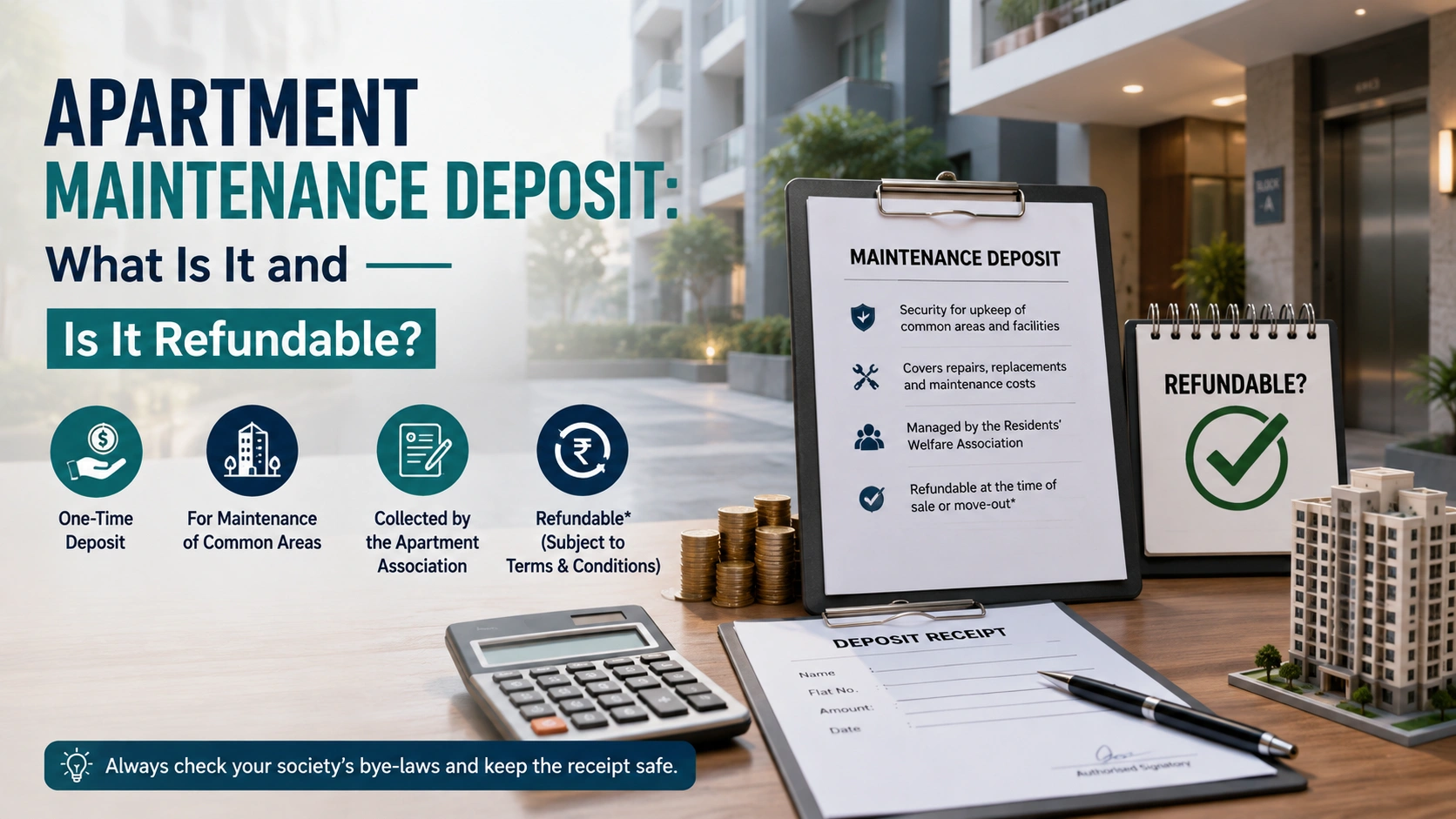
An apartment maintenance deposit is an amount collected from a flat buyer, owner, or resident to cover future maintenance and upkeep of common areas and shared facilities in a residential project. It is different from the monthly maintenance charges you pay for regular services such as housekeeping, security, lift operation, common-area electricity, and landscaping. For homebuyers, understanding what a maintenance deposit covers, how it is calculated, whether it is refundable, and who controls the money is important before purchasing or taking possession of an apartment.
What Is an Apartment Maintenance Deposit?
An apartment maintenance deposit is generally a one-time or upfront amount collected for the future maintenance of common facilities in an apartment complex.
Depending on the project and the agreement, the amount may be collected by:
- The builder or developer
- Residents' Welfare Association (RWA)
- Apartment Owners Association (AOA)
- Maintenance agency or facility-management company
- A society or other project management body
The deposit may be intended to support the maintenance of common infrastructure over a specified period or to create a maintenance fund for the apartment community.
Example
Suppose you purchase a flat and the developer asks for a Rs 1 lakh maintenance deposit at the time of possession.
This Rs 1 lakh should not automatically be assumed to be the same as your monthly maintenance charge. The agreement should clearly explain:
- Why the deposit is being collected
- How the amount will be used
- Who will hold it
- Whether it earns interest
- Whether it can be adjusted against maintenance bills
- Whether it is refundable
- When it can be refunded
- What deductions are permitted
Maintenance Deposit vs. Monthly Maintenance Charges
One of the most common sources of confusion for apartment buyers is the difference between a maintenance deposit and regular maintenance charges.
| Particulars | Maintenance Deposit | Monthly Maintenance Chargers |
| Nature | Usually upfront/one-time | Recurring |
| Purpose | Maintenance fund/security for future upkeep | Day-to-day maintenance |
| Payment frequency | Usually once or as specified | Monthly/quarterly/annual |
| Common Users | Major repairs, reserve fund, or agreed maintenance expenses | Security, housekeeping, lifts, electricity, cleaning |
| Refundability | Depends on agreement and applicable rules | Generally not refundable |
| Amount | Project-specific | Usually based on area, services, or association rules |
| Paid to |
Important: There is no universal rule that every maintenance deposit collected from an apartment buyer must automatically be refunded. The answer depends on the nature of the amount, the sale/maintenance agreement, project documents, and applicable law.
Why Do Builders or Associations Collect a Maintenance Deposit?
A residential project requires continuous expenditure even after construction is completed. A maintenance fund can help the community manage these expenses.
Common purposes can include:
1. Common-area maintenance
The fund may support maintenance of:
- Corridors
- Staircases
- Lobbies
- Clubhouses
- Internal roads
- Common toilets
- Other shared facilities
2. Major repairs
Apartment communities eventually require significant repairs to:
- Plumbing systems
- Electrical infrastructure
- Waterproofing
- Elevators
- Pumps
- External walls
- Common structures
A reserve or maintenance fund can help meet these expenses.
3. Security and facility management
- Depending on the agreement, maintenance funds may support security systems and other community facilities.
4. Landscaping and external areas
- Gardens, lawns, plants, irrigation systems, and other common outdoor areas require regular maintenance.
5. Replacement of common equipment
Large apartment projects may have equipment such as
- Lifts
- Water pumps
- DG sets
- STP equipment
- Fire-safety systems
- Access-control systems
Some of these assets require periodic servicing or replacement.
Is an Apartment Maintenance Deposit Refundable?
It can be refundable, but not in every case.
The most important document is the agreement or document under which the amount was collected. Buyers should not rely solely on verbal assurances from a salesperson or maintenance team.
The agreement should be checked for words such as:
- Maintenance deposit
- Corpus fund
- Sinking fund
- Advance maintenance
- Maintenance advance
- Security deposit
- Common-area maintenance fund
- Interest-free maintenance deposit
These terms can have different implications.
- Case 1: Refundable security deposit
If the agreement specifically describes the amount as a refundable security deposit, the buyer may have a stronger contractual basis to seek its return, subject to the agreed conditions and permissible deductions.
- Case 2: Corpus or reserve fund
A corpus fund may be intended as a long-term fund for the apartment community. It should not automatically be treated as a refundable security deposit. The agreement and association rules should clarify its treatment.
- Case 3: Advance maintenance
If the amount represents advance maintenance, it may be adjusted against future maintenance expenses rather than refunded immediately.
- Case 4: Transfer to the association
In some projects, the developer may collect an amount and subsequently transfer the relevant maintenance fund to the apartment owners' association. The buyer should verify the project's documentation to understand how the money is handled.
Also Read: Apartment Maintenance Charges in Chennai 2026 Complete Guide for Flat Buyers
What Does "Non-Refundable Maintenance Deposit" Mean?
If the agreement clearly states that a particular amount is non-refundable, it generally means that the payer cannot demand the amount back simply because they sell the apartment or move out.
However, buyers should still examine:
- The exact contractual wording
- Whether the charge was disclosed before purchase
- The purpose for which it was collected
- Whether the amount is consistent with the applicable agreement and regulations
- Whether the builder or association has accounted for the fund properly
A label such as "maintenance deposit" alone does not tell you whether the amount is refundable.
Is the Maintenance Deposit Transferable When You Sell the Flat?
This depends on the project's rules and the agreement.
For example, if you sell your apartment, there may be different arrangements:
- Option 1: The maintenance deposit remains attached to the apartment and passes to the new owner.
- Option 2: The seller receives the refundable amount, and the buyer pays a fresh deposit.
- Option 3: The amount is adjusted between the buyer and seller as part of the sale transaction.
- Option 4: The amount is part of a permanent corpus or reserve fund and remains with the association.
Therefore, before selling a flat, check the association's rules and obtain written clarification regarding the treatment of the deposit.
Who Should Hold the Maintenance Deposit?
This depends on the project's stage and the contractual arrangement. For a completed apartment community, the owners' association/RWA/AOA or other legally responsible body may manage maintenance funds after handover, subject to applicable laws and project documents.
If the developer is collecting and holding money for maintenance, buyers should ask for:
- Receipt for payment
- Purpose of collection
- Account details or accounting mechanism where applicable
- Maintenance agreement
- Handover details
- Transfer arrangements to the association
- Statement of utilization where applicable
Transparency is particularly important for large apartment projects where the maintenance fund can involve substantial amounts.
What Documents Should a Flat Buyer Check?
Before paying an apartment maintenance deposit, carefully review the following:
1. Agreement for Sale
Check whether the amount is specifically mentioned and how it is described.
2. Maintenance Agreement
Look for:
- Maintenance period
- Services covered
- Maintenance rates
- Deposit amount
- Refund conditions
- Adjustment provisions
3. Payment Receipt
Always obtain a proper receipt showing:
- Amount paid
- Date
- Purpose
- Project/unit details
- Applicable taxes, if any
4. Association Documents
If the association has already been formed, understand its rules regarding:
- Corpus funds
- Maintenance deposits
- Transfer charges
- Monthly maintenance
- Refunds
5. Project's statutory documents
For a new project, buyers should also verify the project's applicable approvals and registration details, including the relevant RERA information where applicable.
How Is an Apartment Maintenance Deposit Calculated?
There is no single calculation method followed by every apartment project.
A developer or association may determine the amount based on:
- Flat size
- Number of bedrooms
- Number of units
- Common facilities
- Estimated maintenance expenses
- Maintenance period
- Reserve requirements
- Project-specific contractual terms
For example, if a project estimates a maintenance requirement of Rs X per sq. ft. for a specified period, the amount could be calculated according to the project's agreed formula. However, buyers should not assume that every maintenance deposit is legally calculated using a standard per-square-foot formula.
Always check the agreement and supporting documents.
What Happens If the Builder Doesn't Refund the Deposit?
If the amount is contractually refundable and the builder or responsible authority fails to return or appropriately adjust it, the buyer should first make a written request.
Step 1: Check the agreement.
Confirm that the amount is actually refundable.
Step 2: Request clarification in writing.
Ask for:
- Deposit statement
- Refund/adjustment calculation
- Applicable deductions
- Expected refund date
Step 3: Keep documentary evidence.
Maintain:
- Sale agreement
- Maintenance agreement
- Receipts
- Bank statements
- Emails
- Letters
- Handover documents
- Association communications
Step 4: Escalate the matter
Depending on the nature of the dispute, the appropriate legal/regulatory forum may include RERA authorities, consumer dispute mechanisms, civil remedies, or other competent authorities. The correct forum depends on the facts of the case and the nature of the claim.
Are Maintenance Deposits Taxable?
Tax treatment can vary depending on what the payment actually represents and how it is invoiced.
A maintenance deposit, advance maintenance, corpus contribution, and service charge should not automatically be treated as identical for tax purposes.
Before making a significant payment, buyers should check:
- Invoice description
- Applicable GST treatment
- Whether the amount represents a service or deposit
- Whether tax has been separately charged
- Whether the association or developer is collecting the amount
For a large transaction, obtaining advice from a qualified tax professional is advisable.
Important Points for Apartment Buyers
Before paying an apartment maintenance deposit, ask these 10 questions:
- What exactly is this amount called?
- Is it refundable?
- If refundable, when will it be returned?
- If I sell the flat, does it transfer to the new owner?
- Who will hold the money?
- Will the amount earn interest?
- Can it be adjusted against maintenance charges?
- What deductions are allowed?
- Is GST or another tax applicable?
- Which agreement governs the payment?
Getting these answers in writing can prevent disputes later.
Apartment Maintenance Deposit
An apartment maintenance deposit is not necessarily the same as monthly maintenance charges. It can be collected to support future maintenance, create a reserve/corpus fund, cover advance maintenance, or serve another purpose specified in the project's documents. The biggest question for a buyer is whether the amount is refundable, adjustable, or non-refundable. That depends primarily on the nature of the payment and the applicable contractual and legal framework. Before paying, always check the Agreement for Sale, maintenance agreement, payment receipt, and association rules. If the amount is substantial, getting the terms reviewed by a property lawyer can be worthwhile.
FAQs
1. Is an apartment maintenance deposit refundable?
It may be refundable if the agreement specifically provides for a refund. Corpus funds and other maintenance-related payments may have different treatment.
2. Is maintenance deposit the same as monthly maintenance?
No. A deposit is generally an upfront fund, while monthly maintenance is a recurring payment for regular services and upkeep.
3. Can a builder keep my maintenance deposit?
The builder's rights depend on the agreement, applicable regulations, and the purpose for which the amount was collected.
4. Can I get the maintenance deposit back after selling my flat?
Not necessarily. It depends on the project's agreement and association rules. It may be refunded, transferred to the buyer, or retained as a corpus fund.
5. What is a corpus fund in an apartment?
A corpus fund is generally a long-term fund maintained for the apartment community's future expenses, major repairs, or other purposes specified by the governing documents.
6. Should I pay a maintenance deposit before possession?
Before making payment, verify the agreement, amount, purpose, refund/adjustment terms, and who will manage the fund.
7. What should I do if my refundable deposit is not returned?
Make a written request with supporting documents and, if the issue remains unresolved, consider the appropriate legal or regulatory remedy based on the nature of the dispute.
8. Is a maintenance deposit mandatory for every apartment?
No single universal rule makes the same maintenance deposit applicable to every apartment project. The requirement depends on the project structure, agreements, and applicable regulations.
9. Can maintenance deposits be charged separately from maintenance bills?
Yes, a project may have both an upfront fund and recurring maintenance charges, but the purpose and treatment of each amount should be clearly documented.
10. What is the safest way to pay a maintenance deposit?
Pay through a traceable banking method and obtain a proper receipt clearly mentioning the purpose and nature of the payment.