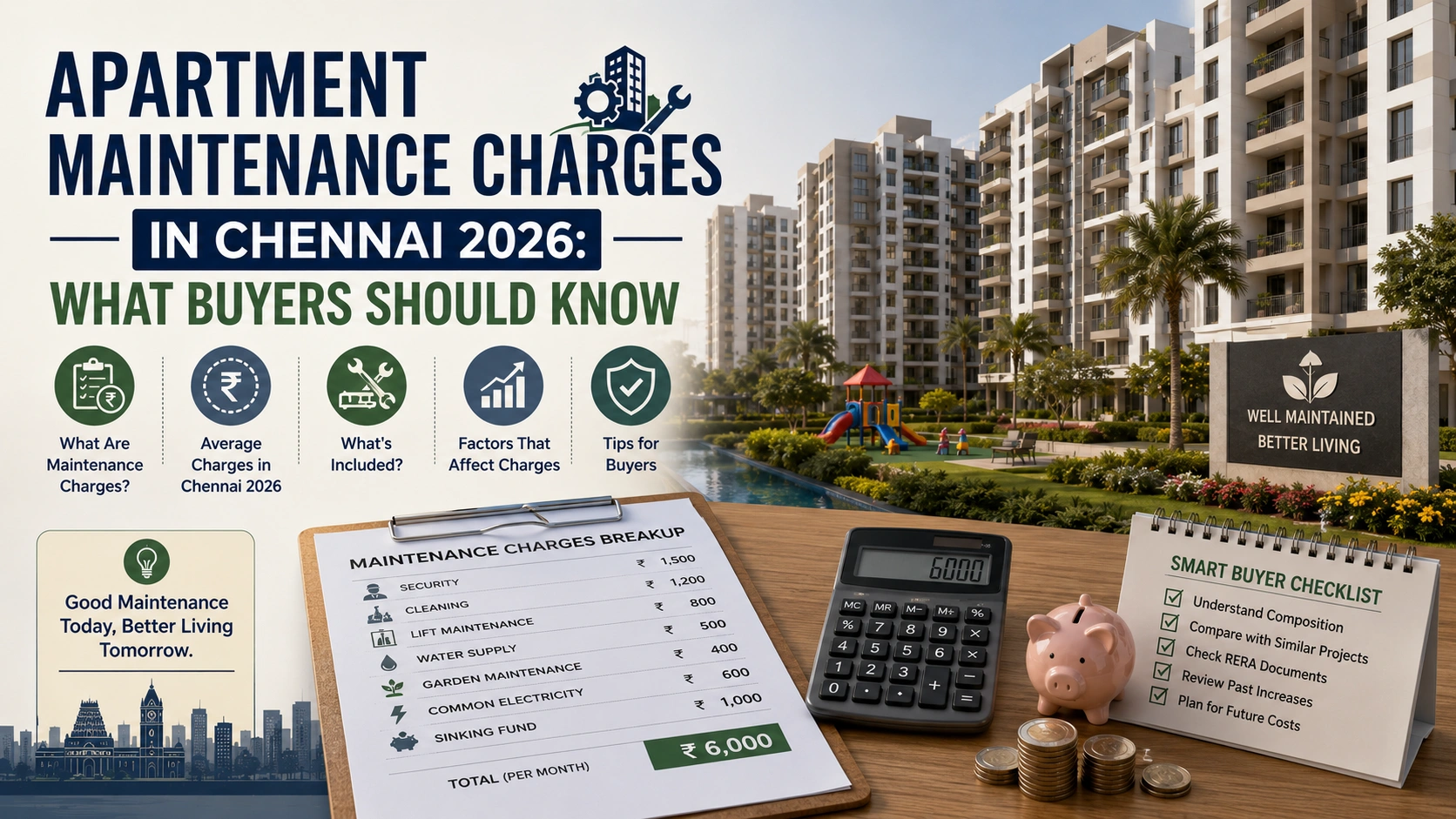
Buying an apartment in Chennai is not only about comparing the flat price, home-loan EMI, GST, stamp duty and registration charges. One of the most important recurring expenses that buyers should understand before purchasing a flat is the apartment maintenance charge. Maintenance charges directly affect the monthly cost of living in a residential community. A basic apartment may have relatively limited maintenance expenses, while a large gated community with lifts, security, clubhouse, swimming pool, gym, landscaped gardens, power backup and multiple common facilities can have significantly higher monthly charges.
What Are Apartment Maintenance Charges?
Apartment maintenance charges are recurring payments collected from apartment owners for maintaining and operating the common areas and shared facilities of a residential project.
These charges are generally used for expenses such as:
- Security guards
- Common-area housekeeping
- Lift maintenance
- Common electricity
- Water pumps
- STP/WTP systems, where applicable
- Generator and power-backup systems
- CCTV and access-control systems
- Landscaping
- Garbage collection and common-area cleaning
- Fire-safety systems
- Clubhouse maintenance
- Swimming-pool maintenance
- Children's play areas
- Common-area repairs
- Facility-management staff
The exact list depends on the apartment project and its association rules.
Apartment Maintenance Charges in Chennai 2026
There is no single fixed maintenance rate for all apartments in Chennai.
As a broad budgeting reference, buyers may come across maintenance rates in the following range:
| Apartment Category | Approx. Maintenances Rate | 1,000 sqft Monthy Cost |
| Basic apartment | Rs 2-3 sqft | Rs 2,000 - 3,000 |
| Standard apartment | Rs 3 - 5 sqft | Rs 3,000 - 5,000 |
| Gated Community | Rs 4 - 6 sqft | Rs 4,000 - 6,000 |
| Pemium community | Rs 5 - 8+ sqft | Rs 5,000 - 8,000 sqft |
Important: These are indicative market ranges for budgeting, not government-prescribed rates. Actual maintenance depends on the individual project's facilities, expenses, association structure and calculation method.
How Is Apartment Maintenance Calculated?
One of the first things a buyer should ask is:
“How does this apartment calculate maintenance?”
The calculation may depend on the project's governing documents and applicable apartment-ownership framework.
A common example is a per-square-foot calculation.
Example 1: 800 Sq. Ft. Apartment
Maintenance rate = Rs 3/sq. ft.
800 × Rs 3 = Rs 2,400/month
Annual cost:
Rs 2,400 × 12 = Rs 28,800
Example 2: 1,200 Sq. Ft. Apartment
Maintenance rate = Rs 4/sq. ft.
1,200 × Rs 4 = Rs 4,800/month
Annual cost:
Rs 4,800 × 12 = Rs 57,600
Example 3: 1,500 Sq. Ft. Apartment
Maintenance rate = Rs 6/sq. ft.
1,500 × Rs 6 = Rs 9,000/month
Annual cost:
Rs 9,000 × 12 = Rs 1,08,000
These examples show why apartment buyers should calculate the annual maintenance burden, not just the monthly amount.
Is Maintenance Always Based on Square Feet?
No.
Buyers should not automatically assume that every apartment association charges exactly:
Apartment size × maintenance rate.
The method can depend on the project's declaration, association rules and applicable legal framework. Under the Tamil Nadu Apartment Ownership Act, 2022, common expenses are connected to an apartment owner's percentage of undivided interest in the common areas and facilities. The Act also provides that an apartment owner remains liable for common expenses even if the owner does not use or enjoy particular common facilities. Therefore, buyers should ask the association or builder for the actual maintenance calculation method applicable to that project.
What Does Monthly Maintenance Usually Include?
1. Security Charges
Security is one of the major recurring expenses in gated communities.
It may include:
- Security guards
- Main-gate security
- Night security
- Visitor management
- CCTV monitoring
- Access-control systems
- Security supervisor
A large community with multiple entrances may require more security personnel.
2. Lift Maintenance
Apartments with multiple floors depend heavily on elevators.
Maintenance may cover:
- Lift AMC
- Routine inspections
- Servicing
- Repairs
- Emergency support
- Common electricity consumption
A project with several towers and multiple lifts can have a substantially larger lift-maintenance budget.
3. Housekeeping
Common-area cleaning can include:
- Entrance lobby
- Corridors
- Staircases
- Parking areas
- Clubhouse
- Common toilets
- Lift areas
- Outdoor areas
The number of housekeeping staff required depends on the size of the property.
4. Common Electricity
Maintenance collections can be used to pay electricity expenses for:
- Corridors
- Staircases
- Parking areas
- Entrance lighting
- Garden lighting
- Security cabins
- Clubhouse
- Lifts
- Common equipment
Individual apartment electricity consumption is normally separate.
5. Water Systems
Depending on the project, maintenance may cover the operation and upkeep of:
- Water pumps
- Overhead tanks
- Underground tanks
- Water-treatment systems
- Sewage-treatment systems
- Common plumbing systems
Individual water usage may be billed separately.
6. Generator and Power Backup
Many Chennai apartment communities provide power backup for common areas and sometimes individual apartments.
Expenses can include:
- Generator servicing
- AMC
- Fuel
- Battery maintenance
- Repairs
Some communities include these costs in maintenance, while others separately charge residents based on usage.
Why Gated Community Maintenance Can Be Higher
A gated community usually provides significantly more facilities than a basic apartment.
For example, a large project may have:
- Multiple towers
- Multiple lifts
- Clubhouse
- Swimming pool
- Gym
- Gardens
- Security gates
- CCTV
- Children's play area
- Sports facilities
- Generator backup
- STP
- Internal roads
- Visitor parking
All these facilities require staff, electricity, cleaning, servicing and periodic repairs. Therefore, buyers should not compare a Rs 3/sq. ft. basic apartment directly with a Rs 6/sq. ft. premium community without considering what each maintenance package includes.
Amenities Can Increase Long-Term Maintenance
Amenities are attractive when buying a home, but every amenity comes with an operating cost.
Swimming Pool
Requires:
- Water treatment
- Cleaning
- Pumps
- Filtration
- Chemical treatment
- Equipment servicing
Gym
Requires:
- Equipment maintenance
- Air conditioning, where applicable
- Cleaning
- Electricity
Clubhouse
Requires:
- Housekeeping
- Electricity
- Repairs
- Security
- Equipment maintenance
Landscaped Garden
Requires:
- Gardeners
- Irrigation
- Fertilisation
- Plant replacement
- Tree trimming
This is why more amenities can mean higher maintenance charges.
What Charges May Be Separate From Maintenance?
This is one of the most important things a buyer should verify.
The quoted maintenance amount may not cover everything.
Possible additional charges include:
Electricity
Your flat's electricity consumption is usually separate.
Water
Individual water consumption may be separately metered or billed.
Power Backup
Some projects charge separately for electricity supplied through backup systems.
Parking
Parking-related charges depend on the project's arrangements and applicable rules.
Clubhouse Charges
Certain facilities may have separate usage or membership charges.
Sinking Fund
A separate contribution may be collected for major future repairs.
Corpus Fund
A project may have a separate corpus contribution.
Special Repair Contribution
Owners may occasionally be asked to contribute toward major unexpected repairs.
What Is a Sinking Fund?
A sinking fund is a reserve created for major future expenditure. It is different from normal monthly operating expenses.
For example, after several years a project may need:
- Major external painting
- Waterproofing
- Lift replacement
- Pump replacement
- Major electrical work
- Structural repairs
- Equipment replacement
The association may use its sinking fund for such expenditure, depending on its rules and approvals.
What Is a Corpus Fund?
A corpus fund is another financial reserve associated with the long-term management of a residential project.
It should not automatically be treated as the same thing as monthly maintenance.
For example, a builder may quote:
- Advance maintenance: Rs 40,000
- Corpus fund: Rs 50,000
- Monthly maintenance: Rs 4,500
These are three different financial components. Buyers should ask exactly what each payment is for and whether it is refundable, adjustable or transferable, according to the project's documents.
Builder Maintenance vs Apartment Association Maintenance
New apartment buyers should understand who is responsible for maintenance at different stages.
During the initial period:
Builder / Facility Management Company → Apartment maintenance
After association formation and handover:
Apartment Owners' Association → Maintenance management
The transition process varies by project.
Before buying a new flat, ask:
- Has the association been formed?
- Who currently manages the property?
- Who collects maintenance?
- What is the current rate?
- Is there a facility-management contract?
- When is management expected to be transferred?
- Has a maintenance budget been prepared?
Can Apartment Maintenance Charges Increase?
Yes.
A maintenance rate quoted at the time of purchase should not automatically be considered a permanent lifetime rate.
Costs can increase because of:
- Salary revisions
- Security costs
- Electricity expenses
- Lift AMC increases
- Equipment replacement
- Inflation
- Water-system repairs
- Building ageing
- Insurance
- Major repairs
- Increased facility-management costs
Apartment Maintenance for Resale Properties
Buying a resale flat requires additional due diligence.
Suppose the seller has not paid:
Rs 25,000 maintenance dues
The buyer should clarify who will settle the outstanding amount before registration.
Before purchasing, request:
- Latest maintenance receipt
- Association dues statement
- No-dues confirmation, where applicable
- Property-tax payment status
- Electricity-related outstanding dues
- Any special repair contribution
Do not assume that the seller has cleared every association payment.
What Buyers Should Check in the Maintenance Agreement
Before purchasing a flat, carefully examine the documents for:
Maintenance Rate
Find out the exact amount currently payable.
Calculation Method
Understand whether it is:
- Per sq. ft.
- Equal contribution
- Based on undivided interest
- Another association-approved method
Payment Frequency
Check whether payment is:
- Monthly
- Quarterly
- Half-yearly
- Annually
Additional Charges
Identify separate payments for:
- Water
- Power backup
- Amenities
- Sinking fund
- Corpus fund
- Parking
- Special repairs
How Much Should You Budget for Maintenance?
A buyer can create a simple annual estimate.
For example:
| Expense | Approx. Monthly Budget |
| Maintenance | Rs 4,000 |
| Property Tax provison | Rs 1,000 |
| Commonother utilities | Rs 1,000 |
| Elecricity | Rs 2,500 |
| Total indicative housing running cost | Rs 8,500 |
This is only an illustrative budget. Actual costs vary significantly by household consumption and project.
Maintenance Charges for Luxury Apartments
Luxury apartments typically have more facilities and therefore potentially higher operating costs.
For example:
- Multiple swimming pools
- Large clubhouse
- Gym
- Spa
- Sports facilities
- Landscaped gardens
- Multiple security points
- Concierge/facility services
- Multiple lifts
- Extensive common areas
A buyer considering a premium apartment should ask:
How Buyers Can Reduce Maintenance Expenses
Buyers cannot always control association charges, but they can choose projects with efficient operating structures.
Look for:
- Energy-efficient lighting
- Solar systems for common areas
- Efficient water management
- Reasonable number of amenities
- Preventive lift maintenance
- Transparent association accounts
- Proper waste management
- Adequate reserve funds
- Professional facility management
A project that is efficiently managed can sometimes control costs better than a poorly managed property with similar amenities.
Apartment Maintenance Checklist for Chennai Buyers
Before booking a flat, verify the following:
- Current maintenance amount
- Maintenance per sq. ft., if applicable
- Calculation methodology
- Monthly/quarterly payment schedule
- Sinking fund
- Corpus fund
- Advance maintenance
- Water charges
- Power-backup charges
- Clubhouse charges
- Parking-related charges
- Association formation status
- Builder handover status
- Current maintenance budget
- Previous maintenance statements
- Outstanding dues for resale properties
- Rules for increasing maintenance
- Major upcoming repair requirements
Top 10 Questions to Ask Before Buying an Apartment
1. What is the current maintenance charge?
Get the exact amount rather than relying on an approximate figure.
2. How is the charge calculated?
Ask whether it is based on area, common ownership interest or another method.
3. What is included?
Request a detailed list.
4. What is excluded?
Find out whether electricity, water, power backup or amenities are separate.
5. Is there a sinking fund?
Ask how much is collected and what it is intended for.
6. Is there a corpus fund?
Clarify whether it has already been collected.
7. Can maintenance increase?
Ask how revisions are determined.
8. Who manages the apartment?
Builder, facility manager or owners' association?
9. Are there pending major repairs?
This is particularly important for resale apartments.
10. Are there outstanding dues?
Obtain confirmation before completing the transaction.
Apartment Maintenance Charges: New Flat vs Resale Flat
| Factor | New Apartment | Resale Apartment |
| Maintenance history | Limited | Can be checked |
| Association | May be newly formed | Usually established |
| Major repairs | Usually lower initially | Need verification |
| Outstanding dues | Usually limited | Must be checked |
| Maintenance trend | Future trend uncertain | Historical data available |
| Equipement age | Generally newer | Must be inspected |
| Sinking fund | May be developing | Existing reserve can be checked |
For resale properties, reviewing the association's previous maintenance statements can give buyers valuable information about actual running costs.
Common Mistakes Buyers Make
Mistake 1: Looking Only at the Flat Price
A low purchase price does not automatically mean a low total ownership cost.
Mistake 2: Ignoring Maintenance Increases
Today's maintenance may not remain unchanged for many years.
Mistake 3: Assuming Amenities Are Free
Amenities require regular operating and maintenance expenditure.
Mistake 4: Not Checking Additional Charges
Water, power backup, sinking fund and special repairs may be separate.
Mistake 5: Not Checking Resale Dues
Outstanding association charges should be clarified before purchase.
Mistake 6: Comparing Only the Per-Sq.-Ft. Rate
A higher rate may include more services, while a lower rate may cover only basic maintenance.
FAQs
1. What is the average apartment maintenance charge in Chennai in 2026?
Apartment maintenance charges in Chennai generally range from Rs 2–Rs 5 per sq. ft. per month, while premium gated communities may charge more.
2. How much is maintenance for a 1,000 sq. ft. flat?
At Rs 4 per sq. ft., maintenance would be around Rs 4,000 per month or Rs 48,000 annually.
3. What is included in apartment maintenance charges?
It may cover security, housekeeping, lifts, common electricity, landscaping, water systems and common-area maintenance.
4. Can apartment maintenance charges increase?
Yes. Charges can increase due to higher operating costs, staff expenses, repairs, electricity and facility-management costs.
5. Is maintenance compulsory for flat owners?
Apartment owners are generally responsible for their share of common-area and facility expenses under applicable rules and association documents.
6. Is apartment maintenance the same as property tax?
No. Maintenance charges are for common facilities, while property tax is paid to the relevant local authority.
7. What is a sinking fund in an apartment?
A sinking fund is a reserve collected for major future repairs, replacements and long-term building maintenance.
8. Do luxury apartments have higher maintenance charges?
Often, yes. Clubhouses, swimming pools, gyms, landscaped areas, multiple lifts and enhanced security can increase maintenance costs.
9. What should buyers check before paying maintenance?
Check the maintenance rate, calculation method, inclusions, additional charges, sinking fund, corpus fund and future revision rules.
10. Why should buyers check maintenance before buying a flat?
Maintenance is a recurring expense, so checking it helps buyers calculate the true cost of owning an apartment in Chennai.