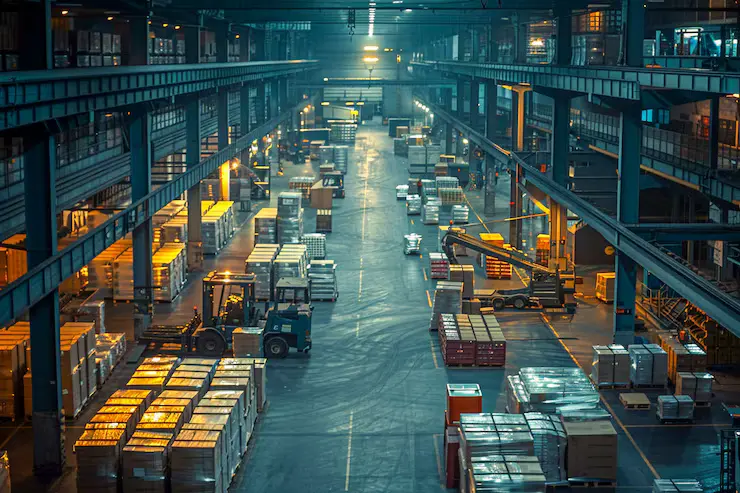
The state government on Tuesday unveiled a five-year warehousing policy aimed at easing logistics bottlenecks and supporting its ambition to build a $1 trillion state economy by 2030. The policy focuses on expanding warehousing infrastructure beyond established industrial hubs into delta regions, Category C districts, and Tier II and Tier III cities. Under the policy, projects in delta and Category C districts will be eligible for a 25% fixed capital subsidy, capped at ?2 crore and disbursed over three years, provided they meet minimum capacity requirements. Land in state-run industrial parks will be offered at half the standard rate, while large facilities of at least 1 million sq ft on government land will receive a five-year exemption from electricity tax. Additional incentives will be available for green features such as rooftop solar and certified sustainable construction. It identifies six priority areas: greenfield warehousing in industrial parks, brownfield expansion of existing facilities, public-private partnerships through land allocation, adoption of sustainable and smart technologies, development of commodity-specific silos and cold chains, and ease-of-doing-business reforms aligned with the state’s logistics policy. The policy underscores the growing importance of storage and distribution to the state’s manufacturing-led growth strategy. The state, which contributes about 9.2% to India’s GDP despite accounting for just 4% of its landmass, is targeting a $250 billion manufacturing output by the end of the decade. Officials say the Warehousing Policy 2026 is designed to address sharp regional imbalances in storage infrastructure while consolidating established logistics hubs. At present, demand is heavily concentrated around the capital city, which absorbed around 5 million sq ft of Grade-A warehousing space in 2024, led by third-party logistics providers, manufacturing firms, and e-commerce companies. Another major city followed with about 1.5 million sq ft, driven largely by retail supply chains, while an industrial town has emerged as a key node for the automotive and electronics ecosystem. By contrast, delta districts and several Category C regions remain under-served, despite strong bases in foodgrains, agro-processing, fisheries, and small-scale manufacturing. Limited access to cold storage and commodity-specific warehousing has constrained value addition, increased post-harvest losses, and weakened supply-chain resilience in these regions. Government-owned warehousing capacity in the state currently exceeds 1.5 million tonnes, supplemented by around 135 private cold storage facilities with an estimated 0.2 million tonnes of capacity. However, the report acknowledges that the geographical spread of this infrastructure remains uneven.
https://www.livehomes.in/news_letter