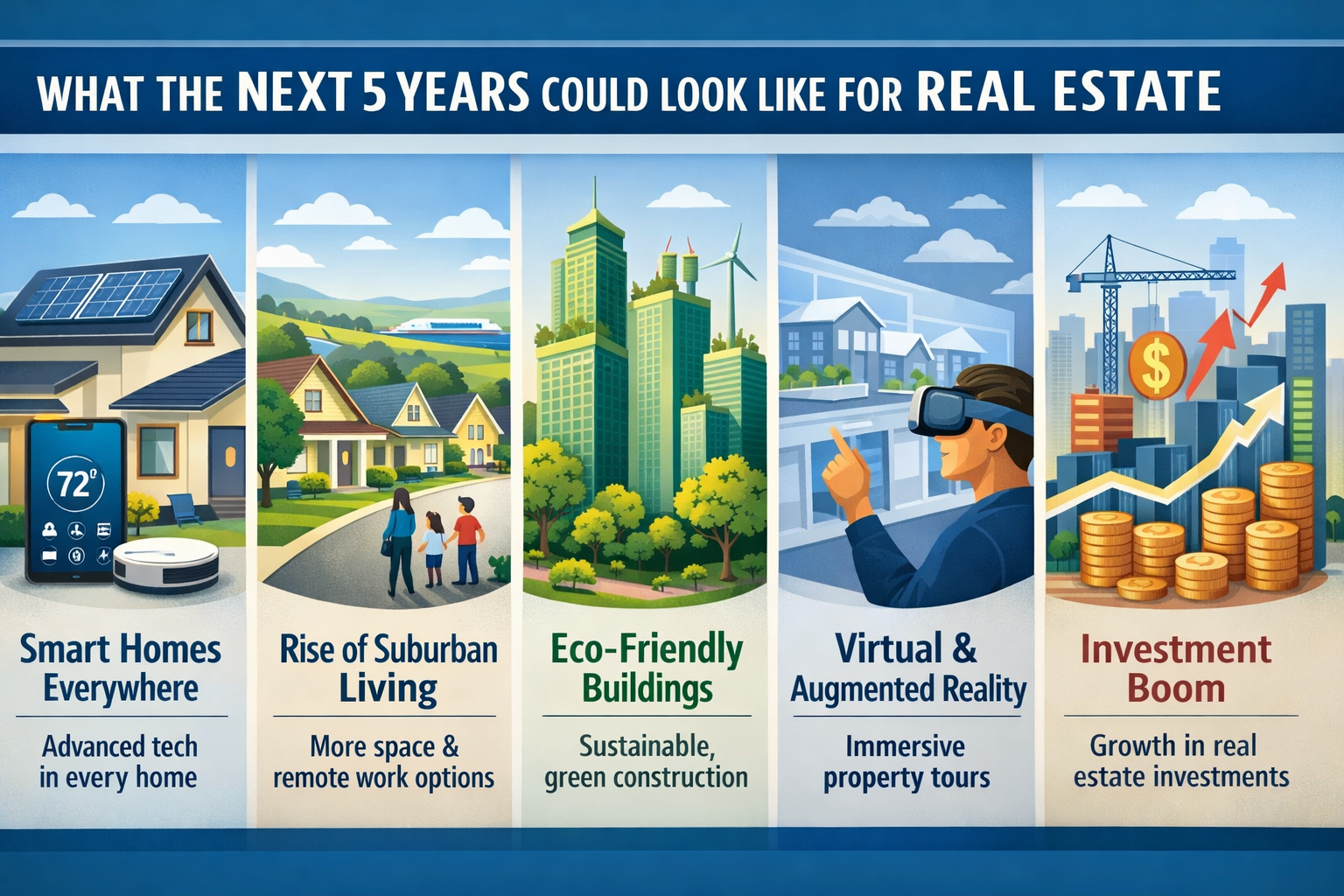
The next five years are likely to be a transitionary era rather than a boom or crash cycle. Real estate will become more localized, data-driven, and selective, with pros and cons determined by location, asset type, and adaptability.
1. Interest Rates & Financing Environment
What’s Likely
- Interest rates are expected to gradually decline or stabilize, but not return to the ultra-low levels of the 2010s.
- Central banks like the Federal Reserve are prioritizing inflation control over aggressive stimulus.
Impact
- Mortgage rates may settle in the 5–6% range long-term.
- Buyers will adjust expectations; affordability becomes the main constraint.
- Creative financing (rate buydowns, assumable mortgages, and seller financing) becomes more common.
Insight: Real estate recalibrates around “normal” money rather than cheap money.
2. Residential Housing Market
Supply & Demand
- Housing shortages persist in many regions due to:
- Underbuilding since 2008
- Zoning restrictions
- Aging housing stock
- Demand remains strong from:
- Millennials entering peak buying years
- Immigration and population growth
- Smaller household sizes
Price Trends
- Nationally: slower appreciation (2–4% annually).
- Regionally: wide divergence
- Growth markets outperform
- Overpriced or declining-population areas stagnate or decline
Insight: Housing becomes less speculative and more needs-based.
3. Rental Market & Multifamily
Key Trends
- Rent growth moderates but remains positive.
- Build-to-rent communities expand.
- Institutional ownership continues to rise.
Pressure Points
- Rent regulation expands in some cities.
- Operating costs (insurance, taxes, and maintenance) rise.
- Affordability becomes a political issue.
Insight: Rentals remain attractive, but cash flow matters more than appreciation.
4. Commercial Real Estate (CRE)
Office
- Traditional offices continue to struggle.
- Demand shifts to:
- Smaller footprints
- Flexible, high-quality spaces
- Conversions to residential or mixed-use increase.
Retail
- Experience-driven retail survives.
- Neighborhood and necessity-based retail performs well.
- Weak malls continue to decline.
Industrial
- Warehousing, logistics, and data centers remain strong.
- E-commerce and AI infrastructure fuel demand.
Insight: CRE doesn’t disappear—it evolves or repurposes.
5. Technology & Real Estate
PropTech Growth
- AI-powered valuation, leasing, and underwriting tools become standard.
- Smart buildings reduce energy and operating costs.
- Digital closings and blockchain-backed records expand.
Remote Work Legacy
- Permanent shift in where people live.
- Secondary cities and suburbs benefit.
Insight: Tech rewards efficiency and transparency, punishing outdated operators.
6. Demographics & Lifestyle Shifts
Key Forces
- Aging population increases demand for:
- Single-story homes
- Senior living
- Younger buyers favor:
- Walkable communities
- Sustainability
- Flexibility
Migration Patterns
- Sunbelt and tax-friendly states continue attracting residents.
- Climate risk increasingly priced into property values and insurance.
Insight: Real estate follows people, not headlines.
7. Regulation, Taxes & Government Influence
Expected Developments
- Stricter rental regulations in major metros.
- Incentives for affordable housing development.
- Zoning reform (slow, uneven, but growing).
Organizations like the U.S. Department of Housing and Urban Development will play a larger role in shaping supply responses.
Insight: Policy risk becomes a location-specific investment factor.
8. Real Estate as an Investment Asset
Institutional Behavior
- Institutions remain active but more selective.
- Focus on long-term yield, not rapid flips.
Individual Investors
- BRRR and short-term rentals face tighter margins.
- Platforms tied to short-term stays like Airbnb face increasing regulation in urban areas.
Insight: The era of “easy money real estate investing” is over—skill wins.
9. Pros & Cons (2026–2031)
Pros
- Affordable housing developers
- Well-located multifamily
- Industrial/logistics assets
- Adaptive reuse projects
- Markets with job and population growth
Cons
- Obsolete office buildings
- Highly leveraged speculators
- Climate-exposed properties without mitigation
- Markets dependent on single industries
Conclusion
The next five years will reward realism over optimism.
Real estate won’t collapse—but it won’t bail out poor decisions either.
The future favors:
- Cash flow over speculation
- Location intelligence over hype
- Adaptability over legacy models