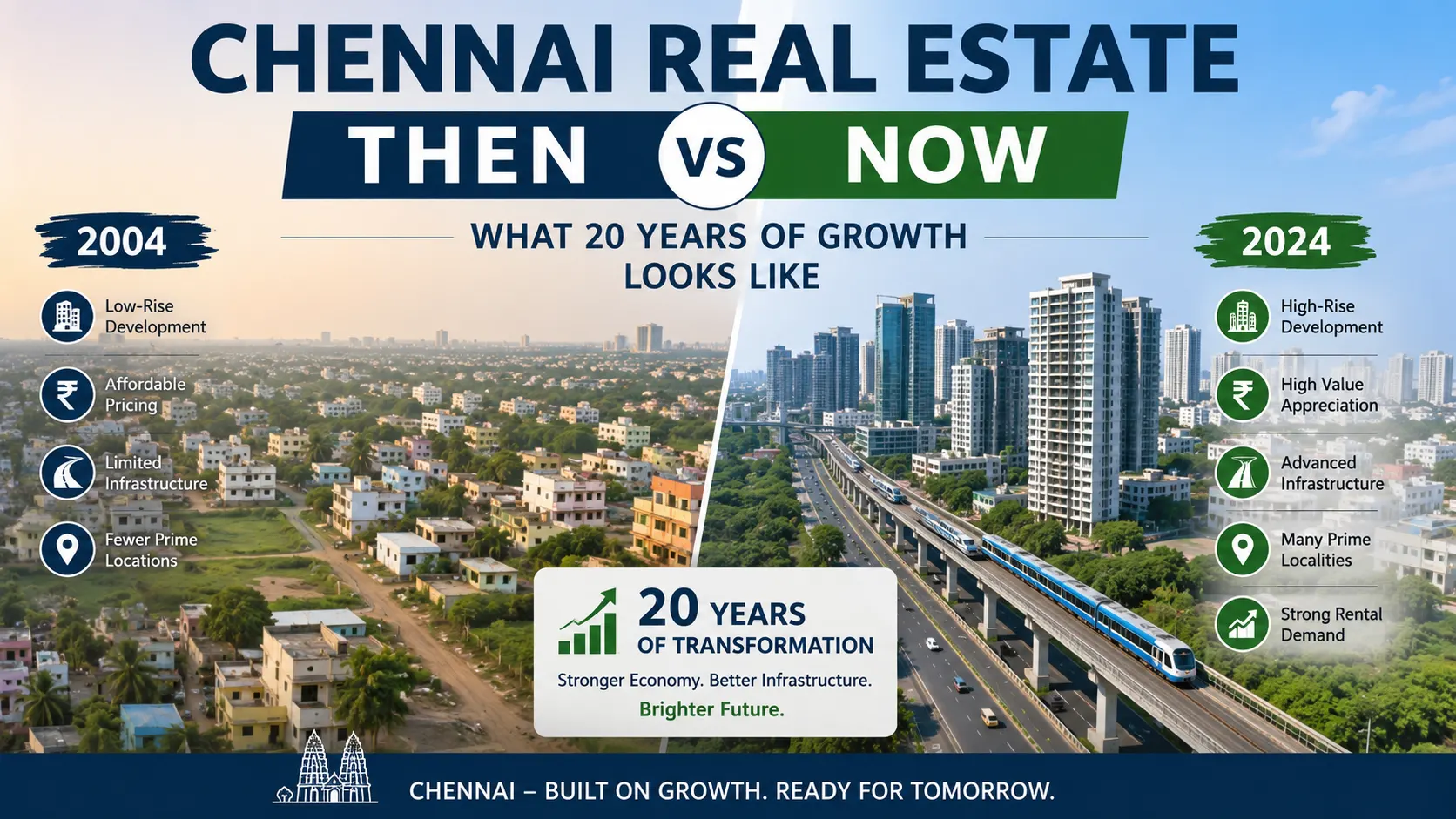
Over the last two decades, real estate in Chennai has transitioned from a slow, affordability-led housing market into a mature, infrastructure-driven and stable urban property ecosystem. Growth has been consistent rather than speculative, shaped by employment, connectivity, and end-user demand.
Phase 1: Foundation Years (2006–2012)
During this period, Chennai’s real estate growth was largely organic.
- Housing demand was driven mainly by local residents and professionals
- Development focused on independent houses and low-rise apartments
- Prices remained affordable with gradual appreciation
- Growth corridors began forming along OMR and GST Road
- Infrastructure development was limited mostly to road expansion
Insight:
This phase established Chennai as a low-risk, end-user-oriented market, avoiding speculative overheating.
Phase 2: Organised Expansion (2012–2018)
The market began to formalise and expand structurally.
- Increase in apartment projects and gated communities
- Rising demand from IT professionals and middle-income families
- Gradual improvement in social infrastructure (schools, hospitals, retail)
- Early metro development started influencing location preferences
- Prices continued to rise steadily, without sharp spikes
Insight:
Chennai moved from scattered growth to planned residential development, strengthening long-term market stability.
Phase 3: Market Maturity (2018–2023)
This period marked a shift toward a more resilient and regulated market.
- Demand remained largely end-user driven
- Mid-segment housing became the dominant category
- Developers focused more on quality, compliance, and delivery
- Suburban locations gained importance due to affordability and connectivity
- Price appreciation slowed but remained consistent
Insight:
The market demonstrated resilience during economic disruptions, reinforcing Chennai’s reputation for stability.
Also Read: Chennai Real Estate Market 2026 Property Prices, Emerging Hotspots, Buyer Demand & Future Growth
Phase 4: Infrastructure-Led Growth (2023–2026)
By 2026, Chennai’s real estate market reflects maturity and balance.
- Infrastructure has become the primary driver of value
- Metro expansion, road upgrades, and suburban rail connectivity shape demand
- Suburban and peripheral zones show stronger growth than saturated core areas
- Buyer preference has shifted toward larger homes, better layouts, and amenities
- Premium housing demand has increased, while mid-segment remains dominant
Insight:
Growth is now location-specific and infrastructure-dependent rather than citywide, leading to measured appreciation.
Price Behaviour Over 20 Years
- Property prices have multiplied steadily over two decades
- Appreciation has been gradual rather than speculative
- Well-connected corridors have outperformed isolated locations
- Volatility remains low compared to other major Indian cities
Insight:
Long-term price growth reflects real demand rather than short-term investor cycles.
Buyer Evolution
Earlier Years
- Affordability and proximity to work
- Smaller homes and basic specifications
By 2026
- Preference for space, amenities, and community living
- Increased participation from professionals and NRIs
- Lifestyle and connectivity outweigh proximity alone
Insight:
Buyer expectations have evolved, driving qualitative improvements in housing supply.
Core Insights from 20 Years of Growth (2006–2026)
- Chennai’s real estate growth is steady and disciplined
- End-user demand continues to anchor the market
- Infrastructure now determines value more than geography alone
- Suburban expansion defines the current growth phase
- Premiumisation is increasing without weakening mid-segment demand
Summary Then vs Now
Aspect / Then / Now (2026)
Market Nature
- Affordable, slow growth
- Mature, stable growth
Growth Driver
- Employment & land availability
- Infrastructure & lifestyle
Buyer Profile
- Local end-users
- Professionals, families, NRIs
Development Style
- Low-rise housing
- Gated communities & high-rises
Price Movement
- Gradual
- Gradual and location-specific