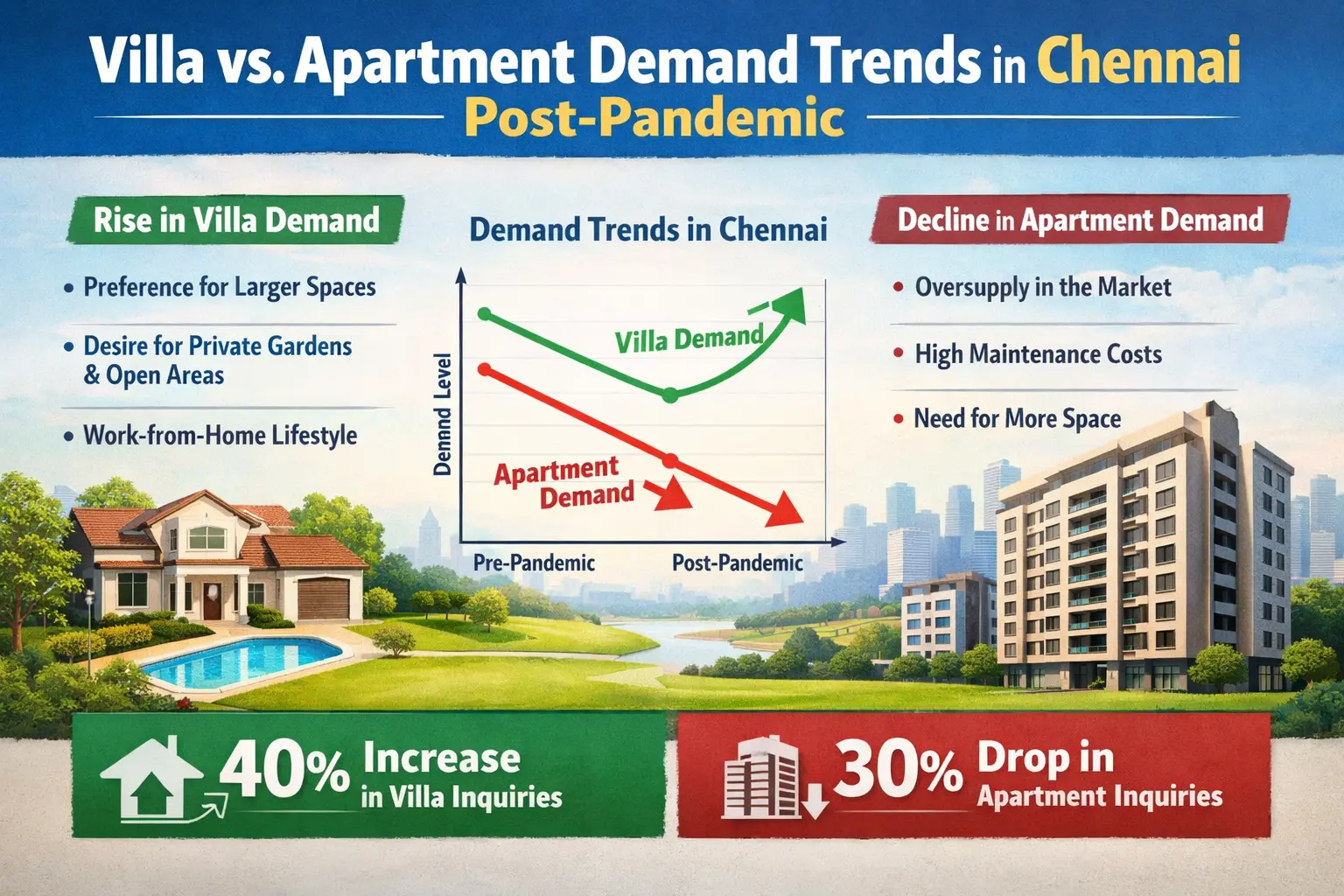
Market Context – Chennai
Chennai’s residential real estate market has historically been end-user driven, conservative, and less speculative than other Indian metros. Buyer demand is shaped mainly by job stability, infrastructure growth, and long-term self-use, rather than quick investment flips. Over the past 4–5 years, demand has begun to gradually shift upward—from purely affordable housing toward mid-segment and premium apartments, while affordable housing remains relevant but comparatively constrained.
Affordable Housing: Demand Stability, Supply Pressure
What Defines Affordable Housing in Chennai
- Typically priced below Rs 50–60 lakh
- Smaller unit sizes
- Located largely in outer suburbs and peripheral corridors
Demand Characteristics
Affordable housing continues to attract:
- First-time homebuyers
- Middle-income salaried households
- Buyers prioritising ownership over lifestyle upgrades
Demand remains steady but price-sensitive. Buyers in this segment are highly influenced by:
- Loan eligibility
- Monthly EMI affordability
- Commute costs
Key Demand Constraints
- Rising land and construction costs have reduced new affordable launches
- Developers face thin margins, leading to lower supply growth
- Many affordable projects are pushed farther from the city core
Outcome
Affordable housing demand has not collapsed, but its share of new demand and launches has stagnated, mainly because supply has not expanded in line with population growth.
Premium Apartments: Clear Upward Demand Shift
What Defines Premium Apartments
- Typically priced Rs 1 crore and above
- Larger configurations (2.5, 3, 4 BHK)
- Gated communities with amenities
- Better locations or improved connectivity
What Is Driving the Demand Shift
- Income Growth
- Strong employment base in IT, manufacturing, and services
- Dual-income households increasing purchasing power
- Lifestyle Re-evaluation
- Post-pandemic preference for:
- Larger homes
- Dedicated workspaces
- Better ventilation and amenities
- Buyers are upgrading rather than buying entry-level units
- Infrastructure Expansion
- Metro rail phases
- Improved road networks
- Better suburban-to-city connectivity
These have made premium housing viable beyond traditional core areas.
- Long-Term Security Mindset
Premium homes perceived as:
- Better quality assets
- Lower future maintenance risk
- Stronger resale and rental demand
Outcome
Premium and upper-mid segments are seeing:
- Higher enquiry growth
- Faster absorption rates
- Increasing share of new launches
This indicates a structural demand upgrade, not a short-term trend.
Location-Driven Demand Pattern
- Affordable housing demand is concentrated in outer growth zones where land costs are lower.
- Premium demand is spreading from established residential areas into newer corridors enabled by infrastructure.
This shows demand is not abandoning affordability—it is expanding upward faster than it is expanding outward.
Overall Demand Direction in Chennai
- Chennai is not seeing a sharp divide between rich and affordable buyers.
- Instead, it is witnessing a graduated shift:
- Entry-level demand remains
- Mid-segment has strengthened
- Premium demand is accelerating the fastest
The market is becoming quality-driven rather than price-driven, especially among salaried urban households.
Concussion
- Affordable housing remains essential but constrained by supply economics.
- Premium apartments are gaining stronger buyer traction due to income growth, lifestyle changes, and infrastructure support.
- Chennai’s buyer demand is not abandoning affordability, but progressively moving toward better-quality, higher-value homes.
- The shift is gradual, structural, and end-user led, consistent with Chennai’s historically stable market behavior.
This explains where and why buyer demand in Chennai is shifting, without speculation or promotional framing.