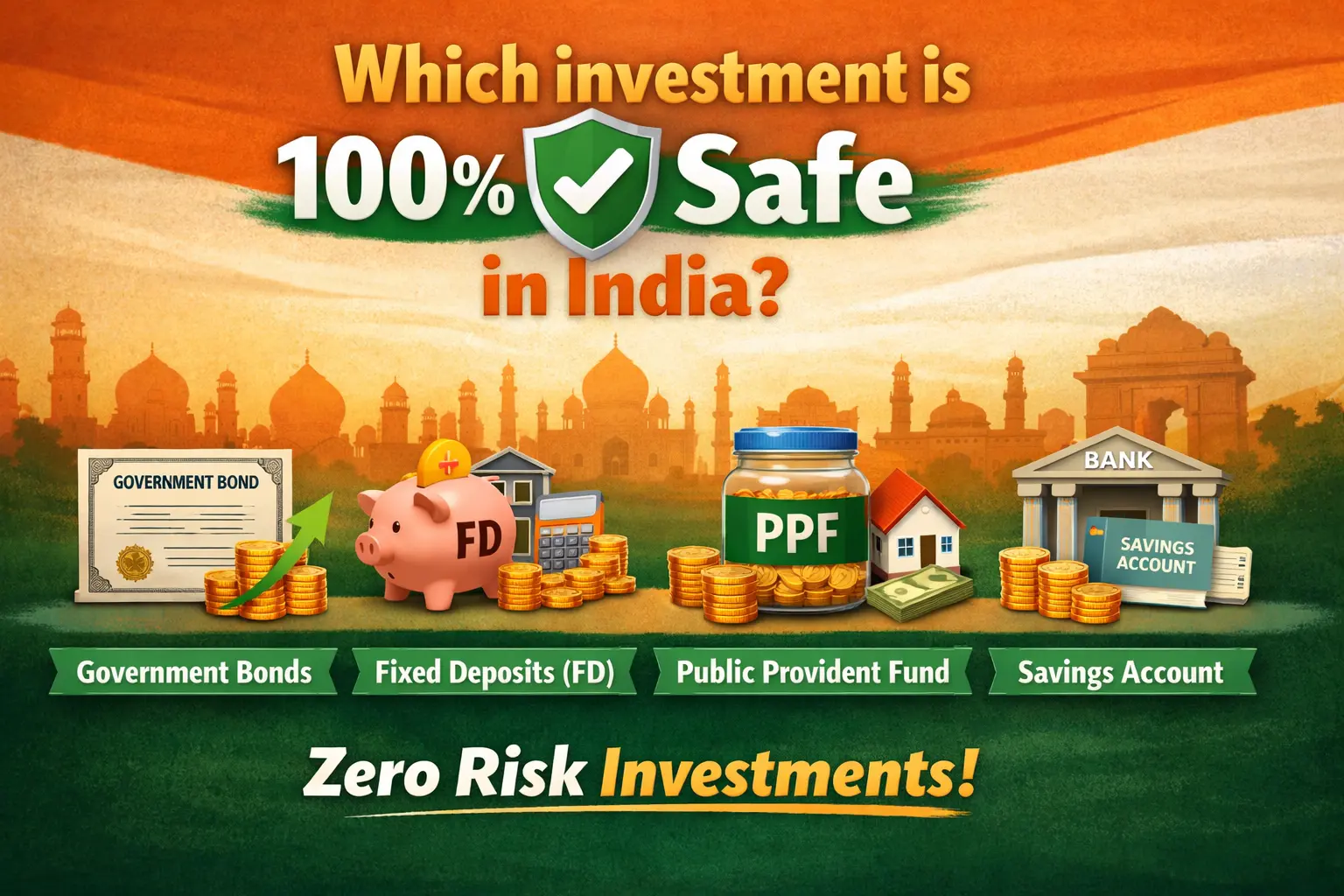
Understanding “100% Safe” Investment
Before naming any investment, it is important to understand what “100% safe” really means.
In finance, absolute safety does not exist. However, in India, some investments are considered practically risk-free because they are backed by the Government of India.
When people say “100% safe,” they usually mean:
- No risk of losing principal (capital protection)
- Guaranteed returns
- Backed by law or government
- No default history
Government-backed instruments meet these conditions better than any other investment
The Safest Investments in India (Detailed)
1. Public Provident Fund (PPF)
Most trusted and safest long-term investment
Why PPF is considered 100% safe
- Fully backed by the Government of India
- No market risk
- No default risk
- Returns are guaranteed by the government
Key Features
- Lock-in period: 15 years
- Minimum investment: Rs 500 per year
- Maximum investment: Rs1.5 lakh per year
- Interest rate: Decided by government (revised quarterly)
- Interest is compounded annually
Tax Benefits
- Investment qualifies under Section 80C
- Interest earned is tax-free
- Maturity amount is tax-free
(EEE – Exempt, Exempt, Exempt)
Best for
- Salaried individuals
- Long-term wealth protection
- Retirement planning
- Risk-averse investors
Also Read: Home Loan Interest Rates in 2026
2. Post Office Savings Schemes
Among the safest options in India
The Indian Post Office operates under the Government of India, making these schemes extremely secure.
a) Post Office Savings Account
- Similar to a bank savings account
- Government-backed
- Very safe, but low returns
b) National Savings Certificate (NSC)
- Fixed tenure: 5 years
- Guaranteed interest
- Eligible for tax deduction under Section 80C
c) Post Office Time Deposit
- Tenure options: 1, 2, 3, or 5 years
- Fixed returns
- 5-year deposit qualifies for tax deduction
d) Senior Citizens Savings Scheme (SCSS)
- For individuals aged 60 years or above
- High interest compared to FDs
- Quarterly interest payout
- Tenure: 5 years (extendable)
3. Government of India Bonds / Treasury Securities
Direct lending to the government
Why they are safe
- Issued by RBI on behalf of Government of India
- Zero default risk
- Guaranteed repayment
Types
- Treasury Bills (short-term)
- Government Bonds (long-term)
- Inflation-indexed bonds (limited availability)
Best for
- Institutional investors
- Conservative long-term investors
- Capital preservation
4. Sovereign Gold Bonds (SGBs)
Safest way to invest in gold
Why SGBs are safe
- Issued by Government of India
- No risk of physical gold theft
- Assured interest + gold price linkage
Key Features
- Interest: 2.5% per year
- Tenure: 8 years (exit allowed after 5 years)
- Capital gains tax-free if held till maturity
Risk involved
- Gold price may fluctuate
- No risk of default
5. Fixed Deposits in Government Banks
Very safe but not entirely risk-free
Safety aspects
- Government banks are stable
- Deposit Insurance and Credit Guarantee Corporation (DICGC) covers up to ?5 lakh per bank per depositor
Limitations
- Returns are taxable
- Inflation may reduce real returns
- Amount above ?5 lakh is uninsured
Why Stocks, Mutual Funds, Crypto Are NOT Safe
| Investment Type | Risk Level |
| Stocks | High Risk |
| Equity Mutual Funds | Market Risk |
| Corporate Bonds | Default Risk |
| Real Estate | Legal & Liquidity risk |
| Cryptocurrency | Extermely volatile |
These investments may offer high returns but cannot be called 100% safe.
Biggest Hidden Risk in Safe Investments
Inflation Risk
Even safe investments may not beat inflation.
Example:
- Return = 7%
- Inflation = 6%
- Real return = 1%
So while your money is safe, its purchasing power may reduce.
Best 100% Safe Investments by Goal
| Goal | Best Option |
| Long term safety | PPF |
| Senior Citizens | SCSS |
| Tax Saving | PPF / NSC |
| Gold with Safety | SGB |
| Short term safety | Treasury Bills / Post Office TD |
Final Conclusion
- No investment is absolutely risk-free
- Government-backed investments are the safest in India
- PPF is the closest to a “100% safe” investment
- Post Office schemes and Government bonds are equally reliable
Safe investments are ideal for capital protection, but for wealth growth, a balanced approach is recommended.
Frequently Asked Questions (FAQs)
Q1. Is there any truly 100% safe investment in India?
No. But government-backed investments are practically risk-free and considered the safest.
Q2. Is PPF safer than Fixed Deposit?
Yes. PPF is backed by the Government of India, while FD safety depends on the bank.
Q3. Are Post Office schemes safer than banks?
Yes. Post Office schemes carry direct government backing.
Q4. Is it safe to invest all money in PPF?
It is safe but not always ideal due to:
- Long lock-in
- Limited annual investment
- Lower returns compared to equity
Q5. Which is safest for senior citizens?
- Senior Citizen Savings Scheme (SCSS)
- Post Office Monthly Income Scheme
- Government bank FDs
Q6. What is the safest short-term investment?
- Treasury Bills
- Post Office Time Deposit
- Government bank short-term FD
Q7. Is investing only in safe options a good idea?
It protects capital but may not grow wealth significantly. A mix is better.
Q8. Can the Indian government default?
Historically, India has never defaulted on its domestic obligations.
Q9. What is the safest tax-free investment?
- Public Provident Fund (PPF)
- Sovereign Gold Bonds (on maturity)
https://www.livehomes.in/blogs