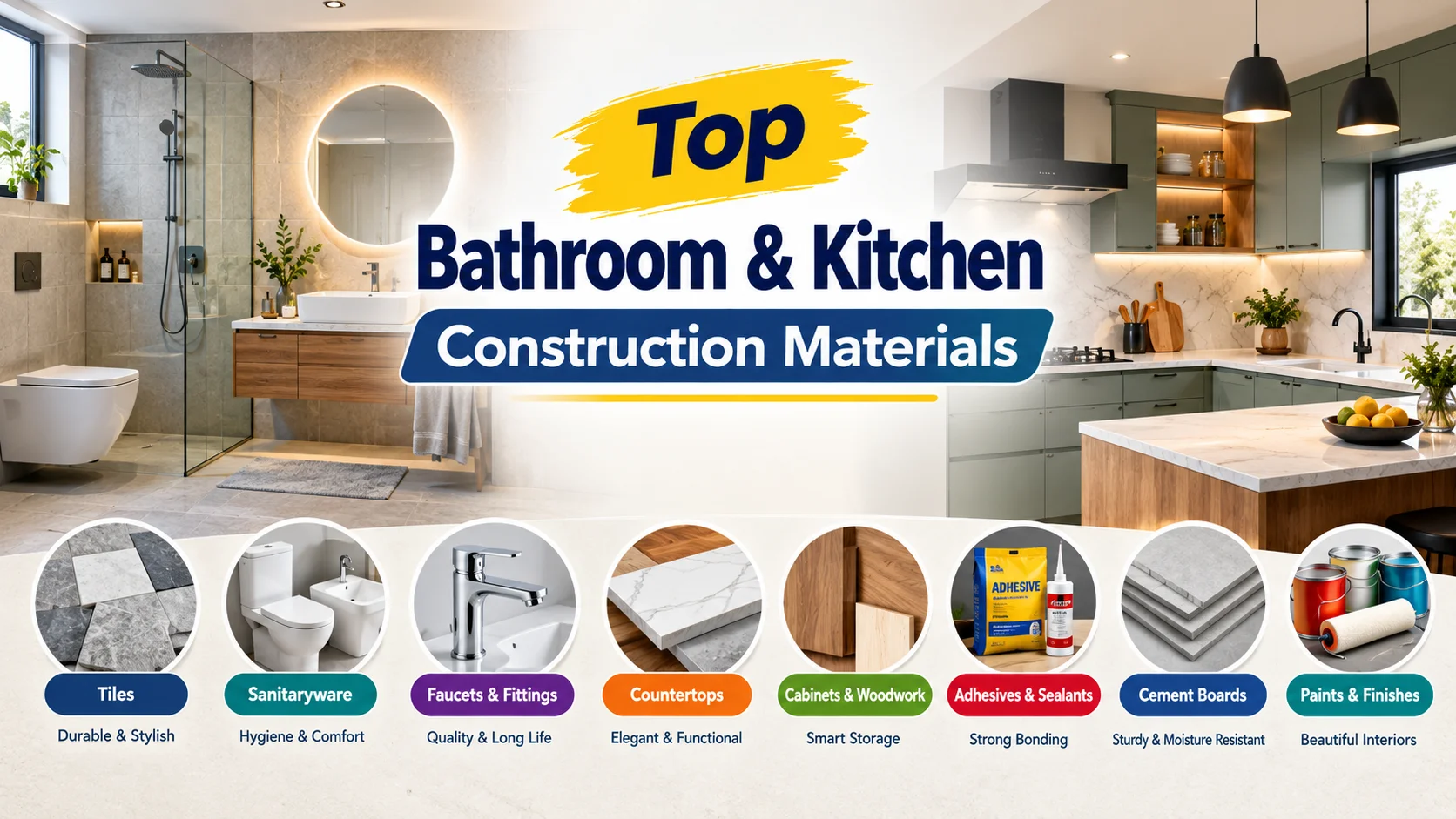
Choosing the right construction materials for bathrooms and kitchens is important because these areas face constant moisture, heat, stains, chemicals, water exposure and daily wear. The right materials can improve durability, hygiene, appearance and maintenance while reducing the chances of leakage, dampness and repairs.
Why Material Selection Matters for Bathrooms & Kitchens
Bathrooms and kitchens are different from other rooms in a home. They need materials that can handle challenging conditions.
The ideal materials should offer:
- Water and moisture resistance
- Good durability
- Easy cleaning
- Resistance to stains and chemicals
- Heat resistance where required
- Anti-skid properties for bathroom floors
- Resistance to termites and corrosion
- Low maintenance
- Good long-term value
- A clean and attractive finish
Instead of choosing materials only based on appearance or price, consider their performance, installation quality and expected lifespan.
1. Flooring Materials
Flooring is one of the most important material choices for both kitchens and bathrooms.
Vitrified Tiles
Vitrified tiles are widely used for kitchen and bathroom floors because they have low water absorption and are relatively easy to clean.
Advantages:
- Durable
- Easy to maintain
- Available in many designs
- Resistant to stains
- Suitable for heavy use
For bathrooms, choose a matte or textured anti-skid finish rather than a highly polished surface.
Ceramic Tiles
Ceramic tiles are another common choice, especially for walls and residential flooring.
Advantages:
- Affordable
- Easy to install
- Available in numerous colours and patterns
- Easy to clean
- Suitable for walls and moderate-use floors
Natural Stone
Granite, marble and other natural stones can create a premium appearance.
Advantages:
- Attractive natural appearance
- Strong and durable
- Suitable for premium interiors
However, some stones require sealing and regular maintenance. Slipperiness should also be considered when selecting stone for bathroom flooring.
2. Bathroom Wall Materials
Bathroom walls are continuously exposed to water vapour and splashes, so the wall finish needs to be moisture-resistant.
Ceramic Wall Tiles
Ceramic tiles are a practical option for bathroom walls.
They are:
- Water-resistant when properly installed
- Easy to clean
- Available in many designs
- Relatively economical
Porcelain Tiles
Porcelain tiles are denser than standard ceramic tiles and can provide excellent durability and moisture resistance.
They are particularly useful for:
- Shower walls
- Feature walls
- Full-height bathroom walls
- Premium bathroom designs
Large-Format Tiles
Large-format tiles are increasingly used in modern bathrooms because they create fewer visible joints.
Benefits include:
- Modern appearance
- Fewer grout lines
- Easier visual cleaning
- More spacious appearance
However, installation requires a properly prepared surface and experienced tile workers.
3. Waterproofing Materials
Waterproofing is arguably more important than the decorative finish in a bathroom. Even expensive tiles cannot compensate for poor waterproofing.
Cement-Based Waterproofing
Cementitious waterproofing products are commonly used on bathroom floors and walls.
They can be applied to:
- Bathroom floors
- Shower areas
- Wet walls
- Utility areas
Waterproofing Membranes
Waterproofing membranes provide an additional protective layer beneath the finished surface. They can be useful in areas where water exposure is high.
Waterproofing for Kitchen Areas
Waterproofing is also important around:
- Kitchen sinks
- Countertop junctions
- Plumbing points
- Wet walls
- Utility areas
Important: Waterproofing should be completed and tested before tiles or other finishes are installed.
4. Kitchen Countertop Materials
The kitchen countertop experiences daily exposure to heat, water, oil, food stains and cleaning products.
Granite
Granite remains one of the most practical countertop materials for Indian kitchens.
Advantages:
- Strong and durable
- Good heat resistance
- Scratch-resistant compared with many softer materials
- Available in many colours and patterns
- Suitable for heavy cooking
It is particularly suitable for homeowners looking for a durable countertop with relatively straightforward maintenance.
Quartz
Engineered quartz provides a modern, consistent appearance.
Advantages:
- Low porosity
- Easy to clean
- Available in uniform patterns
- Suitable for contemporary kitchens
However, it should not be treated as completely heat-proof. Extremely hot cookware should not be placed directly on the surface.
Marble
Marble offers a premium appearance but is more vulnerable to staining and scratching than many engineered or granite options. It can be considered when appearance is a higher priority and the homeowner is prepared for additional maintenance.
5. Kitchen Cabinet Materials
Cabinet material has a major impact on the lifespan of a modular or built-in kitchen.
Plywood
Plywood is one of the commonly preferred materials for durable kitchen cabinets.
Advantages:
- Strong
- Good screw-holding capacity
- Suitable for modular kitchens
- Available in moisture-resistant grades
For areas exposed to moisture, selecting an appropriate grade and sealing all exposed edges is important.
BWP / Boiling Water Proof Plywood
BWP plywood is designed to offer better moisture resistance than ordinary plywood.
It can be considered for:
- Sink cabinets
- Lower kitchen cabinets
- Moisture-prone areas
Always check the actual product specification and certification rather than relying only on the label.
MDF
Medium-density fibreboard provides a smooth surface and can work well for certain cabinet applications.
Advantages:
- Smooth finish
- Good for painted finishes
- Easy to machine
- Often more economical than premium plywood
However, ordinary MDF should not be exposed to prolonged moisture.
HDHMR Boards
High-density high-moisture-resistant boards are another option for kitchen furniture. They can provide a smooth finish and better moisture resistance than standard MDF, depending on the specific product.
6. Laminate Materials
Laminates are commonly used as the outer finish for kitchen cabinets. They provide protection while also allowing homeowners to customize the appearance.
Types of Kitchen Laminates
- Matte laminates
- Gloss laminates
- Textured laminates
- Wood-finish laminates
- Anti-fingerprint laminates
- High-pressure laminates
Why Choose Laminates?
They are:
- Easy to clean
- Available in many designs
- Relatively economical
- Suitable for everyday kitchen use
For busy kitchens, matte or textured surfaces can be easier to maintain than very glossy finishes.
7. Kitchen Sink Materials
The sink should withstand water, cleaning chemicals, food waste and daily impact.
Stainless Steel
Stainless steel is one of the most practical sink materials.
Advantages:
- Durable
- Hygienic
- Easy to clean
- Corrosion-resistant when good-quality steel is used
- Suitable for Indian cooking
Look for a good-quality stainless-steel grade and suitable thickness rather than selecting only on price.
Granite Composite
Granite-composite sinks provide a premium appearance and can offer good resistance to scratches and stains. They are available in several colours and work well with contemporary kitchen designs.
8. Bathroom Sanitaryware
Sanitaryware includes toilets, wash basins and related bathroom fixtures.
Ceramic Sanitaryware
Vitreous ceramic sanitaryware is widely used because it is:
- Smooth
- Easy to clean
- Hygienic
- Durable
- Available in many designs
Wall-Hung Toilets
Wall-hung toilets can create a cleaner modern appearance and make floor cleaning easier. However, the concealed frame and plumbing must be properly installed.
Countertop Wash Basins
Countertop basins are suitable for modern bathroom designs and can be combined with vanity units.
9. Bathroom Fittings
Bathroom fittings include taps, showers, mixers, health faucets and other fixtures.
Brass Fittings
Good-quality brass fittings are commonly preferred because they offer strength and durability.
Stainless-Steel Fittings
Stainless steel can also be a good choice, particularly where corrosion resistance and durability are priorities.
When choosing fittings, check:
- Material
- Finish quality
- Cartridge quality
- Warranty
- Availability of replacement parts
- Water-pressure compatibility
10. Plumbing Pipes
A good plumbing system is essential because concealed plumbing can be expensive to repair after tiles and walls are finished.
Common plumbing materials include:
CPVC Pipes
CPVC is widely used for hot and cold water supply in residential buildings.
UPVC Pipes
UPVC is commonly used for drainage and certain cold-water applications, depending on the system design.
PPR Pipes
PPR piping can be used for hot and cold water systems and is known for heat resistance and welded joints. The right pipe should be selected according to water temperature, pressure, application and local plumbing specifications.
11. Tile Adhesives and Grout
Tiles are only as reliable as their installation.
Tile Adhesive
Modern tile adhesives can provide better bonding than traditional cement-sand methods for many applications.
The adhesive should be selected according to:
- Tile size
- Tile type
- Wall/floor application
- Wet or dry area
- Interior or exterior use
Grout
Grout fills the joints between tiles.
Common choices include:
- Cement-based grout
- Epoxy grout
Epoxy grout generally offers better resistance to stains and moisture, making it useful in areas such as shower zones and kitchen backsplashes, though it costs more and requires careful installation.
12. Kitchen Backsplash Materials
The backsplash protects the wall behind the cooking area from oil, water and food stains.
Popular materials include:
- Ceramic tiles
- Porcelain tiles
- Glass
- Natural stone
- Large-format tiles
- Quartz slabs
For everyday Indian cooking, choose a surface that is easy to clean and resistant to heat, stains and moisture.
13. Ceiling Materials
Bathrooms require moisture-resistant ceiling solutions.
PVC Ceiling Panels
PVC panels can be useful in moisture-prone areas because they are resistant to water and relatively easy to maintain.
Moisture-Resistant Gypsum
Moisture-resistant gypsum boards can be used for suitable bathroom ceiling applications when properly installed and ventilated.
Cement Boards
Cement boards can be considered for areas requiring greater moisture resistance and dimensional stability.
14. Glass Materials
Glass is increasingly used in modern bathrooms.
Toughened Glass
Toughened glass can be used for:
- Shower enclosures
- Shower partitions
- Bathroom doors
- Decorative partitions
For safety, use properly specified safety glass and professional installation.
15. Doors for Bathrooms
Bathroom doors are constantly exposed to humidity.
Suitable choices can include:
- uPVC doors
- WPC doors
- Waterproof laminate-finished doors
- Properly treated solid-core doors
The door frame should also be selected carefully because water exposure at the bottom can cause swelling or deterioration in unsuitable materials.
16. Electrical Materials for Bathrooms & Kitchens
Electrical components require special attention in wet areas.
Use:
- Good-quality copper wiring
- Appropriate switches and sockets
- Proper earthing
- RCCB/RCBO protection as applicable
- Suitable IP-rated fixtures for wet locations
- Exhaust fans with appropriate installation
Electrical installation should comply with applicable electrical safety requirements and be carried out by a qualified electrician. Never place ordinary electrical fittings close to water sources without appropriate protection.
17. Sealants and Silicone
Sealants are small components but play an important role in preventing water penetration.
They can be used around:
- Kitchen sinks
- Countertop joints
- Wash basins
- Shower areas
- Bathtubs
- Plumbing fixtures
A good-quality sanitary silicone sealant can help prevent water from entering gaps and joints.
How to Choose the Best Materials on a Budget
A good construction budget does not mean choosing the cheapest material available. Instead, spend more on components that are difficult or expensive to replace later.
Give Higher Priority to:
- Waterproofing
- Plumbing pipes
- Electrical safety
- Flooring
- Kitchen cabinet carcass
- Countertop
- Bathroom fittings
- Tile installation
- Sealants and grout
Decorative elements such as premium laminates or designer tiles can be upgraded later more easily than concealed plumbing or waterproofing.
Tips for Long-Lasting Bathrooms and Kitchens
- Use anti-skid flooring in wet areas.
- Seal countertop and sink joints properly.
- Check waterproofing before tile installation.
- Use moisture-resistant boards in wet-prone kitchen areas.
- Provide sufficient bathroom ventilation.
- Use quality plumbing fittings.
- Maintain proper floor slope.
- Clean grout regularly.
- Repair leaking taps and pipes immediately.
- Avoid using harsh chemicals that can damage surfaces.
- Keep kitchen cabinets dry around the sink.
- Select materials according to actual usage rather than appearance alone.
Conclusion
The best bathroom and kitchen construction materials are not necessarily the most expensive ones. The ideal combination depends on water exposure, usage, budget, maintenance requirements, design preferences and installation quality. For bathrooms, prioritise waterproofing, anti-skid flooring, durable tiles, reliable plumbing and moisture-resistant finishes. For kitchens, focus on strong cabinet materials, durable countertops, quality hardware, stain-resistant surfaces and reliable plumbing. A well-planned material selection can make the bathroom and kitchen safer, easier to maintain and more durable for many years.
FAQs
1. Which flooring is best for a bathroom?
Matt-finish or textured anti-skid vitrified, porcelain or ceramic tiles are commonly suitable. The final choice should consider slip resistance, water exposure and installation quality.
2. Is granite or quartz better for a kitchen countertop?
Both can be good choices. Granite is known for strength and heat resistance, while engineered quartz offers low porosity and a consistent modern appearance.
3. Which material is best for kitchen cabinets?
Good-quality plywood, including suitable moisture-resistant grades, is a popular durable option. HDHMR and other engineered boards can also be considered depending on the application and budget.
4. Is waterproofing necessary before bathroom tiling?
Yes. Tiles and grout should not be treated as the primary waterproofing system. Proper waterproofing beneath the finished surface helps protect the underlying structure.
5. Which pipe is best for bathroom plumbing?
CPVC, PPR and other approved plumbing systems can be suitable depending on whether the application involves hot water, cold water, drainage, pressure and local specifications.
6. Are large tiles suitable for bathrooms?
Yes. Large-format tiles can provide a modern appearance with fewer grout joints, but they require proper surface preparation and skilled installation.
7. Which material is best for a kitchen sink?
Stainless steel is a practical and widely used option because it is durable, hygienic and easy to maintain. Granite-composite sinks are another option for a premium appearance.
8. What is the most important bathroom construction material?
There is no single material. Waterproofing, plumbing, flooring and proper drainage are among the most important components because failures in these areas can lead to costly repairs.
9. How can I reduce bathroom and kitchen construction costs?
Choose durable mid-range materials, compare product specifications, avoid unnecessary decorative upgrades and invest more in concealed systems such as waterproofing, plumbing and electrical safety.
10. What should I check before buying construction materials?
Check the material grade, specifications, water resistance, durability, warranty, manufacturer information, application suitability and installation requirements. For structural or concealed applications, follow the recommendations of the relevant engineer or qualified professional.