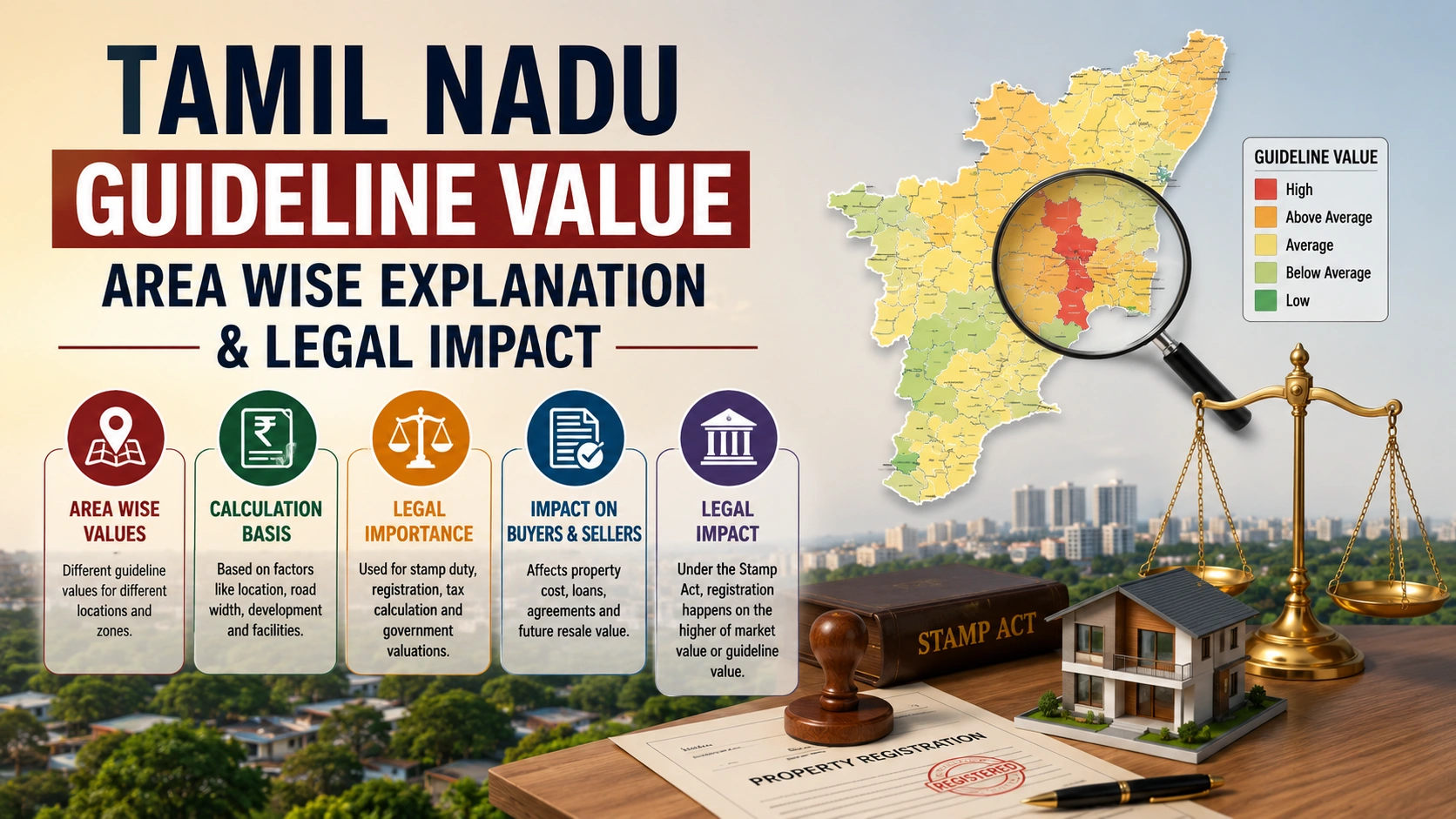
When buying or selling a property in Tamil Nadu, one of the first terms you will come across is the guideline value. It is a crucial factor that affects property registration, stamp duty, registration charges, taxation, and even home loan processing. Whether you are purchasing a residential apartment, villa, plot, commercial property, or agricultural land, understanding the Guideline Value helps you make informed financial and legal decisions. Many buyers assume that the guideline value and market value are the same. However, they are entirely different. The Guideline Value is the minimum value fixed by the Tamil Nadu Registration Department for every property, while the Market Value is the price at which a property is actually bought or sold. Since guideline values differ from one street, locality, and survey number to another, checking the correct value before registration is essential.
What is Guideline Value?
Guideline Value (GV) is the minimum value fixed by the Tamil Nadu Government for registering immovable properties. It serves as the official benchmark for calculating stamp duty and registration fees.
The Registration Department determines the Guideline Value after evaluating various factors such as location, infrastructure, road access, commercial importance, and market trends.
The primary objective of the Guideline Value is to:
- Prevent undervaluation of properties
- Ensure fair collection of stamp duty.
- Reduce tax evasion
- Maintain transparency in property transactions
- Standardize property valuation across the state.
Why Was Guideline Value Introduced?
Before the Guideline Value system was implemented, many property transactions were registered at values much lower than their actual selling price to reduce stamp duty and registration charges. This resulted in revenue loss for the government and created disputes regarding the true value of properties.
To address these issues, the Tamil Nadu Government introduced the Guideline Value system to establish a minimum registration value for every property.
The objectives include:
- Preventing fraudulent property registrations
- Eliminating undervaluation
- Increasing transparency
- Protecting government revenue
- Creating a standardized valuation framework
Who Fixes the Guideline Value?
The guideline value is determined and maintained by the Tamil Nadu Registration Department. Officials conduct periodic surveys and analyze multiple factors before revising values.
The department collects data from:
- Previous property registrations
- Market trends
- Infrastructure developments
- Commercial growth
- Public demand
- Government development projects
Based on these assessments, guideline values are revised periodically.
Also Read: Guideline Value in Chennai, Rates, rules and Registration Impact
How is Guideline Value Fixed?
Unlike market prices, guideline value is determined using several technical and administrative factors.
These include:
1. Location
Properties located in prime areas generally receive higher guideline values.
Examples include:
- Central business districts
- IT corridors
- Metro-connected areas
- High-demand residential neighborhoods
2. Road Width
Road width significantly influences property valuation.
Properties located on:
- Main roads
- State highways
- National highways
usually receive higher Guideline Values than those situated on narrow internal streets.
3. Property Usage
The intended use of the property affects its Guideline Value.
Property categories include:
- Residential
- Commercial
- Industrial
- Institutional
- Agricultural
- Mixed-use
Commercial properties usually have higher values due to business potential.
4. Infrastructure
Areas with better civic infrastructure receive higher guideline values.
Infrastructure includes:
- Roads
- Water supply
- Underground drainage
- Street lighting
- Parks
- Schools
- Hospitals
- Shopping centers
5. Public Transport
Accessibility greatly influences property valuation.
Nearby facilities include:
- Metro stations
- Railway stations
- Bus terminals
- Airports
- Major highways
6. Future Development
Upcoming infrastructure projects often increase Guideline Values.
Examples include:
- Metro Rail
- Ring Roads
- Flyovers
- IT Parks
- Industrial Corridors
- Smart City Projects
Area-Wise Classification of Guideline Value
Prime Residential Areas
Prime residential localities generally have the highest guideline values because of:
- Excellent infrastructure
- Premium housing
- Strong buyer demand
- Better connectivity
- High appreciation potential
Commercial Areas
Commercial zones receive higher guideline values because they generate business income.
These include:
- Shopping streets
- Business districts
- Office corridors
- Retail markets
Developing Areas
Emerging suburbs usually have moderate guideline values.
Their values increase gradually as:
- Roads improve.
- Metro expands
- Residential demand grows.
- Commercial activity increases.
Village Areas
Village properties generally have lower guideline values because development is comparatively limited.
The valuation depends on:
- Survey Number
- Village Classification
- Road Access
- Land Usage
Survey Number-Wise Guideline Value
Agricultural lands and undeveloped properties are usually valued based on:
- District
- Taluk
- Village
- Survey Number
- Land Classification
Different survey numbers within the same village may have different guideline values.
Apartment Guideline Value
For apartments, registration value generally includes:
- Undivided Share (UDS) value
- Building value
- Common area proportion
- Floor-wise valuation (where applicable)
Premium apartments located in well-developed areas often have higher guideline values.
Plot Guideline Value
For residential plots, the Guideline Value depends on:
- Road access
- Plot location
- Layout approval
- Corner plot advantage
- Infrastructure
- Demand
Commercial Property Guideline Value
Commercial properties generally receive higher guideline values due to:
- Rental income potential
- Business activity
- Footfall
- Road frontage
- Market demand
Agricultural Land Guideline Value
Agricultural lands are valued based on:
- Survey number
- Irrigation facilities
- Road connectivity
- Soil classification
- Conversion potential
Difference Between Guideline Value and Market Value
| Guideline Value | Market Value |
| Fixed by Government | Determined by buyers and sellers |
| Used for Registration | Actual selling price |
| Minimum value | Negotiated value |
| Stable for a period | Changes frequently |
| Official valuation | Demand-based valuation |
Legal Impact of Guideline Value
Property Registration
The Registration Department uses the Guideline Value as the minimum benchmark during property registration. If the sale consideration is lower than the applicable guideline value, registration charges are generally calculated based on the guideline value.
Stamp Duty
Stamp duty is calculated using whichever is higher:
- Sale Price
- Guideline Value
Registration Charges
Registration fees are also based on the higher of the two values.
Prevention of Undervaluation
The guideline value prevents:
- False declarations
- Under-reporting
- Stamp duty loss
- Fraudulent registrations
Home Loan Processing
Banks consider:
- Guideline Value
- Market Value
- Technical valuation
- Legal verification
- before sanctioning loans.
Property Resale
During resale, buyers often compare:
- Market Price
- Guideline Value
to assess whether the quoted price is reasonable.
Capital Gains and Taxation
The registered value of the property may be relevant for certain income tax provisions, especially where the law considers the stamp duty value while computing capital gains or evaluating property transactions.
Court Cases
Guideline value may be referred to in:
- Property disputes
- Partition suits
- Compensation claims
- Valuation-related cases
However, courts may also consider independent valuation and other evidence depending on the facts of each case.
Also Read: RERA Rules for Apartments What Buyers Must Know
Advantages of Guideline Value
Creates transparency in property transactions
- Reduces tax evasion
- Prevents undervaluation
- Protects government revenue
- Helps buyers estimate registration costs
- Assists banks during loan evaluation
- Supports fair property valuation
- Encourages legally compliant transactions
Limitations of Guideline Value
- It may not reflect the actual market price.
- Market values can rise faster than guideline values.
- Adjacent streets may have significantly different values.
- Premium features of a property are not always reflected in the guideline value.
- Frequent infrastructure changes can make revisions necessary.
Documents Required to Verify Guideline Value
Before purchasing property, verify:
- Sale Deed
- Parent Documents
- Patta
- Chitta (where applicable)
- Encumbrance Certificate (EC)
- Survey Number Details
- Approved Layout or Building Plan
- Property Tax Receipts
Common Mistakes Buyers Should Avoid
- Assuming Guideline Value equals Market Value
- Not checking the exact street or survey number
- Ignoring additional registration expenses
- Purchasing without legal verification
- Relying only on verbal information from brokers
- Not verifying approvals and ownership documents
Conclusion
The Tamil Nadu Guideline Value System is a fundamental part of every real estate transaction. It establishes the minimum value for property registration, ensures transparency, reduces undervaluation, and helps determine stamp duty and registration charges. Since guideline values differ based on locality, street, survey number, infrastructure, and property type, buyers and sellers should verify the applicable value before completing any transaction. Understanding how the system works enables better financial planning, legal compliance, and informed real estate decisions.
FAQs
1. What is Guideline Value?
Guideline Value is the minimum government-fixed value used for property registration in Tamil Nadu.
2. Is Guideline Value the same as Market Value?
No. Guideline value is the government benchmark, while market value is the actual selling price.
3. Why does Guideline Value vary between areas?
It depends on location, infrastructure, road access, property type, and development level.
4. Is Guideline Value applicable to apartments, plots, and agricultural land?
Yes. It applies to all categories of immovable property.
5. Does guideline value affect stamp duty?
Yes. Stamp duty is calculated on the higher of the sale consideration or guideline value.
6. Can Guideline Value Change?
Yes. The Tamil Nadu Government revises Guideline Values periodically based on development and market conditions.
7. Why should buyers verify the guideline value?
It helps estimate registration costs, compare government valuation with the market price, and ensure legal compliance.
8. Can two properties on the same road have different guideline values?
Yes. Differences in survey number, road frontage, property classification, or street segmentation can result in different Guideline Values.