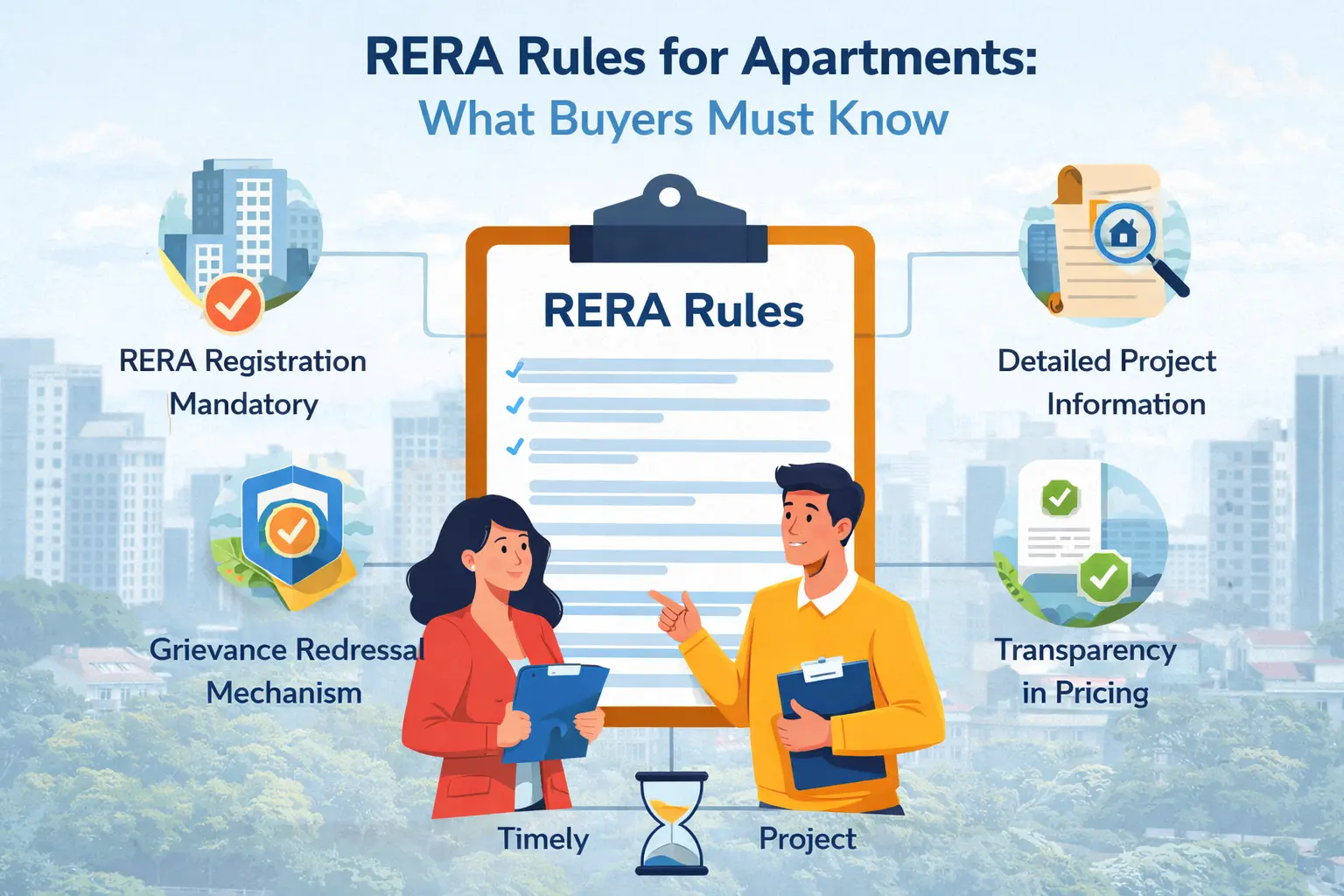
Buying an apartment involves long-term financial commitment and legal responsibility. In the past, buyers faced issues such as project delays, misleading advertisements, hidden charges, poor construction quality, and lack of accountability. To address these challenges, the Government of India introduced the Real Estate Regulatory Authority (RERA) under the Real Estate (Regulation and Development) Act, 2016. RERA establishes a legal framework that protects apartment buyers and ensures fairness, transparency, and accountability in real estate transactions.
1. Objectives of RERA
The main objectives of RERA are:
- Protect the interests of apartment buyers
- Ensure timely completion and delivery of projects
- Prevent misleading advertisements
- Promote transparency in pricing and project details
- Create a fast and specialized dispute resolution mechanism
- Regulate developers and real estate agents
2. Applicability of RERA to Apartment Projects
Projects Covered Under RERA
RERA applies to:
- New residential apartment projects
- Ongoing projects that had not received completion certificate as of May 1, 2017
- Commercial and mixed-use projects (where applicable)
Projects Exempted
- Projects with land area less than 500 sq. meters
- Projects with less than 8 apartments
- Projects with completion certificate obtained before RERA enforcement
States may modify thresholds slightly, but buyer protection principles remain intact.
3. Mandatory Project Registration: Buyer’s First Checkpoint
Before advertising, booking, or selling apartments, builders must:
- Register the project with the State RERA Authority
- Obtain a RERA registration number
- Renew registration if timelines change
Information Available to Buyers
On the RERA portal, buyers can verify:
- Legal title of land
- Approved building plans
- Apartment layout and carpet area
- Construction schedule
- Financial disclosures
- Past project track record of the builder
Marketing or selling without registration is illegal.
4. Truthful Advertising and Marketing Rules
Builders:
- Cannot advertise unregistered projects
- Must ensure all ads match approved plans
- Cannot promise amenities not sanctioned by authorities
Misleading advertisements allow buyers to:
- Cancel booking
- Claim full refund with interest
- Seek compensation
5. Carpet Area Definition: Absolute Pricing Transparency
Under RERA:
- Apartments can be sold only on carpet area
- Carpet area includes internal usable area but excludes:
- External walls
- Balconies (unless specified)
- Common areas like lifts, corridors, clubhouse
This eliminates confusion around:
- Super built-up area
- Loading charges
Buyers now know exactly what they are paying for.
6. Advance Payment and Agreement for Sale
10% Rule
- The builder cannot accept more than 10% of the apartment cost without:
- Signing a written Agreement for Sale
- Registering the agreement
Agreement Must Include
- Possession date
- Carpet area details
- Payment schedule
- Interest rate for defaults (both parties)
- Defect liability clause
- Exit and refund terms
Unfair, one-sided clauses are legally invalid under RERA.
7. 70% Escrow Account Rule: Financial Discipline
Builders must:
- Deposit 70% of all buyer collections into a separate escrow account
- Use funds only for:
- Land cost
- Construction cost of that project
Withdrawal Conditions
- Based on construction progress
- Certified by:
- Engineer
- Architect
- Chartered Accountant
This rule prevents:
- Fund diversion
- Project abandonment
8. Construction Timeline and Possession Guarantees
The completion date declared to RERA is:
- Legally binding
- Enforceable by buyers
Delay Consequences
If possession is delayed:
- Buyer may withdraw and get full refund plus interest.
- OR continue and receive monthly compensation
Interest rates are usually linked to SBI lending rates and vary slightly by state.
9. Five-Year Defect Liability Period
Developers are liable for:
- Structural defects
- Poor workmanship
- Quality issues
- Faulty plumbing, electrical, or waterproofing
Key Points
- Valid for 5 years from possession
- Builder must repair defects within 30 days
- Failure leads to compensation claims
10. Changes in Layout, Plans, or Specifications
Builders:
- Cannot make major changes without 2/3rd buyer consent
- Cannot reduce carpet area beyond permissible limits
- Cannot alter promised amenities arbitrarily
Minor changes require prior disclosure.
11. Rights of Apartment Buyers Under RERA
Buyers have the right to:
- Verified project information
- Transparent pricing
- Timely possession
- Compensation for delays
- Quality construction
- Refund with interest
- Occupancy certificate
- Formation of apartment owners’ association
- Legal remedies through RERA
12. Duties and Obligations of Buyers
Buyers must:
- Pay installments as per agreement
- Pay interest for delayed payments
- Participate in association formation
- Take possession within 2 months of OC
- Follow society rules after possession
13. Regulation of Real Estate Agents
Agents must:
- Be registered with RERA
- Display registration number in ads
- Promote only registered projects
- Maintain transaction records
Unregistered agents face:
- Heavy penalties
- Cancellation of business rights
14. Penalties for Builders Under RERA
Violations can attract:
- Fines up to 10% of project cost
- Additional daily penalties
- Imprisonment up to 3 years
- Project deregistration
15. Grievance Redressal Mechanism
Where to File Complaints
- State RERA Authority
- RERA Appellate Tribunal
Common Complaints
- Delayed possession
- Refund denial
- False promises
- Poor construction
- Agreement violations
RERA ensures time-bound resolution, usually within 60 days.
Conclusion
RERA has fundamentally changed apartment buying in India by shifting power from developers to buyers. Understanding RERA rules helps buyers make safe, transparent, and legally secure investments, minimizing risk and ensuring accountability.
Frequently Asked Questions (FAQs)
Q1. Is RERA registration compulsory for all apartment builders?
Yes, for projects exceeding prescribed size limits and for all ongoing projects without completion certificate.
Q2. Can a builder cancel my allotment under RERA?
Only if the buyer defaults repeatedly as per agreement terms and after following due legal process.
Q3. Is interest payable by buyer and builder equal?
Yes. RERA mandates equal interest rates for both parties.
Q4. Are parking charges regulated under RERA?
Open parking cannot be sold separately. Covered parking rules vary by state.
Q5. Can I sell my apartment before possession?
Yes, subject to agreement terms and RERA rules.
Q6. Does RERA apply to luxury apartments?
Yes. RERA applies equally to affordable, mid-range, and luxury apartments.
Q7. Can I approach consumer court instead of RERA?
Yes. Buyers may choose either forum, but not both simultaneously.
Q8. What documents should buyers preserve?
- Payment receipts
- Agreement for Sale
- Builder communications
- RERA project details
Q9. Does RERA guarantee possession?
RERA does not guarantee success of projects but provides strong legal remedies for buyers.
Q10. Is RERA applicable to plotted developments?
Yes, if plots are part of a registered real estate project.