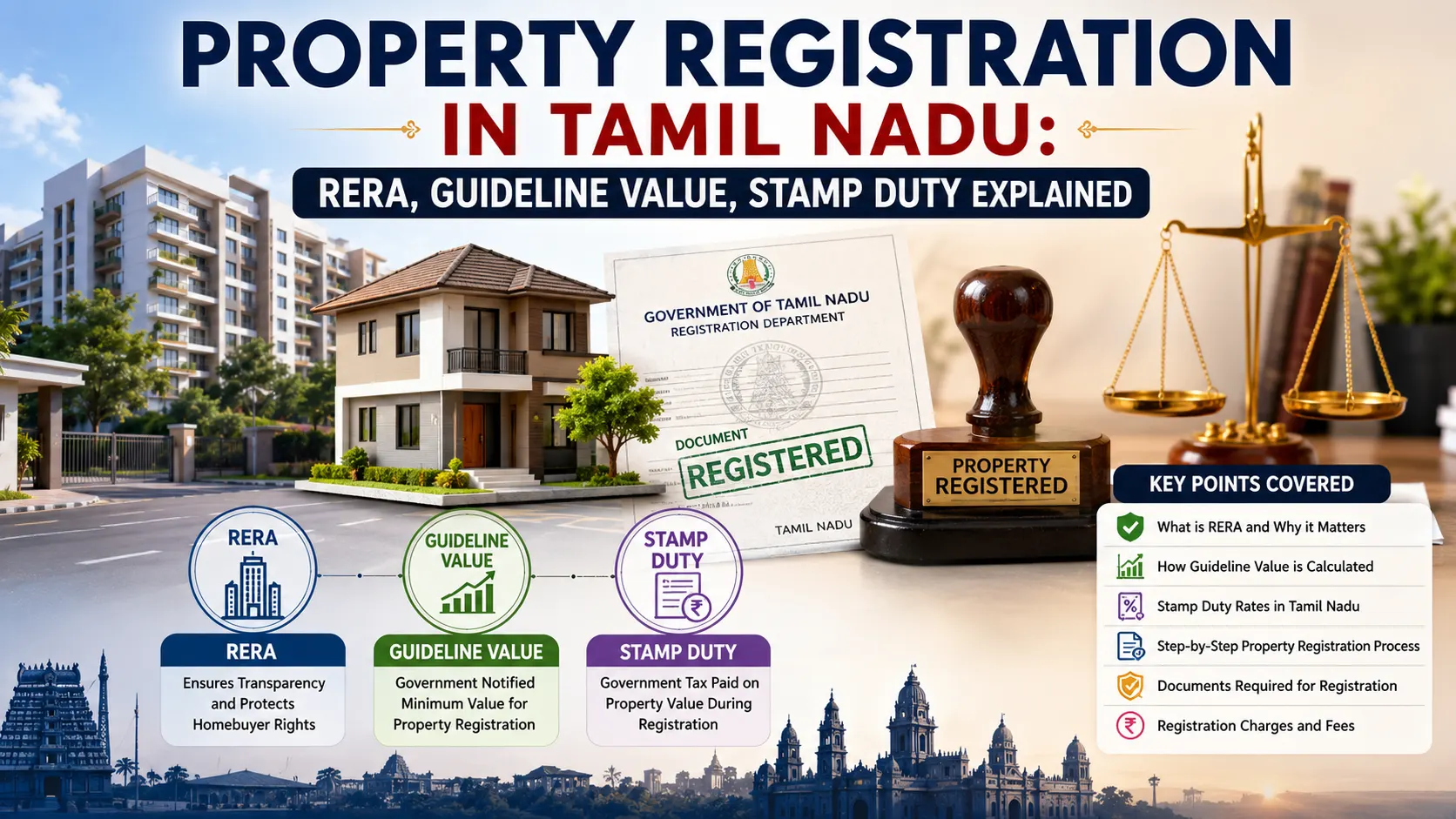
Buying a property is one of the biggest financial decisions in life. However, many homebuyers in Tamil Nadu focus only on the property's selling price and overlook the legal registration process, government charges, and RERA compliance. Understanding these aspects before purchasing a property can help you avoid legal issues, unexpected expenses, and future disputes.
What is Property Registration?
Property registration is the legal process of recording the transfer of ownership from the seller to the buyer through the Registration Department of Tamil Nadu. Once the sale deed is registered at the Sub-Registrar Office (SRO), the buyer becomes the legal owner of the property. Registration also provides legal evidence of ownership and protects the buyer's rights in case of disputes.
Why Property Registration is Important
Property registration offers several important benefits:
- Provides legal ownership of the property.
- Protects buyers from fraudulent transactions.
- Makes it easier to obtain home loans.
- Helps in future resale of the property.
- Required for property mutation, Patta transfer, and tax records.
- Acts as legal proof in courts.
Without registration, ownership rights are incomplete even if full payment has been made.
What is RERA?
The Real Estate (Regulation and Development) Act, 2016 (RERA), was introduced to bring transparency and accountability to India's real estate sector. In Tamil Nadu, it is implemented through Tamil Nadu Real Estate Regulatory Authority (TNRERA). Its primary objective is to protect homebuyers and regulate developers.
Why is RERA Important Before Property Registration?
Before registering a property, always verify whether the project is registered under RERA (where applicable).
A RERA-registered project provides the following:
- Approved project details
- Legal land ownership
- Approved layout plans
- Construction timeline
- Completion schedule
- Complaint redressal mechanism
- Transparency in carpet area
- Protection against misleading advertisements
Buying a RERA-approved property significantly reduces legal risks
What is a guideline value?
Guideline Value (GV) is the minimum value fixed by the Tamil Nadu Registration Department for every street, survey number, or locality.
It is used to calculate:
- Stamp Duty
- Registration Charges
- Government valuation during property registration
The guideline value is not always the same as the market value.
Market Value vs Guideline Value
| Guideline Value | Market Value |
| Fixed by Government | Determined by buyers and sellers |
| Used by registration | Actual selling price |
| May be lower than market price | Changes based on demand |
| Used to calculate stamp duty | Used during negotiation |
For example:
- Market Price = Rs 90 Lakhs
- Guideline Value = Rs 75 Lakhs
Stamp duty is calculated on whichever is higher—the declared sale value or the guideline value. If the sale price exceeds the guideline value, charges are based on the sale price. If the sale price is lower, the guideline value becomes the basis.
Why Guideline Value Matters
Guideline Value helps the following:
- Prevent undervaluation of properties
- Reduce tax evasion
- Standardize registration values
- Calculate government fees
- Estimate property registration costs
How to Check Guideline Value
Before purchasing any property:
- Visit the TNREGINET portal.
- Search using:
- Survey Number
- Street Name
- Village
- District
- View the latest guideline value.
- Compare it with the builder's quoted price.
Always verify the latest value because the government can revise guideline values periodically.
Stamp Duty in Tamil Nadu
Stamp duty is a tax collected by the Tamil Nadu government during property registration.
For a standard property sale:
- Stamp Duty: 7%
- Registration Fee: 4%
These charges are generally calculated on the higher of the sale consideration or the guideline value.
Also Read: Stamp Duty and Registration Charges in Chennai Latest Update
Documents Required for Property Registration
The buyer should keep the following documents ready:
Buyer Documents
- Aadhaar Card
- PAN Card
- Passport Size Photos
- Address Proof
- Sale Agreement
- Payment Receipts
- Home Loan Documents (if applicable)
Seller Documents
- Original Sale Deed
- Parent Documents
- Patta
- Encumbrance Certificate (EC)
- Property Tax Receipts
- Building Approval
- Completion Certificate (if applicable)
- Occupancy Certificate (OC) where required
Property Registration Process in Tamil Nadu
Step 1: Legal Verification
Verify:
- Property ownership
- Parent documents
- EC
- Patta
- Approvals
- RERA Registration
Step 2: Draft the Sale Deed
A legal professional prepares the sale deed mentioning the following:
- Buyer details
- Seller details
- Property description
- Sale consideration
- Boundaries
- Payment details
Step 3: Calculate Registration Charges
Charges are calculated based on:
- Guideline Value
- Sale Value
- Applicable Stamp Duty
- Registration Fee
Step 4: Book Registration Appointment
An appointment is scheduled at the concerned sub-registrar office or through the online registration system, depending on the transaction type and current procedures.
Step 5: Visit the Sub-Registrar Office
Buyer and seller appear together with:
- Original documents
- Identity proofs
- Witnesses
- Payment receipts
Biometric verification, photographs, and signatures are completed.
Step 6: Registration
The sub-registrar verifies the following:
- Ownership
- Identity
- Property details
- Stamp duty payment
After verification, the sale deed is officially registered.
Step 7: Receive Registered Document
The registered document is issued after completion of registration formalities.
Step 8: Patta Transfer
After registration:
- Apply for a Patta transfer.
- Update revenue records.
- Update municipal tax records if required.
Common Mistakes to Avoid
- Buying an unapproved property
- Ignoring RERA registration
- Not checking Encumbrance Certificate
- Skipping legal verification
- Registering below the applicable value
- Ignoring pending loans on the property
- Not verifying Patta
- Not checking building approvals
- Relying only on verbal promises from the seller
Benefits of Buying a RERA Registered Property
- Greater transparency
- Better legal protection
- Timely project completion commitments
- Standardized carpet area disclosures
- Reduced risk of fraud
- Easier dispute resolution
- Improved buyer confidence
Tips Before Registering Property
Verify the seller's ownership.
Check the latestguideline value..
- Ensure all approvals are in place.
- Confirm RERA registration (if applicable).
- Review the Encumbrance Certificate.
- Budget for stamp duty and registration charges.
- Have the documents verified by a qualified property lawyer.
Conclusion
Property registration is more than just paying government fees—it legally secures your ownership. By understanding RERA, Guideline Value, Stamp Duty, and the registration process, buyers can make informed decisions and avoid costly mistakes. Always verify legal documents, compare the property's market value with the official guideline value, and ensure compliance with all applicable regulations before completing the purchase. Keeping yourself informed today can save significant time, money, and legal complications in the future.
Frequently Asked Questions
1. What is property registration?
It is the legal transfer of ownership recorded with the Registration Department.
2. Is RERA mandatory for every property?
RERA registration is mandatory for eligible real estate projects under the Act, though certain categories are exempt.
3. What is a guideline value?
It is the government's minimum value used for calculating registration charges and stamp duty.
4. Is Guideline Value the same as Market Value?
No. Guideline value is fixed by the government, while market value is the actual negotiated selling price.
5. What is the current stamp duty for property registration in Tamil Nadu?
For a standard sale deed, it is generally 7%, subject to government notifications.
6. What is the registration fee in Tamil Nadu?
For a standard sale deed, it is generally 4%, subject to applicable rules.
7. Can I register a property below the Guideline Value?
No. Registration charges are based on the higher of the declared sale value or the applicable guideline value.
8. Which documents are essential before registration?
Sale Deed, Encumbrance Certificate, Patta, identity proofs, tax receipts, approvals, and applicable certificates.
9. Why should I check RERA before buying a property?
It helps verify project legality, approvals, timelines, and buyer protections.
10. Can I transfer Patta after property registration?
Yes. After registration, you can apply for Patta transfer to update the ownership records.