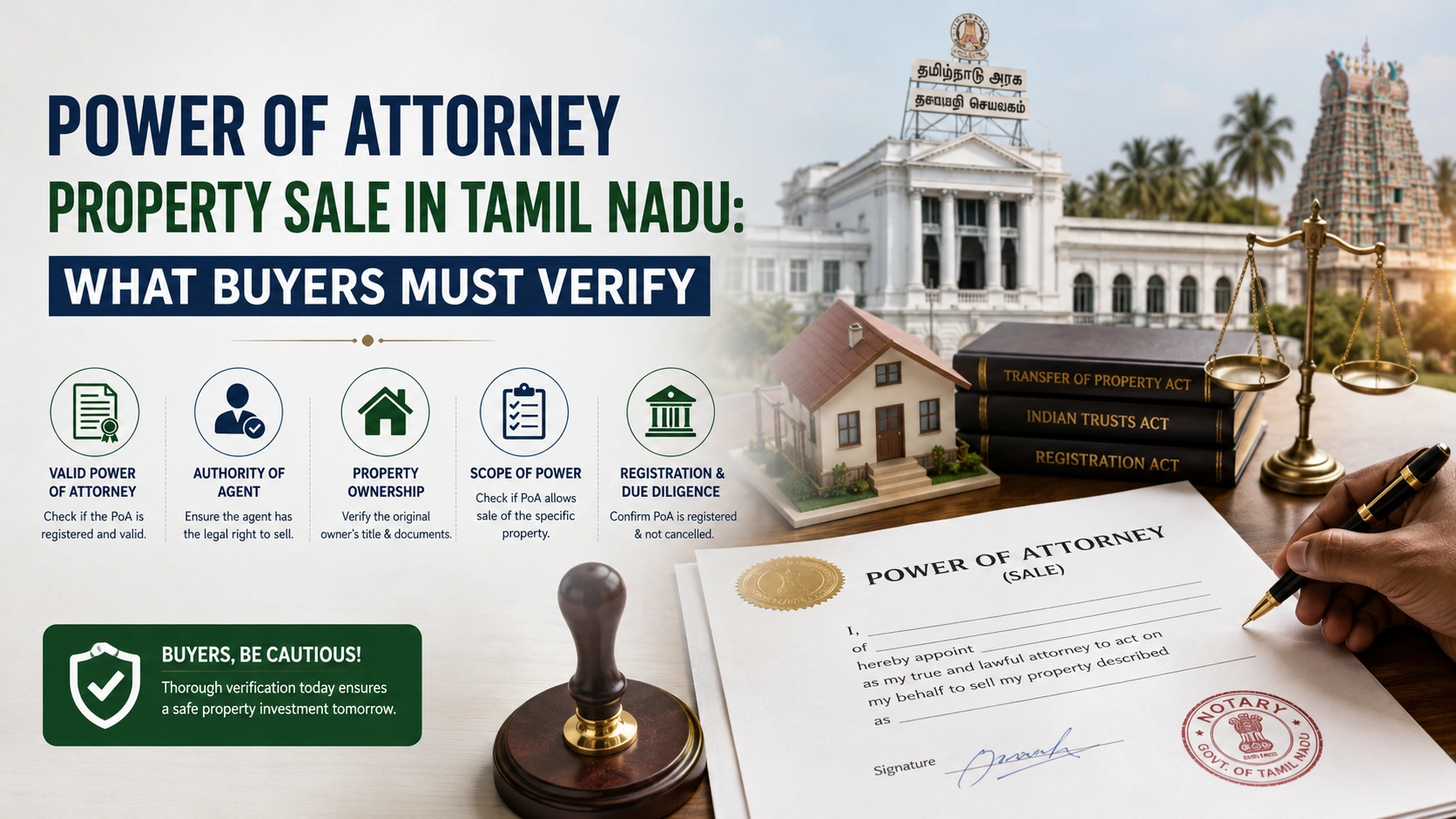
Buying a property in Tamil Nadu through a Power of Attorney (POA) can make the transaction easier when the actual owner is unable to personally attend the sale. This situation is common when property owners live in another city, stay abroad, are elderly, or cannot attend registration in person. However, a POA property transaction needs extra verification. The person standing before the buyer may be the attorney, but the attorney is not automatically the owner. A buyer must establish that the actual property owner has valid title and has given the attorney sufficient legal authority to sell the particular property.
What Does Power of Attorney Mean in a Property Sale?
A power of attorney is a legal document through which one person authorizes another person to act on their behalf. The person giving the authority is generally called the principal, while the person receiving the authority is the attorney or agent.
For example:
- Property Owner → Principal
- Authorized Person → Attorney
- Buyer → Purchaser
The owner may authorize the attorney to perform certain property-related activities, including negotiating a sale and executing documents, depending on the powers specifically granted. The important point for buyers is that the POA gives authority to act; it does not by itself make the attorney the owner of the property.
Why Do Property Owners Use POA?
There are several practical reasons for using a Power of Attorney.
- Owners living outside Tamil Nadu
An owner living in Bengaluru, Mumbai, Delhi, or another state may appoint someone in Tamil Nadu to handle the transaction.
- NRI property owners
An NRI may appoint a trusted person in India to complete certain property-related formalities.
- Elderly property owners
An elderly owner may authorize a family member to handle documentation and registration-related work.
- Multiple properties
Property owners who cannot personally manage every transaction may appoint an authorized representative.
- Business or investment properties
Companies and individuals may use authorized representatives for certain property transactions, subject to the applicable legal requirements.
Is a POA Holder the Owner of the Property?
No.
This is one of the most important things a property buyer should understand. A POA holder generally acts on behalf of the Principal within the authority granted by the document.
Therefore:
- POA ≠ Ownership
A buyer should not purchase a property merely because the seller produces a power of attorney.
The buyer must separately verify:
- Who owns the property?
- How did the owner acquire it?
- Is the title clear?
- Is the POA valid?
- Does the POA authorize the proposed sale?
- Is the property correctly identified?
- Is the sale deed being executed by a properly authorized person?
Can a POA Holder Sell Property in Tamil Nadu?
A POA holder may be able to execute a sale on behalf of the property owner when the authority granted under the POA legally covers the transaction. This means buyers should not simply look for the words "Power of Attorney." They should examine the actual clauses.
The document should be checked for authority relating to activities such as
- Selling the property
- Executing the sale deed
- Presenting the document for registration
- Completing registration formalities
- Receiving sale consideration, if authorized
- Signing related declarations and documents
The precise legal effect depends on the document and circumstances, so an independent property lawyer should examine the POA.
10 Important Checks Before Buying a POA Property
1. Identify the Real Property Owner
Start with the title, not the POA. Find out who is recorded as the owner in the current title document. Then compare the owner's details with the person who executed the Power of Attorney.
Check:
- Full name
- Father's/spouse's name where relevant
- Address
- Identification details
- Property details
Any unexplained difference should be investigated before proceeding.
2. Examine the Complete Title Chain
Do not stop with the latest sale deed. Trace how the property reached the current owner. Depending on the property, the chain may include:
Parent Document → Sale Deed → Settlement/Partition → Current Title → POA → Buyer's Sale Deed
Look for:
- Previous sale deeds
- Settlement deeds
- Gift deeds
- Partition documents
- Release deeds.
- Inheritance documents
- Court orders, where applicable
A missing document in the ownership chain can become a problem during resale or financing.
3. Verify the POA Registration Details
Obtain the original POA and verify its registration particulars where applicable.
Check:
- Document number
- Registration year
- Sub-Registrar Office
- Date of execution
- Principal
- Attorney
- Property description
- Powers granted
- Do not rely solely on a photocopy provided by the seller.
The registration particulars should be independently verified through the appropriate registration records.
Also Read: Legal Checklist Before Buying a Flat in Chennai
4. Check the Exact Powers Granted
This is where many buyers make a mistake. A POA may give someone authority to manage a property without giving them authority to sell it.
For example:
Property management authority may not necessarily mean authority to execute a sale deed. Therefore, read the relevant clauses carefully. The buyer should establish that the attorney has authority for the specific transaction being proposed.
5. Check Whether the POA Has Been Cancelled
A buyer should determine whether the POA is still operative.
Ask whether:
- The principal has revoked it.
- A cancellation deed exists.
- A new POA has been executed.
- The earlier POA has been superseded.
- Any dispute exists between the principal and attorney.
- A seller producing an old POA is not, by itself, enough.
The buyer should establish that the attorney continues to have the required authority.
6. Verify the Principal's Status
This check becomes especially important for older POAs. Confirm the current status of the principal and investigate circumstances that could affect the authority.
For example, if the principal is deceased, the buyer should not simply proceed based on the old POA. The transaction may instead involve succession and legal-heir issues. This is one reason why old POA transactions require particularly careful legal examination.
7. Match the Property Details
The property described in the POA should match the property being sold.
Compare:
| Property Details | What Buyers Should Check |
| Survey Number | Match title documents |
| Sub-Division | Verify carefully |
| Extent | Compare across documents. |
| Boundaries | Check all four sides. |
| Door Number | Verify current details. |
| Flat Number | Match apartment records |
| Undivided Share | Check sale documents. |
| Location | Confirm actual property |
Even a small discrepancy should be investigated rather than ignored.
8. Check the Encumbrance Certificate.
An Encumbrance Certificate (EC) is an important part of property due diligence. Review the EC for relevant registered transactions and encumbrances.
Look for indications of:
- Previous transactions
- Mortgages
- Releases
- Other registered interests
- Attachments, which are reflected in the records
However, a clean EC should not be treated as a complete guarantee that there are no legal issues. The EC should be considered alongside the title documents and other due-diligence checks.
9. Check Revenue and Local Records
Depending on the type of property, buyers should examine relevant records such as
- Patta
- A-Register details
- FMB/sketch, where applicable
- Property tax records
- Local-body records
- Building approvals, where applicable
For flats, also verify:
- UDS
- Approved building plan
- Apartment-related documents
- Association dues
- Maintenance status
The documents should be consistent with the property actually being purchased.
10. Check for Loans and Legal Disputes
Before paying a major advance, investigate whether the property has:
- Existing bank loans
- Mortgage
- Family disputes
- Partition claims
- Court cases
- Ownership disputes
- Boundary disputes
- Pending claims
If the property is mortgaged, obtain appropriate evidence of loan closure/release before completing the purchase.
POA Property Buying Checklist for Chennai Buyers
If you are purchasing a POA property in Chennai or elsewhere in Tamil Nadu, keep this checklist handy:
Ownership
- Current title deed verified
- Parent documents checked
- Ownership chain established
- Property boundaries verified
POA
- Original POA examined
- Registration details verified
- Attorney's identity checked
- Specific sale authority confirmed
- Cancellation/revocation checked
Property
- EC examined
- Patta/revenue records checked
- Property tax verified
- Mortgage checked
- Approvals verified where applicable
- Physical property inspected
Legal
- Litigation check completed
- Legal-heir issues checked
- Independent lawyer's opinion obtained
- Sale deed reviewed before signing
POA Property Sale: Common Red Flags
Buyers should slow down if they encounter any of these situations.
- The attorney refuses to show the original POA.
A buyer should be able to examine the document establishing the attorney's authority.
- The POA does not clearly cover the sale.
If the authority to sell is unclear, obtain professional legal advice before proceeding.
- Property details do not match.
Differences in survey number, extent, or boundaries require investigation.
- The owner cannot be independently verified.
This becomes especially important for high-value transactions.
- The seller asks for large cash payments.
Property consideration should be handled transparently through proper banking channels and documented correctly.
- There are several legal heirs
Inherited property requires careful verification of succession and the rights of all relevant parties.
- The seller says, "POA means ownership."
This is a major misconception. A power of attorney is not, by itself, a substitute for a conveyance of title.
POA Sale vs. Direct Owner Sale
| Factor | Direct Owner sale | POA Sale |
| Person signing | Owner | Authorised attorney |
| Owner's title check | Required | Required |
| POA Verification | Not required | Essential |
| Sale authority | Owner's own authority | Must be established |
| EC verification | Important | Important |
| Title chain verification | Important | Important |
| Legal review | Recommended | Strongly recommended |
The biggest difference is the additional authority check involved in a POA transaction.
How Buyers Can Reduce Risk
A buyer can reduce the risk of a POA property transaction by following a simple sequence:
Step 1: Identify the actual owner.
Step 2: Verify the complete ownership history.
Step 3: Obtain and examine the original POA.
Step 4: Confirm that the POA authorizes the proposed sale.
Step 5: Check whether the authority has been revoked or replaced.
Step 6: Verify the property details across all documents.
Step 7: Check EC, revenue records, tax, mortgage, and litigation issues.
Step 8: Physically inspect the property and confirm possession.
Step 9: Have an independent property lawyer review the documents.
Step 10: Proceed with the properly drafted and registered sale deed only after the legal checks are satisfactory.
Conclusion
A power of attorney property sale in Tamil Nadu is not automatically risky, but it requires more careful verification than a straightforward owner-to-buyer transaction. The most important rule for buyers is Don't verify only the person selling the property. Verify the person who owns it and the legal authority that allows the seller to act for that owner. Before paying a major advance, verify the title chain, original POA, sale authority, revocation status, EC, property records, mortgages, legal disputes, and succession issues. Most importantly, have an independent property lawyer review the documents before completing the transaction. This small step can help prevent much larger legal and financial problems later.
Frequently Asked Questions
1. Can I buy a property from a power of attorney holder in Tamil Nadu?
Yes, a property can be sold through a duly authorized attorney where the legal requirements are satisfied. The buyer should verify both the owner's title and the attorney's authority before purchasing.
2. Does a power of attorney make the holder the owner?
No. A POA generally gives authority to act for the principal. It does not, by itself, transfer ownership of immovable property.
3. What is the first document I should verify?
Start with the current title document and complete parent-document chain, followed by the POA establishing the attorney's authority.
4. Is a registered POA enough to buy a property safely?
No. A registered POA is only one part of the verification process. The buyer should also investigate title, encumbrances, property records, litigation, and the attorney's specific authority.
5. Can an attorney sign the sale deed?
An attorney can execute a sale deed on behalf of the Principal when the POA validly grants the required authority and applicable registration requirements are satisfied.
6. What if the POA is very old?
An old POA should be examined carefully. Verify whether it remains valid, whether it has been revoked or replaced, and whether circumstances affecting the principal have changed.
7. Should I check the EC for a POA property?
Yes. The EC is an important part of the due-diligence process, although it should not be the only verification.
8. Can an NRI sell Tamil Nadu property through POA?
An NRI may appoint an authorized representative subject to applicable legal, execution, stamping, authentication, and registration requirements. The specific POA should be professionally reviewed.
9. What happens if the attorney does not have authority to sell?
The transaction can face serious legal challenges. Buyers should not proceed until the attorney's authority has been properly established.
10. Should I hire a property lawyer before buying a POA property?
Yes. Independent legal verification is particularly valuable because the buyer needs to establish both clear title and valid authority to sell.