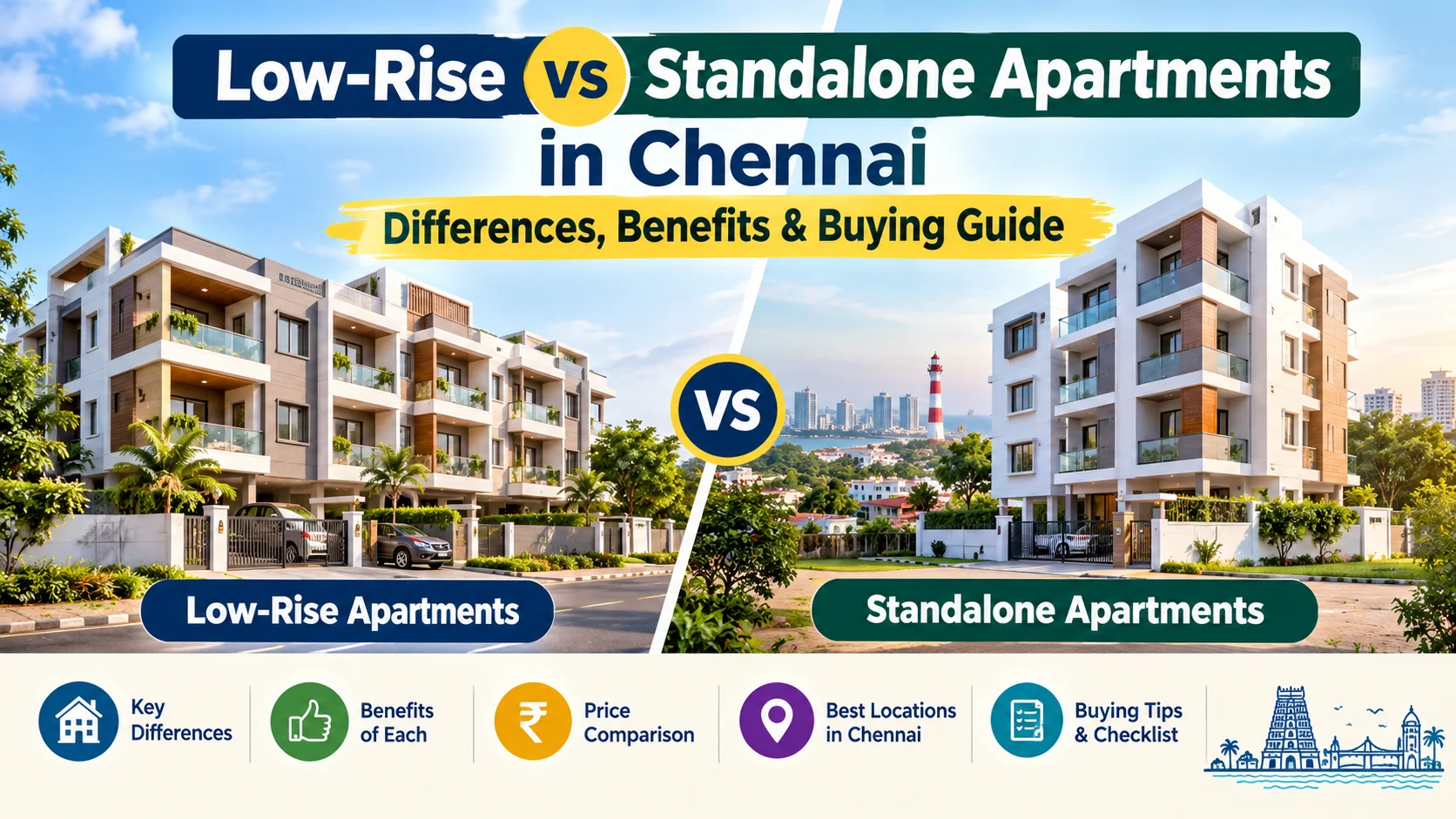
Choosing the right apartment is an important decision for homebuyers in Chennai. With increasing demand for residential properties, many buyers are exploring low-rise apartments and standalone apartments as alternatives to large residential complexes. These properties often appeal to families looking for a comfortable living environment, practical amenities, convenient locations, and manageable maintenance costs. However, the terms "low-rise apartment" and "standalone apartment" do not mean exactly the same thing. A low-rise apartment refers to a building with a relatively small number of floors, while a standalone apartment generally refers to an independent residential building that is not part of a larger apartment complex. A standalone apartment can be low-rise, but the terms are not interchangeable. For buyers searching for flats for sale in Chennai, understanding these differences can help them compare properties, evaluate long-term expenses, and make a more informed purchase. This guide explains low-rise and standalone apartments, their advantages, disadvantages, price considerations, important locations in Chennai, and essential checks to complete before buying a home.
1. What Is a Low-Rise Apartment?
A low-rise apartment is a residential building with a relatively small number of floors. It usually contains a limited number of apartments compared with a large high-rise residential development. Low-rise apartments are commonly found in established residential neighborhoods and developing suburban areas of Chennai. Depending on the project, a building may have two, three, four, or a few additional floors. The exact classification can vary by planning rules and building regulations, so buyers should verify the approved building plans rather than rely only on the marketing description.
Key features of low-rise apartments
- A relatively small number of floors.
- Fewer apartments than many large residential complexes.
- Potentially lower dependence on shared facilities.
- Easier access to homes on lower floors.
- Residential layouts designed for families and individual homeowners.
- Amenities that may include lifts, covered parking, CCTV, power backup, and rooftop facilities, depending on the project.
Benefits of buying a low-rise apartment in Chennai
1. A more manageable residential environment
Low-rise developments may have fewer residents sharing common spaces. This can be attractive to families who prefer a quieter residential setting and a smaller community.
2. Convenient access to your home
Buildings with fewer floors can offer convenient access to lower-floor apartments. However, buyers should check whether a lift is provided, especially when purchasing an apartment on an upper floor or planning for long-term accessibility.
3. Practical living spaces
Many low-rise apartments focus on efficient floor plans, natural light, ventilation, and usable room sizes. Buyers should assess the actual carpet area, room dimensions, window placement, and furniture layout before making a decision.
4. Suitable for established neighborhoods
Low-rise apartments can be found in residential locations with access to schools, hospitals, supermarkets, public transport, and employment centers. Their suitability depends on the specific street and property rather than the building height alone.
5. Potentially manageable maintenance expenses
Some smaller developments have fewer common facilities to maintain than large gated communities. However, maintenance costs depend on the lift, security arrangements, power backup, cleaning, water systems, and other shared services.
2. What Is a Standalone Apartment?
A standalone apartment is a residential building that operates independently rather than as one block within a large residential complex. It may contain a limited number of homes or several apartments across multiple floors. In Chennai, standalone apartments are commonly considered by families looking for homes in established residential streets, smaller developments, and neighborhoods close to everyday services. A standalone apartment can be low-rise or taller, subject to applicable planning and building regulations. Therefore, buyers should distinguish between the building's height and the type of residential development.
Key features of standalone apartments
- An independent residential building.
- A separate entrance and building identity.
- Shared facilities within the building rather than necessarily across a large township.
- Common ownership and maintenance arrangements for shared areas.
- Amenities that vary according to the developer and project.
- Potentially convenient access to surrounding neighborhood facilities.
Benefits of buying a standalone apartment in Chennai
1. Greater choice of neighborhoods
Standalone apartments are available in a range of established and developing areas. Buyers may find options near schools, offices, shopping streets, hospitals, and public transport, depending on their budget and preferred location.
2. Practical layouts for everyday living
Some standalone projects offer spacious living rooms, functional kitchens, balconies, and bedrooms suited to family requirements. Compare the floor plan and usable space rather than relying on the advertised square footage alone.
3. A smaller residential community
A standalone building may have fewer households than a large apartment complex. This can make communication among residents and coordination of common-area maintenance more straightforward, although the actual experience depends on the residents' association and management arrangements.
4. Useful amenities without a large complex
A standalone apartment may provide essential facilities such as a lift, CCTV surveillance, covered car parking, rainwater harvesting, and common power backup. The availability of these features must be verified for each project.
5. Potentially attractive for end-users
Homebuyers who prioritize location, usable space, daily convenience, and essential facilities over extensive recreational amenities may find standalone apartments suitable.
Limitations of standalone apartments
Standalone buildings may have limited open space, visitor parking, recreational facilities, or dedicated maintenance staff. Some may also depend on residents to coordinate repairs and shared expenses. Buyers should check the building's maintenance system, water supply, sewage arrangements, structural condition, common-area ownership, and provision for major repairs.
3. Low-Rise vs Standalone Apartments: Key Differences
The main difference is that "low-rise" describes building height, whereas "standalone" describes the development arrangement.
| Comparison factor | Low-rise apartment | Standalone apartment |
| Meaning | A building with relatively few floors | An independent residential building outside a large apartment complex |
| Building height | Usually limits a height | Can be low-rise or taller |
| Development type | Maybe part of a larger development or an independent building | Generally an independent building |
| Number of homes | Depends on the project | Depends on the building size |
| Amenities | Basic or extensive, depending on the project | Often selected according to project size and budget |
| Maintenance | Depends on shared facilities on the project | Often coordinated within the individual building |
| Privacy | Depends on apartment layout and occupancy | Depends on the number of homes and building design |
| Best suited for | Buyers who prefer a relatively low building | Buyers who prefer an independent residential development |
Important: These categories overlap. A three-story standalone apartment can be both low-rise and standalone. A low-rise block can also be part of a larger gated community. Compare the actual project, approvals, amenities, and maintenance arrangements before choosing.
4. Price Comparison: Low-Rise vs Standalone Apartments in Chennai
The price of an apartment in Chennai depends on its location, land value, construction quality, apartment size, age, amenities, builder reputation, connectivity, and legal status. Neither low-rise nor standalone apartments are automatically cheaper. A smaller standalone building in a premium neighborhood may cost more than a low-rise apartment in a developing suburb. Similarly, a low-rise apartment in a prime location may command a higher price because of land scarcity and demand.
Illustrative price comparison by location
The following figures are broad examples for understanding how budgets can vary. They are not verified October 2026 market quotations or guaranteed current transaction prices. Actual prices should be confirmed against comparable properties in the same locality.
| Chennai location | Apartment price range |
| West Tambaram | Rs 4,500-7,000 per sq ft |
| Madipakkam | Rs 5,500-8,000 per sq ft |
| Poor | Rs 5,500-8,500 per sq ft |
| Velachery | Rs 7,000-11,000 per sq ft |
| Adyar | Rs 10,000-18,000 per sqft |
These indicative ranges are included for preliminary budget planning only. They may not reflect the latest asking prices, completed sale prices, or the premium attached to an individual building. Verify recent comparable listings and actual transactions before using them to make a purchase decision.
Example: Comparing the purchase budget
Suppose you are comparing two apartments of 1,000 sq. ft. in the same neighborhood.
- Apartment A costs Rs 6,000 per sq. ft., giving a base price of Rs 60 lakh.
- Apartment B costs Rs 6,800 per sq. ft., giving a base price of Rs 68 lakh.
The difference in the base price is Rs 8 lakh. However, Apartment B may have a better layout, covered parking, a lift, improved construction quality, or a more convenient location. Apartment A may offer better value if its condition, approvals, and facilities meet your needs. Before comparing the final cost, account for registration and stamp duty, parking charges where applicable, maintenance deposits, interior work, utility connections, and other charges specified in the sale agreement.
5. Which Chennai Locations Should Buyers Consider?
The right locality depends on your workplace, family needs, preferred budget, commute, and long-term plans. The following areas can be included in your property search, but prices and availability vary by street and project.
- West Tambaram
West Tambaram may suit buyers seeking residential options with access to schools, shops, public transport, and railway connectivity in the wider Tambaram area. Compare the distance from the property to the station, main roads, and essential services.
- Madipakkam
Madipakkam attracts buyers who want access to residential neighbourhoods, schools, supermarkets, and important connecting roads in south Chennai. Check local traffic conditions, street-level drainage, water supply, and the actual commuting distance to work.
- Porur
Porur may be worth considering for buyers who need access to employment areas, educational institutions, hospitals, and major roads. Compare traffic during peak hours and verify how easily you can reach your regular destinations.
- Velachery
Velachery offers established residential infrastructure, shopping facilities, and access to important parts of south Chennai. Buyers should compare property age, road access, parking, drainage, and the travel time to nearby employment centres.
- Adyar
Adyar may appeal to buyers prioritising established neighbourhoods, educational institutions, shopping facilities, and access to central and south Chennai. Property prices can vary significantly depending on the street, land value, building age, and apartment specifications.
How to choose the right location
Before finalising an apartment, check:
- Distance to your workplace and daily destinations.
- Availability of public transport and major roads.
- Nearby schools, hospitals, shops, and supermarkets.
- Water supply, drainage, and monsoon flood exposure.
- Street width, access roads, and parking conditions.
- Current property prices and resale demand in the immediate neighbourhood.
6. Which Is Better for First-Time Homebuyers?
Both options can suit first-time buyers, depending on their financial situation and lifestyle. A low-rise apartment may be suitable if you prefer fewer floors, practical access, and a residential environment without the scale of a high-rise complex. A standalone apartment may be suitable if you value an independent building, a specific neighbourhood, and essential amenities. However, first-time buyers should not choose based only on the building category. A legally compliant apartment with sound construction, a suitable location, reliable water supply, and a manageable total cost is generally a better choice than a cheaper property with unresolved problems.
Factors first-time buyers should prioritise
- Total budget: Include the down payment, home loan, registration expenses, interiors, and recurring maintenance.
- Usable space: Check the carpet area and actual room dimensions.
- Construction quality: Inspect waterproofing, plumbing, electrical systems, cracks, and common areas.
- Legal documentation: Verify ownership, applicable planning approvals, building permits, and other required documents.
- Daily convenience: Assess transport, shops, schools, hospitals, and commute times.
- Future resale: Consider neighbourhood demand, property condition, access, and documentation.
- Recurring expenses: Confirm maintenance charges, lift servicing, power backup, and shared repair responsibilities.
7. Construction Quality and Amenities: What Should You Inspect?
Two apartments with similar prices can differ considerably in quality and long-term upkeep. An inspection helps buyers understand what they are paying for.
- Structural condition
Look for visible cracks, damp patches, water seepage, uneven floors, and signs of poor finishing. For an older property, consider an independent technical inspection.
- Water supply and drainage
Ask about the source of drinking and domestic water, storage capacity, borewell dependence, municipal connections where available, sewage arrangements, and maintenance responsibilities.
- Lift and power backup
If the building has a lift, ask about maintenance contracts and servicing. Confirm exactly which common facilities and apartment services receive power backup.
- Parking
Verify the parking space allocated to the apartment, its dimensions, access, and legal status. Do not assume that a parking area shown during a visit is automatically part of the sale.
- Ventilation and natural light
Check the direction of windows, cross-ventilation, sunlight, privacy, and the distance from neighbouring buildings.
- Security and common areas
Review entrance security, CCTV coverage, lighting, staircases, fire-safety provisions, and emergency access as applicable to the building.
- Maintenance arrangements
Ask who manages common areas, how maintenance charges are calculated, whether a residents' association exists, and how major repair costs are shared.
8. Home Loan and Additional Costs
The advertised apartment price is not the same as the total cost of homeownership. Buyers should calculate the complete amount required before committing to a purchase.
Potential expenses include:
- Down payment and home-loan processing charges.
- Stamp duty and registration fees applicable in Tamil Nadu.
- Legal verification and technical inspection fees.
- Interior design, wardrobes, kitchen fittings, and other modifications.
- Maintenance deposits and monthly common-area charges.
- Property tax and applicable utility expenses.
- Repairs or upgrades required in an older building.
Home-loan eligibility depends on factors such as income, existing obligations, credit history, loan tenure, and the lender's assessment of the property. Obtain a written estimate of the loan amount, interest rate, monthly EMI, and associated charges before finalising your budget. Do not rely only on a builder's estimate of affordability. Leave sufficient funds for emergencies and ongoing household expenses.
9. Investment Potential: Low-Rise vs Standalone Apartments
Both types of apartments can provide long-term value, but appreciation and rental returns are not guaranteed by the building category. The most important factors include location, purchase price, land value, construction quality, demand from tenants and buyers, road access, local infrastructure, and the condition of the property.
Factors that may support long-term value:
- Established residential demand.
- Access to employment centres and transport.
- Reliable water supply and civic infrastructure.
- A well-maintained building with clear documentation.
- A practical apartment layout and usable floor area.
- Competitive purchase pricing compared with similar properties.
10. Step-by-Step Buying Guide
Follow these steps to make the apartment selection process easier.
Step 1: Define your requirements. Decide the number of bedrooms, preferred floor, minimum usable area, parking needs, and essential amenities.
Step 2: Set a realistic budget. Include the purchase price, transaction costs, interiors, loan expenses, and maintenance.
Step 3: Shortlist suitable locations. Choose neighbourhoods based on commute, family needs, transport, and everyday convenience.
Step 4: Compare similar properties. Compare apartments in the same locality with similar ages, areas, specifications, and amenities.
Step 5: Visit the property. Inspect the apartment, common areas, surrounding roads, water supply, parking, and nearby facilities.
Step 6: Verify legal and technical details. Have the relevant title, approvals, sale documents, and building condition checked by qualified professionals.
Step 7: Review the complete cost. Ask for a written breakdown of the price and additional charges.
Step 8: Finalise the agreement carefully. Ensure that the agreed specifications, payment terms, possession date, and other obligations are documented before signing.
Conclusion
Low-rise and standalone apartments are both worth considering for buyers searching for flats for sale in Chennai. The key difference is that low-rise describes a building's height, while standalone describes its position as an independent residential development. Low-rise apartments may appeal to buyers who prefer a relatively small building, while standalone apartments may attract those who value an independent residential setting and essential facilities. Since these categories can overlap, the final decision should depend on the property's location, construction quality, legal status, price, layout, and maintenance arrangements. Before buying, compare similar properties, inspect the building carefully, verify the documents, and calculate the total cost of ownership. Choosing a property that suits both your present needs and long-term finances can help you make a more confident home-buying decision in Chennai.
FAQs
1. What is the difference between a low-rise and a standalone apartment?
A low-rise apartment is defined by its relatively small number of floors. A standalone apartment is an independent residential building rather than a block within a larger residential complex. A standalone apartment can also be low-rise.
2. Are standalone apartments cheaper than gated community apartments in Chennai?
Not always. Prices depend on location, land value, construction quality, apartment size, amenities, and demand. Compare similar properties in the same neighbourhood to determine which offers better value.
3. Are low-rise apartments suitable for families?
Yes. They can be suitable for families looking for practical layouts, convenient access, and a smaller residential setting. Buyers should check safety provisions, lift availability, water supply, parking, and maintenance.
4. Which areas in Chennai should I consider for low-rise apartments?
Areas such as West Tambaram, Madipakkam, Porur, and Velachery can be included in a property search. The best option depends on your budget, workplace, transport requirements, and the specific property.
5. Do standalone apartments have lifts and covered parking?
Some do, while others may not. Check the approved building plan, actual facilities, parking allocation, and maintenance arrangements before purchasing.
6. What documents should I verify before buying an apartment in Chennai?
Review the title documents, Encumbrance Certificate, approved building plan, applicable completion or occupancy records, UDS details, tax records, sale agreement, and RERA registration where applicable. Seek professional legal advice.
7. Are low-rise apartments a good investment?
They can be, depending on the purchase price, location, construction quality, rental demand, and resale potential. Returns are not guaranteed, so compare realistic rental income and ownership costs before investing.
8. What is the most important factor when choosing between low-rise and standalone apartments?
The most important factors are legal compliance, construction quality, location, total cost, usable space, and suitability for your family's needs. The category alone does not determine whether a property is a good purchase.