Buying a property is one of the biggest financial decisions for most people. While savings can cover part of the purchase, many buyers depend on loans to finance a house, flat, or builder floor apartment. Two loan options that people may come across are home loans and personal loans. However, they are very different in terms of interest rates, loan tenure, EMI, security, eligibility, documentation, and overall repayment cost.
What Is a Home Loan?
A home loan is a secured loan specifically designed for housing-related requirements. Depending on the lender and product, it may be available for purchasing a ready-to-move property, an under-construction home, or for constructing a residential property. The property generally serves as security for the loan. The lender assesses both the borrower's financial profile and the property's legal and technical details before approving the loan.
Common Uses of a Home Loan
A home loan may be used for:
- Buying a flat or apartment
- Purchasing a builder floor apartment
- Buying a house
- Purchasing certain residential properties
- Constructing a house
- Other eligible housing-related purposes offered by the lender
Because home loans are specifically designed for property financing, they generally offer longer repayment periods than personal loans.
What Is a Personal Loan?
A personal loan is generally an unsecured loan, meaning the borrower normally does not provide the property as collateral. The borrower can use the funds for eligible personal requirements according to the lender's terms. Personal loans are usually assessed primarily based on factors such as income, credit history, existing liabilities, and repayment capacity. Unlike a home loan, a personal loan is not specifically structured around the purchase of a property. Before using a personal loan for any property-related expense, buyers should check the lender's permitted-use conditions.
Home Loan vs Personal Loan: Major Differences
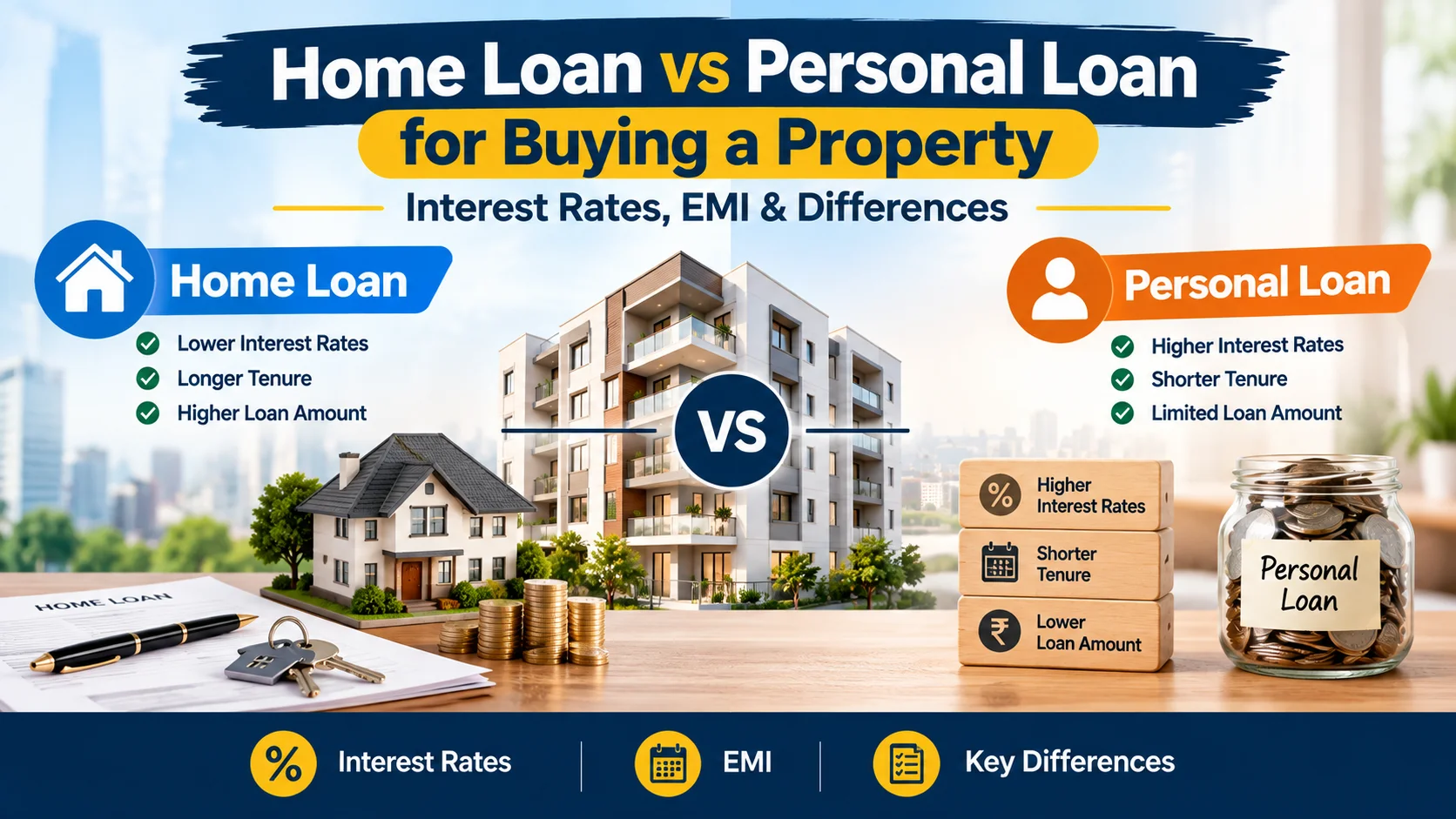
The biggest difference between these two loans is their purpose and structure.
| Feature | Home Loan | Personal Loan |
| Primary purpose | Housing/property financing | Eligible personal expenses |
| Security | Generally secured by property | Generally unsecured |
| Interest rate | Usually lower | Usually higher |
| Repayment period | Usually longer | Usually shorter |
| Loan amount | Generally suitable for larger property purchases | Usually suited to smaller borrowing requirements |
| Property verification | Usually required | Generally not required as collateral |
| Documentation | Property and income documents | Primarily borrower/income documents |
| EMI | Can be lower because of longer tenure | Can be higher due to shorter tenure |
| Down payment | Generally required for property purchase | Not structured as a property fown payment |
| Tax treatment | Specific housing loan provisions may apply | Depends on the purpose and applicable tax provisions |
Home Loan Interest Rate vs. Personal Loan Interest Rate
Interest rate is one of the most important factors when comparing loans. A home loan is generally offered at a lower interest rate than a personal loan because the home loan is secured against the property and has a housing-specific structure. Personal loans generally have higher rates because they are unsecured. However, borrowers should not compare only the advertised starting rate. The actual rate offered may depend on:
- Credit profile
- Income
- Employment or business profile
- Existing loans
- Loan amount
- Tenure
- Property details
- Lender's policies
How EMI Differs Between a Home Loan and Personal Loan
EMI stands for Equated Monthly Instalment. It is the amount paid by the borrower every month towards the loan.
The EMI depends mainly on:
Loan Amount + Interest Rate + Loan Tenure
For the same loan amount, a lower interest rate and longer tenure can generally result in a lower monthly EMI.
Why Loan Tenure Matters
Loan tenure is the period over which you repay the borrowed amount. Home loans generally allow longer repayment periods, which can make large borrowing amounts easier to manage through monthly EMIs. A longer tenure can reduce your monthly EMI, but it can also increase the total interest paid over the entire loan period.
- Higher EMI with a shorter tenure
- Lower EMI with a longer tenure
The second option may improve monthly cash flow, but the borrower could pay interest for a longer period.
Down Payment When Buying a Property
A home buyer generally needs to contribute some amount from their own funds because a lender may not finance the entire property value.
For example:
- Property price: Rs 80 lakh
- Buyer contribution: Rs 20 lakh
- Loan requirement: Rs 60 lakh
The actual eligible loan amount depends on the lender, property value, applicable loan-to-value requirements, and the borrower's eligibility.
Buyers should also budget separately for expenses such as
- Stamp duty
- Registration charges
- Documentation costs
- Legal expenses
- Interior work
- Moving expenses
- Other applicable property-related costs
A buyer should avoid planning the entire property budget around the sanctioned loan amount alone.
Eligibility for a Home Loan
Home-loan eligibility is generally assessed using both the borrower's financial profile and the property details.
Lenders may consider:
- Age
- Monthly income
- Employment or business stability
- Credit history
- Existing EMIs
- Loan repayment history
- Property value
- Property documentation
- Loan tenure
- Overall repayment capacity
A buyer with existing loans may have a lower borrowing capacity because existing EMIs are considered when assessing repayment ability.
Eligibility for a Personal Loan
Personal-loan eligibility is generally based on the borrower's financial profile rather than the value of a property being purchased.
Factors can include:
- Monthly income
- Credit history
- Employment status
- Existing financial obligations
- Banking history
- Age
- Repayment capacity
Since there is generally no property collateral, the lender relies heavily on the borrower's financial profile.
Documentation: Home Loan vs. Personal Loan
A home loan normally involves more documentation because the lender needs to assess the property as well as the borrower.
Home Loan Documents May Include
Personal documents
- PAN
- Aadhaar or other accepted identity proof
- Address proof
- Photographs
Income documents
- Salary slips
- Bank statements
- Form 16
- Income-tax documents where applicable
Property documents
- Sale agreement
- Title-related documents
- Approved building plan
- Previous ownership documents
- Property tax records
- Other documents requested by the lender
Personal Loan Documents
The lender may primarily request:
- Identity proof
- Address proof
- Income proof
- Bank statements
- Employment/business documents
- Other financial documents
The exact requirements differ between lenders.
Property Verification in a Home Loan
One important difference is property verification. Before approving or disbursing a home loan, the lender may conduct legal and technical checks on the property.
This can include checking:
- Ownership documents
- Title history
- Building approvals
- Property layout
- Construction status
- Property valuation
- Applicable regulatory approvals
For buyers, this process can also highlight the importance of purchasing a property with proper documentation.
Home Loan Tax Benefits
Eligible home-loan borrowers may receive certain tax benefits under applicable Indian income-tax provisions.
Depending on the circumstances, tax provisions can relate to:
- Principal repayment
- Interest repayment
- Self-occupied property
- Let-out property
- Certain eligible housing-loan situations
The actual tax benefit depends on the relevant financial year, property status, loan conditions, and the tax regime applicable to the taxpayer. Therefore, buyers should check the latest tax provisions or consult a qualified tax professional instead of assuming that every property loan automatically provides the same deduction.
Can a Personal Loan Replace a Home Loan?
A personal loan and a home loan serve different purposes. A personal loan may provide quicker access to funds in some situations, but it generally comes with a higher interest rate and shorter repayment period. For a large property purchase, these factors can substantially increase the monthly repayment burden. A buyer considering a personal loan for a property-related requirement should therefore evaluate:
- Permitted use of the loan
- Interest rate
- Maximum loan amount
- EMI
- Tenure
- Processing fee
- Total interest
- Existing financial commitments
Advantages of Choosing a Home Loan
Lower Interest Cost Potential
Home loans generally carry lower interest rates than unsecured personal loans.
Longer Repayment Period
A longer tenure can help spread repayment over a larger period.
Higher Property-Financing Capacity
Home loans are designed specifically for housing purchases and can support larger borrowing requirements, subject to eligibility.
Property-Based Financing
The loan is directly connected to the residential property being purchased.
Potential Tax Benefits
Eligible borrowers may receive tax benefits under applicable provisions.
Advantages of a Personal Loan
No Property Collateral
A standard personal loan is generally unsecured.
Simpler Structure
There is usually no property valuation or title verification as collateral.
Flexible Use
The funds can be used for eligible personal purposes according to the lender's terms.
Useful for Smaller Financial Requirements
Personal loans may be considered where the borrowing requirement is relatively small and the borrower can comfortably manage the repayment.
Disadvantages of Home Loans
Although home loans can be suitable for property financing, buyers should also consider their responsibilities.
- Extensive documentation
- Property legal verification
- Technical valuation
- Down payment requirement
- Long-term financial commitment
- Interest payable over the repayment period
- Property serves as security for the loan
Disadvantages of Personal Loans
Personal loans can become expensive when used for large borrowing requirements.
- Higher interest rate
- Shorter tenure
- Higher EMI
- Usually lower borrowing capacity
- Potentially higher total repayment cost
- Additional debt can affect future loan eligibility.
Conclusion
Choosing between a home loan and personal loan for buying a property requires more than comparing interest rates. A home loan is specifically designed for residential property financing and generally provides a longer repayment period with comparatively lower interest rates. A personal loan is generally unsecured and may offer more flexibility, but its higher interest rate and shorter tenure can make large borrowing more expensive.mBefore purchasing a flat, apartment or builder floor, calculate your down payment, EMI, total interest, loan tenure, additional property expenses and existing financial commitments. The best loan structure is one that fits your property budget and allows you to manage repayments comfortably over the entire loan period.
Frequently Asked Questions
1. What is the main difference between a home loan and personal loan?
A home loan is specifically designed for housing-related financing and is generally secured against the property. A personal loan is usually unsecured and can be used for eligible personal requirements.
2. Is a home loan interest rate lower than a personal loan?
Generally, yes. Home loans are secured loans and typically have lower interest rates than unsecured personal loans. The actual rate depends on the lender and borrower profile.
3. Which loan has a lower EMI?
For the same borrowing amount, a home loan can generally have a lower EMI because of its lower interest rate and longer repayment tenure.
4. Can I buy a flat using a personal loan?
A personal loan is not specifically designed as a housing loan. Whether it can be used for a particular property-related expense depends on the lender's terms and permitted purpose.
5. Is a down payment required for a home loan?
Generally, yes. Buyers usually need to contribute part of the property purchase cost from their own funds.
6. Can I get a home loan for a builder floor apartment?
Potentially, yes, subject to the lender's eligibility criteria and verification of the specific property's legal, technical and approval documents.
7. Does a personal loan require property documents?
A standard personal loan is generally unsecured, so property documents are normally not required as collateral. The lender will instead assess the borrower's financial profile.
8. Does a home loan provide tax benefits?
Eligible home-loan borrowers may receive certain tax benefits under applicable income-tax provisions. The actual benefit depends on the borrower's circumstances and current tax rules.
9. Is a longer home-loan tenure better?
A longer tenure can reduce the monthly EMI but may increase the total interest paid. Borrowers should compare both monthly affordability and total repayment cost.
10. What should I check before taking a home loan?
Compare the interest rate, EMI, tenure, total interest, processing fees, prepayment conditions, late-payment charges, loan-to-value and property eligibility.