Buying a home and constructing a house are two different financial commitments. While a home loan is generally used to purchase a ready-to-move-in or under-construction property, a home construction loan is designed for individuals who already own a residential plot and want to build a house on it. Understanding the difference between these two loans is important before applying, because the loan purpose, documentation, disbursement method, EMI structure, and approval requirements can differ.
What Is a Home Loan?
A home loan is a loan provided by a bank or housing finance company to help an individual purchase a residential property.
Depending on the lender and product, a home loan may be used for:
- Buying a ready-to-move-in flat
- Purchasing an under-construction apartment
- Buying an independent house
- Purchasing a residential property from an eligible seller or developer
- Certain home-related purposes permitted under the lender's policy
What Is a Home Construction Loan?
A home construction loan is intended for people who want to construct a residential house on a plot they own.
Instead of financing the purchase of an already-built property, the loan helps fund construction expenses such as
- Foundation work
- Structural construction
- Brickwork
- Roofing
- Flooring
- Electrical work
- Plumbing
- Doors and windows
- Other eligible construction activities
The lender generally evaluates the plot, approved building plan, construction estimate, applicant's income, and repayment capacity before approving the loan.
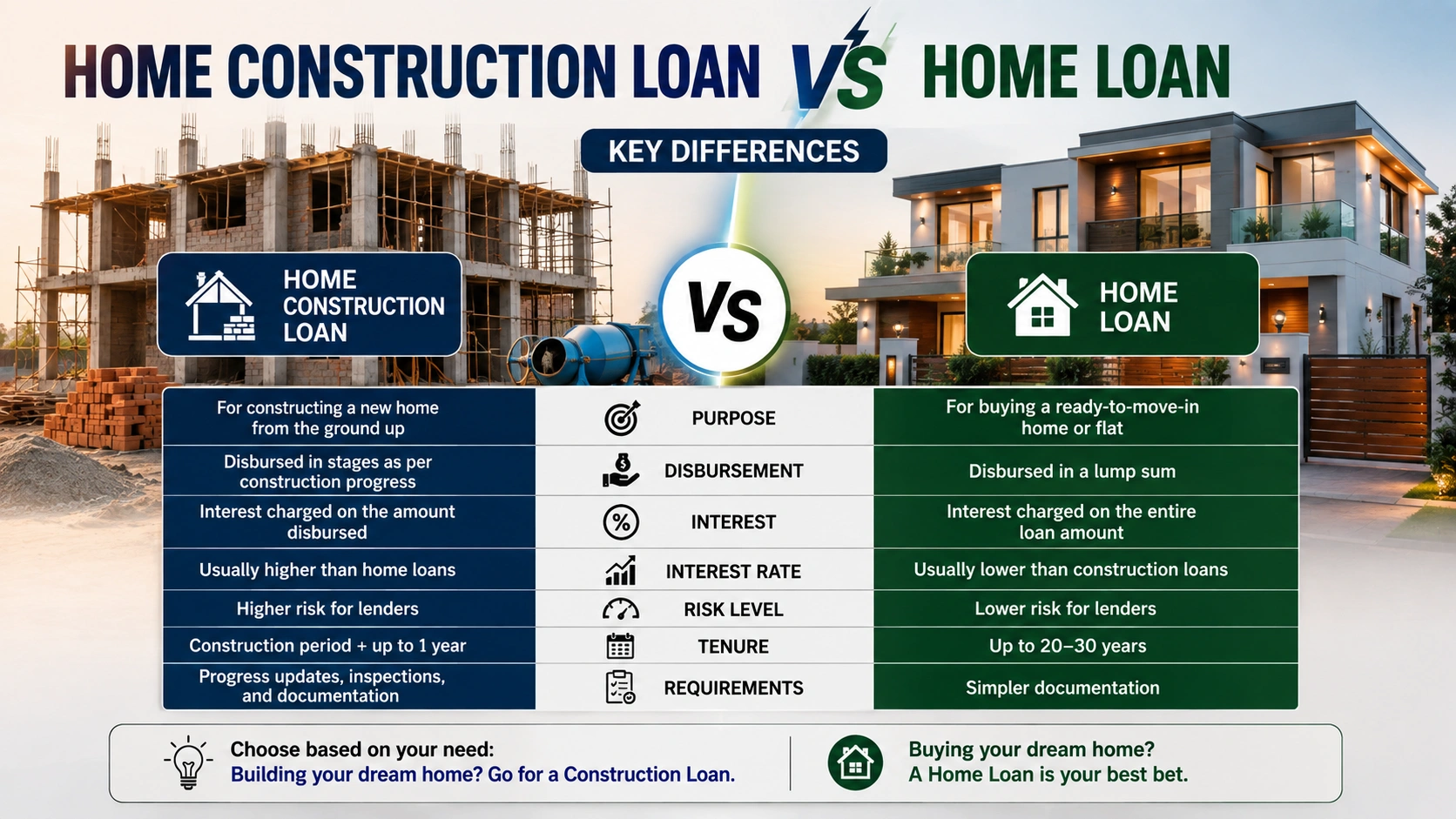
Home Construction Loan vs Home Loan: Key Differences
The biggest difference is the purpose of borrowing.
| Features | Home Loan | Home Construction Loan |
| Main purpose | Purchase a residential property. | Construct a house on owned land. |
| Property Status | Ready or under construction property | Residential plot + proposed house |
| Land ownership | Depends on transaction | Generally required |
| Building plan | Generally not the primary document for purchase | Important for construction approval |
| Construction estimate | Usually not applicable | Important |
| Site inspection | May be required | Often relevant |
| EMI |
Based on the amount disbursed and loan terms |
Can change as construction amounts are disbursed |
| Documentation | Income + property documents | Income + land + building/construction documents |
| Best suited for | Property buyers | Plot owners planning construction |
Home Loan vs Construction Loan: Which Is Better?
There is no single answer because the right loan depends on your objective.
Choose a home loan if:
- You are purchasing a flat.
- You are buying a ready-to-move-in house.
- You are purchasing an eligible under-construction property.
- You want financing linked to a property purchase.
Consider a construction loan if:
- You already own a residential plot.
- You want to build your own house.
- You have an approved building plan.
- You have a construction cost estimate.
- You can meet the lender's eligibility and documentation requirements.
In simple terms:
- Buying a house = Home Loan
- Building a house on your own plot = Home Construction Loan
Best Homeloan Service in Chennai
Home Construction Loan Interest Rates in 2026
Interest rates are one of the most important factors to consider before taking a loan.
The actual rate offered to a borrower can vary based on factors such as:
- Lender
- Credit score
- Monthly income
- Employment/business profile
- Existing financial commitments
- Loan amount
- Loan tenure
- Property characteristics
- Internal lender policies
- Type of interest rate
Therefore, borrowers should not assume that every bank will offer the same rate.
- Floating vs. Fixed Interest Rate
Most borrowers compare floating-rate loans with fixed-rate options.
- Floating Interest Rate
The interest rate can change during the loan tenure depending on the benchmark and lender's applicable spread.
Advantages:
- Potential benefit when rates decline
- Often preferred for long-term borrowing
Disadvantages:
- EMI, or tenure, may change when rates rise.
- Fixed Interest Rate
The rate remains fixed for the applicable fixed-rate period according to the loan agreement.
Advantages:
- Better predictability
- Easier financial planning
Disadvantages:
- You may not automatically benefit from future rate reductions.
Always check the lender's current terms before choosing between fixed and floating rates.
Home Construction Loan Eligibility
Eligibility criteria differ from one lender to another, but lenders generally consider several factors.
1. Age
The applicant must fall within the lender's permitted age range at the time of application and usually at loan maturity.
2. Income
Your income is important because lenders need to determine whether you can comfortably repay the loan.
3. Credit History
A strong credit profile can improve the chances of approval and may help you obtain more favorable loan terms.
4. Employment or Business Stability
Salaried and self-employed applicants may be assessed differently, but lenders generally look for stable and verifiable income.
5. Existing Loans
Your current EMIs, credit card obligations, and other financial commitments can affect your borrowing capacity.
6. Plot Ownership
For a construction loan, ownership and legal status of the plot are particularly important.
7. Construction Approval
The lender may require an approved building plan and other permissions applicable to the property.
Home Loan Eligibility
For a home purchase loan, lenders generally evaluate:
- Applicant's age
- Income
- Employment/business stability
- Credit history
- Existing debts
- Property value
- Loan-to-value considerations
- Repayment capacity
- Property documentation
A borrower with a stable income and strong credit profile may have better access to suitable loan terms, subject to the lender's assessment.
Documents Required for a Home Loan
Typical documents may include:
Identity and Address Proof
- PAN
- Aadhaar or other accepted identity proof
- Address proof
- Passport-size photographs, where required
Income Documents for Salaried Applicants
- Salary slips
- Bank statements
- Form 16 or applicable income tax documents
Self-Employed Applicants
- Income tax returns
- Business financial statements
- Bank statements
- Business-related documents
Property Documents
Depending on the transaction:
- Sale agreement
- Title documents
- Previous ownership documents
- Approved plan, where applicable
- Property tax receipts
- Relevant approval documents
The exact list varies by lender and property type.
Documents Required for a Home Construction Loan
A construction loan usually involves additional property and construction-related documents.
These may include:
- Plot title documents
- Sale deed
- Encumbrance-related documents, where applicable
- Patta/revenue records where applicable
- Approved building plan
- Planning/building approval documents
- Construction estimate
- Site-related documents
- Property tax records where applicable
- Applicant's income documents
- Bank statements
- Identity and address proof
For properties in Tamil Nadu, buyers should pay particular attention to title, planning approval, land-use status, and applicable local authority permissions.
How Does Home Construction Loan Disbursement Work?
One of the major differences between a conventional property purchase loan and a construction loan is the disbursement process. A construction loan is generally not released entirely at once. Instead, the lender may release money in stages according to the progress of construction.
Typical Construction Stages
Stage 1 – Foundation
Initial construction begins after the necessary conditions are satisfied.
Stage 2 – Structure
The lender may release another portion after verifying construction progress.
Stage 3 – Roofing
Further funds may be released after the relevant stage is completed.
Stage 4 – Finishing
Additional amounts may be released for eligible finishing work. The exact number of stages and percentages vary by lender.
How Does a Home Loan Disbursement Work?
- For a ready property, the loan amount may be disbursed according to the sale agreement and lender's approval process.
- For an under-construction apartment, the loan can be disbursed progressively based on the project's construction stages and payment schedule.
This means the borrower may not receive the entire sanctioned amount immediately.
Home Construction Loan EMI
EMI stands for Equated Monthly Instalment.
Your EMI generally depends on:
- Principal amount
- Interest rate
- Loan tenure
A longer tenure generally reduces the monthly EMI but can increase the total interest paid over the life of the loan.
Why Construction Loan EMI Can Be Different
Construction loans are often disbursed in stages.
For example:
- First disbursement: Rs 8 lakh
- Second disbursement: Rs 7 lakh
- Third disbursement: Rs 10 lakh
- Final disbursement: Rs 5 lakh
Interest/repayment treatment during construction depends on the lender's product structure. Some lenders may offer an interest-only or pre-EMI arrangement during the construction period.
What Is Pre-EMI?
Pre-EMI generally refers to payment of interest on the amount actually disbursed before the full loan becomes repayable through regular EMI, subject to the lender's terms.
Borrowers should carefully understand:
- When regular EMI begins
- Whether pre-EMI applies
- Whether principal repayment starts immediately
- How construction delays affect repayment
Home Loan Tax Benefits
Eligible home-loan borrowers may receive tax benefits under applicable provisions of the Income Tax Act, subject to the property, usage, tax regime, and other conditions.
Potential benefits can relate to:
- Interest repayment
- Principal repayment
- Certain additional provisions applicable to eligible borrowers
However, tax benefits are not identical for every borrower.
The availability and extent of deductions can depend on factors such as:
- Self-occupied or let-out property
- Date of borrowing
- Date of construction/completion
- Ownership
- Applicable tax regime
- Current tax laws
Therefore, borrowers should verify the applicable provisions for the relevant assessment year before making financial decisions.
Advantages of a Home Construction Loan
1. Build a Customized Home
You can design the house according to your family's requirements, subject to applicable approvals.
2. Use Your Existing Plot
If you already own land, construction financing can help convert the plot into a residential property.
3. Stage-Wise Funding
Funds can be released according to construction progress rather than necessarily receiving the entire amount at once.
4. Potentially Better Control Over Construction
You can choose materials, layout, and specifications within your budget and approved plan.
Disadvantages of a Home Construction Loan
1. More Documentation
Construction loans can require additional documents compared with a straightforward property purchase.
2. Construction Must Follow the Approved Plan
Changes to the approved design may require lender or authority approval.
3. Construction Delays Can Create Financial Pressure
If construction takes longer than expected, you may have to manage additional expenses and financing costs.
4. Cost Overruns
Construction costs can increase because of changes in material prices, labor charges, or design modifications.
Home Construction Loan vs Home Loan: Cost Factors to Compare
Don't compare loans only by their headline interest rate.
Before choosing a lender, compare:
Interest Rate
Check whether the quoted rate is fixed or floating and understand the applicable benchmark/spread.
Processing Fee
Find out whether the lender charges a percentage of the loan amount or a fixed fee.
Prepayment Terms
Understand the applicable rules for part-prepayment and foreclosure.
Loan Tenure
Compare how different tenures affect both EMI and total interest.
Disbursement Conditions
Construction borrowers should understand exactly when each stage payment will be released.
Legal and Technical Charges
Some lenders may charge separate legal or technical evaluation fees.
Insurance
Check whether any insurance is optional or required and understand the associated cost.
Common Mistakes to Avoid
Mistake 1: Choosing a Loan Only Because of a Low Interest Rate
A slightly lower rate may not always mean a cheaper loan if other charges are significantly higher.
Mistake 2: Ignoring Construction Cost Escalation
Keep a reasonable contingency amount for unexpected expenses.
Mistake 3: Starting Construction Without Proper Approvals
Make sure the required approvals and permissions are in place before construction.
Mistake 4: Taking the Maximum Eligible Loan
Just because a lender offers a particular loan amount does not mean you should borrow the maximum.
Mistake 5: Ignoring the Disbursement Schedule
Understand when money will actually be released and how that affects your cash flow.
Conclusion
The choice between a home loan and home construction loan in 2026 depends mainly on what you intend to do with the property. If your goal is to purchase a flat, house, or eligible residential property, a home loan is generally the relevant financing option. If you already own a plot and plan to build your own house, a home construction loan may be more suitable. Before applying, compare the interest rate, EMI, eligibility requirements, total borrowing cost, documentation, disbursement process, and repayment conditions across lenders. Most importantly, borrow an amount that comfortably fits your long-term budget.
Frequently Asked Questions
1. What is the difference between a home loan and a construction loan?
A home loan is primarily used to purchase an eligible residential property, while a home construction loan is designed to finance construction of a house on a plot owned by the borrower.
2. Can I get a construction loan if I already own land?
Yes, eligible plot owners can apply for a construction loan, subject to the lender's eligibility criteria, title verification, approved building plan, and other requirements.
3. Is the interest rate the same for home loans and construction loans?
Not necessarily. Rates vary by lender, borrower profile, loan product, and prevailing lending conditions.
4. Is construction loan money given at once?
Usually, construction financing is disbursed in stages based on construction progress and the lender's terms.
5. What documents are needed for a construction loan?
Common requirements include income documents, identity proof, plot ownership documents, an approved building plan, a construction estimate, and other property-related approvals.
6. Can I use a home loan to construct a house?
A standard home-purchase loan and a construction loan are different products. If you are constructing on your own plot, you should check whether the lender offers a dedicated home construction loan.
7. Which is better: home loan or construction loan?
Neither is universally better. A home loan is generally appropriate for buying an eligible residential property, while a construction loan is designed for constructing a house on owned land.
8. Does a construction loan have tax benefits?
Eligible borrowers may receive tax benefits under applicable tax provisions, subject to conditions. The exact benefit depends on the borrower's circumstances and applicable tax regime.
9. Can construction costs exceed the sanctioned loan amount?
Yes. If actual construction expenses exceed the approved budget, the borrower may need to fund the additional amount from personal savings or explore financing options available from the lender.
10. What should I check before taking a construction loan?
Check the interest rate, EMI, loan tenure, processing charges, disbursement schedule, prepayment conditions, construction approvals, title documents, and total construction budget before signing the loan agreement.