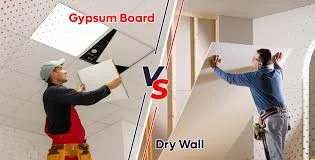
Although the terms gypsum board and drywall are often used interchangeably, they do have differences in scope and meaning. Understanding these terms precisely helps you choose the right material for construction, renovation, or technical design.
1. Terminology and Definition
Drywall
- Drywall is a general building material used to form indoor walls and ceilings.
- It refers to panels made of gypsum plaster sandwiched between two sheets of paper.
- The term “drywall” highlights that it is installed dry (without water-based plastering).
- In the USA and Canada, “drywall” is the dominant term.
- Also commonly called:
- Sheetrock (brand name by USG)
- Wallboard
- Plasterboard (especially in UK, Australia)
- Gypsum panel
Drywall is a category, not a specific product.
Also Read:
Gypsum Board
- Gypsum board is a specific type of drywall, made specifically with a gypsum core.
- Gypsum is a naturally occurring mineral (calcium sulfate dihydrate).
- Almost all modern drywall is technically a gypsum board.
- The term is more formal and is used in industrial, architectural, and specification contexts.
Gypsum board is a type of drywall; drywall may refer broadly to similar panel systems.
2. Composition Differences
Gypsum Board Composition
- Gypsum core (calcium sulfate, sometimes with additives)
- Facing paper:
- Typically heavy kraft paper
- Some boards use fiberglass mat facing (moisture/mold resistant)
- Additives vary by board type:
- Glass fibers for fire-resistance (Type X)
- Silicone or wax for moisture resistance
- Fungicides for mold resistance
Drywall Composition
Because drywall is a general term, any panel used for dry interior construction may be called drywall. Most drywall is gypsum board, but alternatives include:
- Cement board (used in wet areas like showers)
- Fiberboard
- Wood panels
Thus:
- All gypsum boards are drywall
- Not all drywall is gypsum-based
3. Manufacturing Process
Gypsum Board Manufacturing
- Gypsum rock is mined.
- It is heated to remove water (calcination), forming plaster of Paris.
- Water and additives are added back to create a thick slurry.
- The slurry is poured between two sheets of paper.
- It is pressed to thickness, hardened, and cut.
- Panels are dried in large ovens.
- Boards are trimmed, edge-taped, and stacked.
Drywall Production
- Usually identical to gypsum board production, except for alternative drywall types which use different cores.
4. Types of Gypsum Board (Most Common Drywall Types)
| Types | Purpose | Features |
| Regular gypsum board | Standard walls & ceilings | Cheapest, easiest to install |
| Types X ( fire - rated ) | Fire Resistant assemblies | Gypsum reinforced with glass fibers |
| Type C ( enhanced fire ) | Higher fire performance | Additional additivties |
| Moisture resistant ( Green board ) | Bathrooms ( non shower ) | Wax Coated papaer |
| Mold resistant ( Purple board ) | Mold prone area | Fiberglass facing / treated core |
| Cement board | Showers, wet area | Not tecnically gypsum but still used in similar applications |
| Soundproof drywall | Sound insulation | Layers with gypsu, polymers, viscoelastic compounds |
| Flexible drywall | Curved surfaces | Thinner (1/4) and more bendable |
5. Performance Characteristics
A. Fire Resistance
- Gypsum naturally contains water molecules.
- When heated, water is released as steam, delaying heat transfer.
- Type X and Type C gypsum boards provide higher fire resistance.
B. Moisture Resistance
- Gypsum board is normally NOT water-resistant.
- Moisture-resistant drywall adds wax or silicone.
- Mold-resistant drywall uses fiberglass mats and anti-fungal treatments.
C. Soundproofing
- Specialized gypsum boards include viscoelastic polymers that absorb vibration.
D. Structural Strength
- Regular drywall/gypsum board is not load-bearing.
- Can support shelves or cabinetry with proper anchors.
6. Installation Process
Installation steps are essentially the same for both materials:
- Framing (wood or metal studs)
- Cutting the board (using a utility knife to score and snap)
- Fastening (screws or nails)
- Taping (covering joints with tape)
- Mudding (joint compound application)
- Sanding
- Priming and painting
Gypsum board installation techniques are identical to general drywall techniques.
7. Sizes and Thicknesses
Common thicknesses:
- 1/4 in (6.35 mm): Curves, repairs
- 3/8 in (9.5 mm): Older homes, overlay
- 1/2 in (12.7 mm): Standard walls
- 5/8 in (15.9 mm): Ceilings, fire-rated assemblies
Standard panel sizes:
- 4 ft × 8 ft (common)
- 4 ft × 10 ft
- 4 ft × 12 ft (fewer seams)
- Metric sizes for international usage
8. Cost Comparison
Costs vary by region, but generally:
Drywall (general term)
- Includes gypsum board and all alternatives.
- Price range is wide.
Gypsum board (specific product)
Typical cost per sheet:
- Regular 1/2": inexpensive
- Type X: slightly more
- Moisture/mold resistant: moderate
- Soundproof, specialty boards: expensive
9. Advantages and Disadvantages
Advantages of Gypsum Board/Drywall
- Fast installation
- Cost-effective
- Smooth finish
- Fire-resistant properties
- Easy to cut and shape
- Strong, stable surfaces
- Environmentally recyclable
- Many specialized types available
Disadvantages
- Susceptible to water damage
- Requires mudding and sanding
- Not load-bearing
- May crack if building shifts
- Heavy to lift and install
10. When to Use Gypsum Board vs. Generic Drywall
Use gypsum board when:
- You need fire-rated construction (Type X, Type C)
- You need industry-standard, specification-based material
- Moisture/mold resistance is needed (special types)
- Building codes reference gypsum board specifically
Use drywall when:
- You refer casually to interior wall panels
- You include other board types (cement board, fiberglass board, etc.)
Also Read: Top 20 POP Ceiling Modern
Conculsion
| Features | Gypsum Board | Drywall |
| Definition | Specific drywall made from gypsum | General wall panel material |
| Material | Always gypsum core | May be gypsum or other materials |
| Technical Use | Architectural / engineering, mold resistant | General conversation / common terms |
| Variants | Fire - rated, moisture - resistant | All gypsum boards + cement boards + other alternatives |
| Common Use | Most drywall is gypsum board | Boards category |
In practice, gypsum board is the technical product, while drywall is the everyday word. In most building stores and construction conversations, they refer to the same thing unless specifying a special board type.
https://www.livehomes.in/blogs