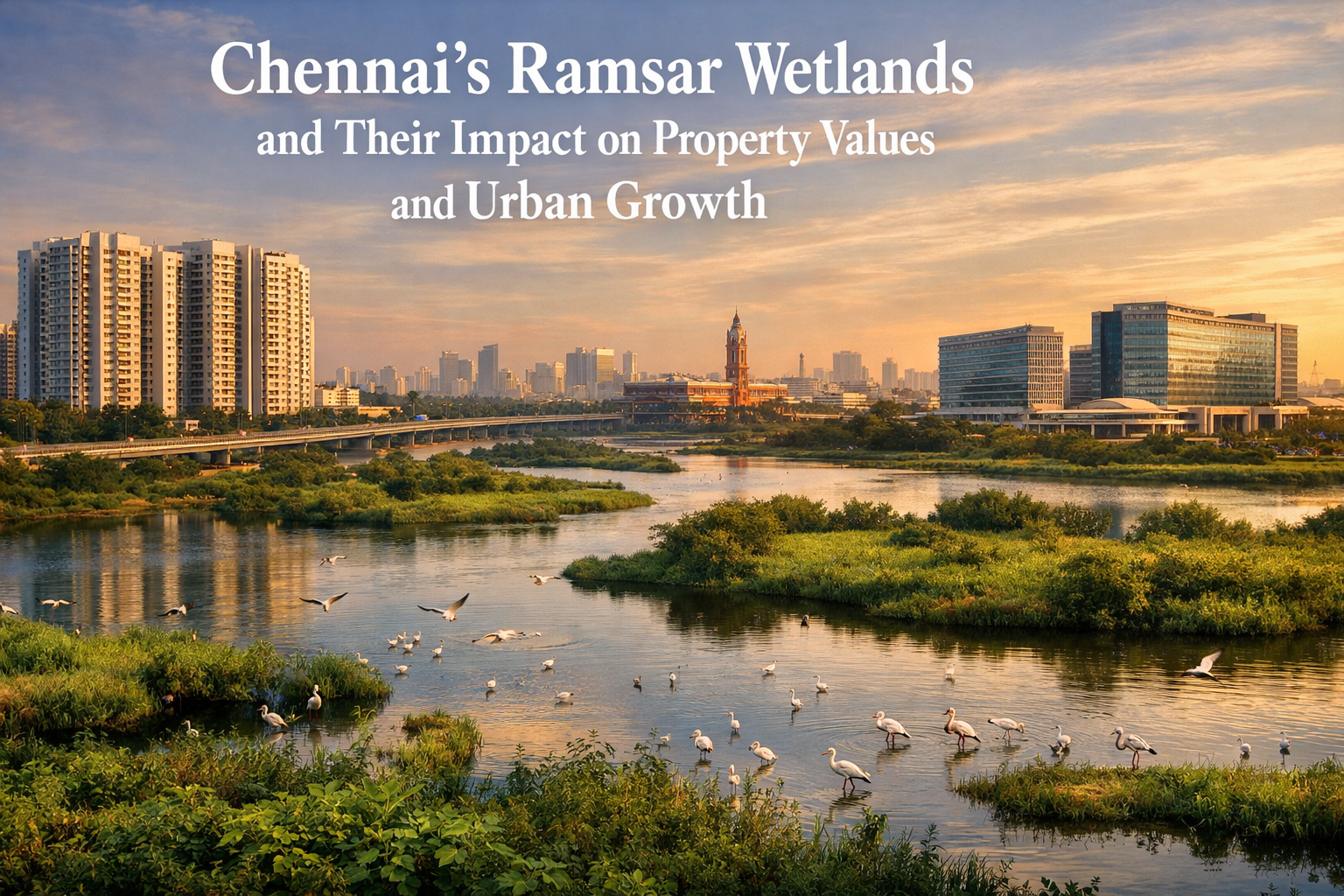
Chennai is one of India’s fastest-growing metropolitan cities, but its growth is deeply intertwined with its natural landscape—especially wetlands. Over decades, unplanned urban expansion has led to severe flooding, water scarcity, and environmental stress. In this context, the recognition of Chennai’s wetlands under the Ramsar framework has become a turning point for urban planning, real estate development, and property valuation.
1. Understanding Ramsar Wetlands (Foundation)
What Is a Ramsar Wetland?
A Ramsar wetland is a wetland designated as a Wetland of International Importance under the Ramsar Convention, adopted in 1971.
The convention recognizes wetlands as:
- Life-support systems
- Natural flood regulators
- Biodiversity hotspots
- Climate stabilizers
- Water security assets
Once a wetland is listed, the country commits to maintaining its ecological character, even while allowing regulated human use.
2. Chennai’s Ramsar Wetland: Ecological Core of the City
Key Ramsar Site in Chennai
- Pallikaranai Marsh Reserve Forest
Why Pallikaranai Is Critical:
- It is Chennai’s last remaining large freshwater marsh
- Acts as a natural drainage basin for South Chennai
- Supports 300+ species of birds, plants, reptiles, and aquatic life
- Recharges groundwater and controls flooding
- Lies at the center of Chennai’s fastest-growing real estate corridors
3. How Urban Growth in Chennai Interacts with Wetlands
Chennai’s Urban Expansion Pattern
Chennai has expanded mainly towards
- South Chennai
- OMR IT Corridor
- Western and Southwest suburbs
These growth zones overlap with historical wetland systems, making wetlands a decisive factor in:
- Infrastructure safety
- Housing approvals
- Flood risk mapping
- Property insurance and resale value
4. Impact of Ramsar Wetlands on Property Values (Detailed Analysis)
4.1 Flood Risk Reduction = Property Stability
Wetlands act as natural sponges, absorbing excess rainwater.
Areas near functioning wetlands:
- Face lower flood damage
- Have reduced insurance risk
- Maintain stable property demand
Areas where wetlands were encroached:
- Experience frequent waterlogging
- See declining buyer interest
- Suffer long-term value erosion
Result: Ramsar protection indirectly supports property value stability.
4.2 Buyer Perception and Market Demand
Post-flood awareness has changed buyer behavior in Chennai.
Modern buyers now ask:
- Is the area flood-prone?
- Are wetlands nearby protected?
- Is the project environmentally compliant?
Properties near protected wetlands are increasingly seen as:
- Safer
- More future-proof
- Better long-term investments
4.3 Regulatory Influence on Real Estate Prices
Ramsar designation introduces:
- Buffer zones
- Height and density controls
- Mandatory environmental clearances
This limits oversupply, which can:
- Increase scarcity
- Support price appreciation
- Reduce risky overdevelopment
5. Impact on Real Estate Development & Urban Planning
5.1 Planning Controls
After Ramsar recognition:
- Wetlands must be included in master plans
- Stormwater systems must align with natural drainage
- Builders must submit environmental assessments
This leads to better-quality urban growth rather than unchecked sprawl.
5.2 Shift Toward Sustainable Development
Developers are increasingly adopting:
- Rainwater harvesting
- Green buffers
- Permeable surfaces
- Eco-sensitive layouts
Such projects often command a “green premium” in the market.
6. Chennai Area List (Zone-Wise – Comprehensive Coverage)
Chennai has hundreds of micro-localities. Below is a comprehensive, zone-wise list of all major residential, commercial, and suburban areas commonly recognized in planning and real estate.
South Chennai (High Wetland Influence)
- Pallikaranai
- Velachery
- Medavakkam
- Perumbakkam
- Sholinganallur
- Thoraipakkam
- Karapakkam
- Navalur
- Kelambakkam
- Adyar
- Besant Nagar
OMR & IT Corridor
- Tidel Park Area
- Perungudi
- Kandanchavadi
- Siruseri
- SIPCOT
- Okkiyam Thoraipakkam
Central Chennai
- T. Nagar
- Saidapet
- Guindy
- Nungambakkam
- Mylapore
- Triplicane
- Royapettah
West Chennai
- Anna Nagar
- Mogappair
- Arumbakkam
- Vadapalani
- Ashok Nagar
- K.K. Nagar
- Porur
North Chennai
- Ennore
- Manali
- Tiruvottiyur
- Washermanpet
- Royapuram
- Madhavaram
- Perambur
Southwest & Outer Suburbs
- Tambaram
- Chromepet
- Pallavaram
- Vandalur
- Guduvanchery
- Mudichur
- Mannivakkam
7. Economic Value of Ramsar Wetlands for Chennai
Wetlands reduce:
- Public spending on flood control
- Infrastructure repair costs
- Disaster recovery expenses
They increase:
- Urban resilience
- Investor confidence
- Long-term livability
Thus, wetlands act as economic shock absorbers.
8. Challenges Despite Ramsar Status
- Encroachments continue in fringe areas
- Pollution from sewage and waste dumping
- Weak enforcement of buffer zones
- Conflict between infrastructure projects and conservation
Ramsar status provides a framework, not automatic protection.
9. What This Means for Stakeholders
For Homebuyers
- Choose flood-resilient zones
- Check proximity to protected wetlands
- Verify builder approvals
For Developers
- Integrate wetlands into project design
- Plan for long-term sustainability
- Market environmental compliance as a strength
For City Planners
- Treat wetlands as infrastructure
- Align growth with natural systems
- Prevent irreversible ecological loss
10. Long-Term Urban Future of Chennai
Chennai’s future depends on:
- Protecting remaining wetlands
- Respecting Ramsar commitments
- Integrating ecology into real estate planning
Cities that ignore wetlands pay later—in floods, water scarcity, and declining quality of life.
Conclusion
Chennai’s Ramsar wetlands are not obstacles to development—they are the foundation of safe, stable, and sustainable urban growth. Their influence on property values, buyer confidence, and planning decisions will only grow stronger as climate risks intensify.Protecting wetlands is no longer just environmental responsibility—it is urban and economic necessity.
FAQs
1. What is Ramsar status?
Ramsar status means a wetland is officially recognized as important at an international level under the Ramsar Convention and must be protected.
2. Which Ramsar wetland is in Chennai?
Chennai has one Ramsar wetland:
- Pallikaranai Marsh Reserve Forest
3. Why is Pallikaranai Marsh important for Chennai?
It:
- Reduces flooding
- Stores rainwater
- Recharges groundwater
- Protects nearby residential areas
4. Does Ramsar status stop construction near wetlands?
No. Construction is allowed, but strict rules, buffer zones, and approvals are required to protect the wetland.
5. How do Ramsar wetlands affect property value?
Areas near protected wetlands usually have:
- Lower flood risk
- Better long-term property value
- Higher buyer confidence
6. Is it risky to buy property near a wetland?
Not if the wetland is protected and well-managed. Risk is higher if buildings are on encroached or filled wetland land.
7. Which Chennai areas are influenced by Pallikaranai Marsh?
- Pallikaranai
- Velachery
- Medavakkam
- Perumbakkam
- Sholinganallur
- Thoraipakkam
- OMR areas
8. How do wetlands help during heavy rain?
Wetlands absorb excess rainwater and release it slowly, helping prevent flooding.
9. Do builders face more rules near Ramsar wetlands?
Yes. Builders must follow:
- Environmental clearances
- Drainage rules
- Buffer zone guidelines
10. Why should homebuyers care about Ramsar wetlands?
Because wetlands:
- Protect homes from floods
- Improve water security
- Support safer, sustainable living