1. Evolution of OMR as a Real Estate Corridor
OMR was initially developed as a dedicated IT corridor, but over the last two decades it has transformed into a self-sustained urban stretch. The presence of large IT parks led to residential development, which in turn attracted schools, hospitals, shopping centers, and entertainment hubs. This organic evolution has made OMR one of the most structured real estate markets in Chennai. Unlike older residential areas that evolved without planning, OMR was designed with wide roads, commercial zoning, and large land parcels, allowing for integrated townships and large-scale developments.
2. Market Structure and Buyer Profile
The OMR real estate market is primarily end-user driven.
Buyer Segments:
- IT and ITES professionals working along the corridor
- Middle- and upper-middle-income families
- Senior professionals preferring work–life proximity
- Long-term rental investors (yield-focused)
Speculative buying is relatively low compared to emerging corridors, which keeps price movements stable and realistic.
3. Residential Supply Characteristics
Residential supply in OMR is diverse and well-segmented:
- Apartments form the majority of the supply.
- Gated communities dominate new developments
- Projects offer lifestyle amenities such as gyms, clubhouses, landscaped spaces, and security
- Unit configurations range from compact 1 BHKs to spacious 4 BHKs
The availability of large land parcels allows developers to create integrated communities rather than isolated buildings.
4. Property Price Movement and Appreciation
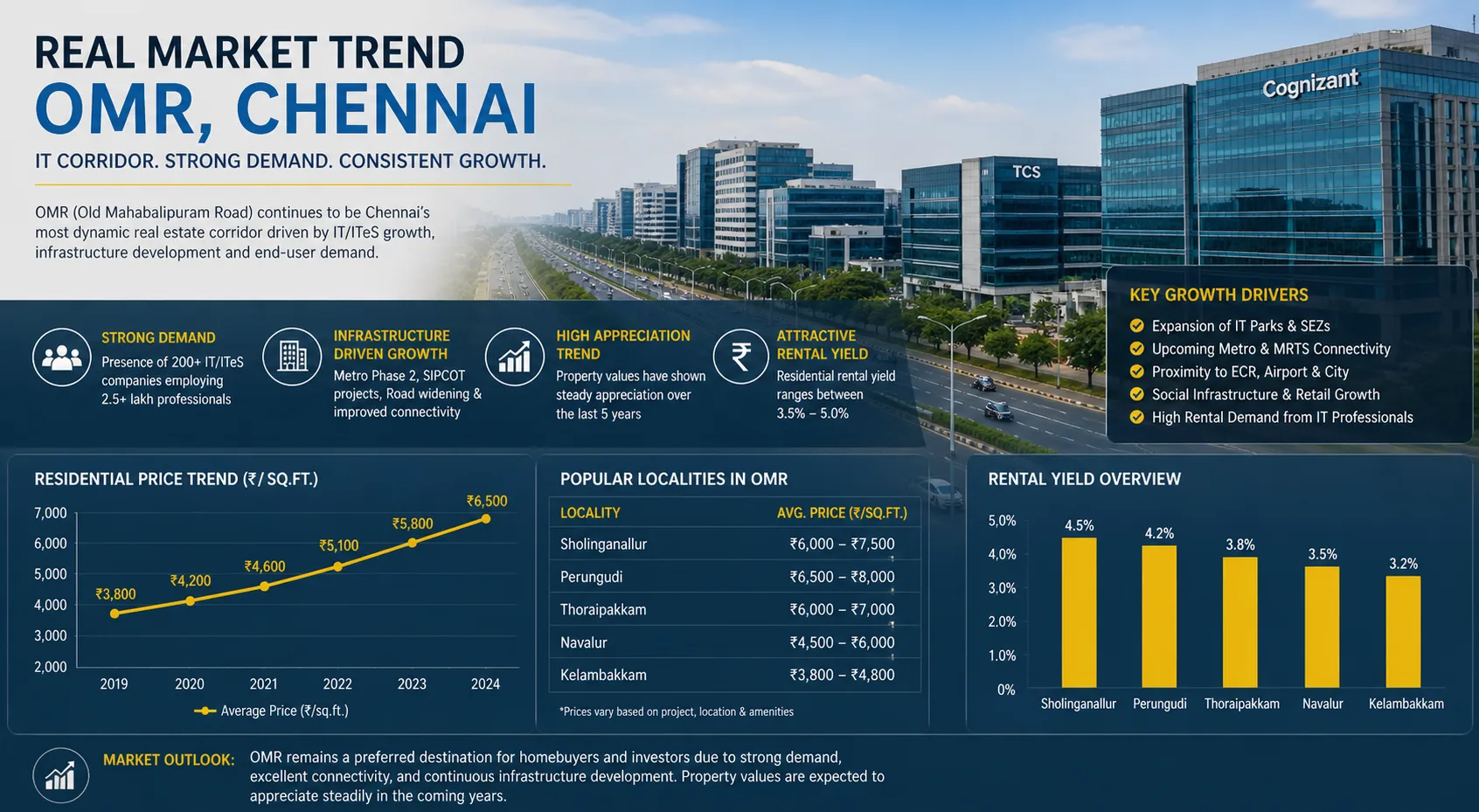
Property prices in OMR follow a gradual appreciation model.
Key characteristics:
- Prices rise steadily rather than sharply
- Appreciation is closely linked to infrastructure progress
- Locations closer to IT parks and metro stations command premium pricing
- Peripheral stretches remain more affordable but appreciate as infrastructure improves
This predictable growth pattern reduces risk for both homebuyers and investors.
Also Read: Why OMR Is The Best Real Estate Investment Corridor In Chennai
5. Rental Market Dynamics
The rental market in OMR is one of the strongest in Chennai.
Rental demand drivers:
- Continuous hiring by IT companies
- High proportion of transferable professionals
- Preference for rental housing close to offices
- Growing demand for managed and co-living spaces
Rental absorption remains healthy, and vacancy levels are relatively low compared to non-employment corridors.
6. Infrastructure and Connectivity Impact
Infrastructure plays a decisive role in OMR’s market performance.
Major influences:
- Metro Rail expansion improves daily commute efficiency
- Road widening projects ease traffic congestion over time
- Improved public transport increases residential catchment areas
- Better connectivity enhances resale value
Infrastructure development does not cause sudden price jumps but strengthens long-term appreciation.
7. Commercial and Employment Influence
OMR is anchored by large employment clusters.
- The presence of multiple IT parks ensures consistent job creation
- Office leasing activity supports retail and residential demand
- Work-near-home preference increases housing absorption
- Commercial stability directly impacts residential value retention
This employment-backed model is why OMR has remained resilient across economic cycles.
8. Social Infrastructure and Livability
Livability is a major strength of OMR.
- Presence of reputed schools and colleges
- Multi-specialty hospitals within short travel distances
- Shopping malls, supermarkets, and restaurants
- Recreational spaces and community living
These factors attract long-term residents rather than short-term occupants.
9. Market Challenges and Constraints
Despite its strengths, OMR faces certain challenges:
- Traffic congestion during peak office hours
- Temporary inconvenience due to ongoing infrastructure works
- Inconsistent civic infrastructure in some micro-stretches
- Flood management and drainage vary by location
Buyers must evaluate specific micro-markets rather than the corridor as a whole.
10. Market Stability and Risk Profile
OMR is considered a low-to-moderate risk real estate market.
- High demand elasticity reduces price volatility
- Employment-led absorption prevents oversupply stress
- Market corrections, if any, are mild and temporary
- Liquidity remains strong for resale properties
This stability appeals to conservative investors and end-users alike.
11. Long-Term Market Outlook
The long-term outlook for OMR remains positive and sustainable.
- Demand is expected to remain consistent due to employment growth
- Capital appreciation will continue at a measured pace
- Rental demand will stay strong due to workforce mobility
- The corridor will continue evolving as a mature residential zone
OMR is transitioning from a growth corridor into a stable urban residential belt.
FAQs – Real Estate Market in OMR, Chennai
1. Why is OMR considered a stable real estate market?
Because demand is driven by employment and end-users rather than speculation.
2. Does OMR offer long-term value appreciation?
Yes. Appreciation is steady and infrastructure-led, making it suitable for long-term holding.
3. Is the rental market reliable in OMR?
Yes. Continuous job inflow ensures sustained rental demand and low vacancy.
4. Are property prices uniform across OMR?
No. Prices vary significantly based on micro-location, infrastructure, and accessibility.
5. What type of buyers dominate the OMR market?
End-users form the majority, followed by long-term rental investors.
6. How does infrastructure affect property value in OMR?
Infrastructure improvements directly improve connectivity, livability, and resale value.
7. Is OMR suitable for families?
Yes. The presence of schools, hospitals, and gated communities makes it family-friendly.
.