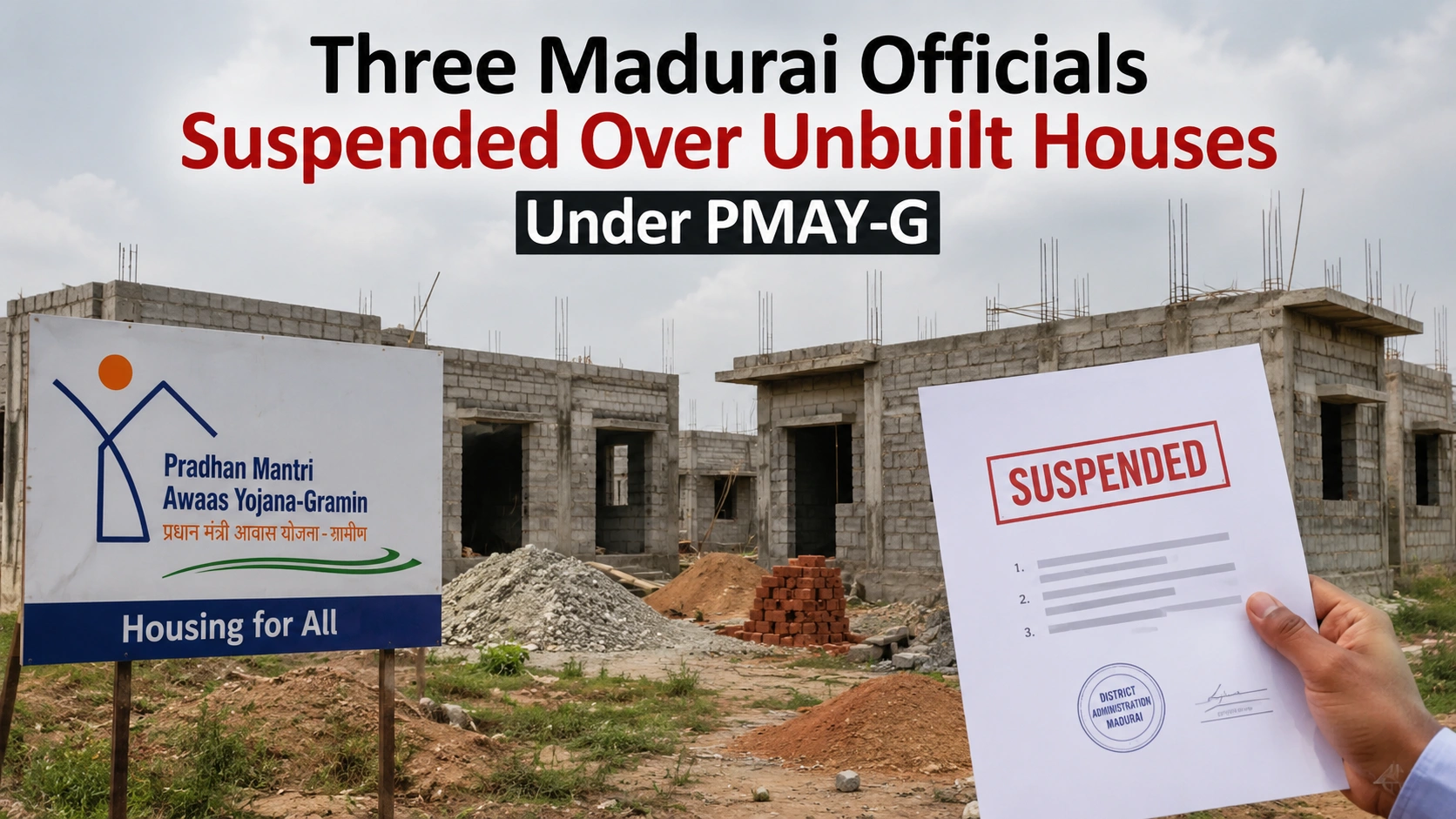
Three revenue officials in Madurai have been suspended following a government inquiry into alleged irregularities in the implementation of the Pradhan Mantri Awas Yojana-Gramin (PMAY-G). The investigation found that government funds meant for constructing rural houses had allegedly been released to beneficiaries even though the sanctioned houses were not constructed. Officials allegedly used photographs of nearby houses to bypass the mandatory GPS-based verification system under PMAY-G. The photographs were reportedly uploaded as proof of construction progress, enabling the release of housing assistance despite construction not taking place at the approved locations. Under PMAY-G, eligible beneficiaries receive financial assistance of around Rs 2.10 lakh, released in four instalments linked to different stages of construction — basement, lintel, roof and completion. Before each instalment is released, officials are required to inspect the construction site and upload GPS-tagged photographs through the PMAY-G application. The system is designed to ensure that funds are released only when construction has reached the required stage. The alleged irregularities came to light following a complaint submitted to the vigilance authorities in October 2025 regarding funds being claimed for houses that had not been constructed. The complaint was subsequently forwarded to the district administration, which ordered an inquiry. The investigation reportedly confirmed irregularities, following which disciplinary proceedings were initiated against the officials concerned and show-cause notices were issued. According to government sources, the three officials were also directed to repay around Rs 21 lakh in connection with the irregular release of funds. The matter later reached the Madras High Court’s Madurai Bench. During the proceedings, the district administration informed the court that an inquiry had confirmed the irregularities and that action had been initiated against those responsible. The court subsequently closed the petition while directing the authorities to take appropriate action against all officials found responsible. The case has raised concerns over the effectiveness of field inspections and digital verification mechanisms used to monitor government housing schemes and highlights the need for strict verification before public funds are released.
Three Madurai Officials Suspended Over Unbuilt Houses Under PMAY G
Aug 10 2026
Latest Newsletter

Chennai Property Tax Deadline Today: September 30 Last Day to Pay Without Penalty
Sep 30 2026

Interest Rates May Rise to 5.50 percentage in October as Inflation Broadens
Sep 29 2026

Housing Sales Decline 6 percentage in Top 9 Cities Amid Weakening Demand
Sep 28 2026

Directs Commercial Sites to Be Assessed Under Existing Master Plan Rules
Sep 26 2026

TN Housing Board to Build New Homes Based on Public Demand
Sep 25 2026