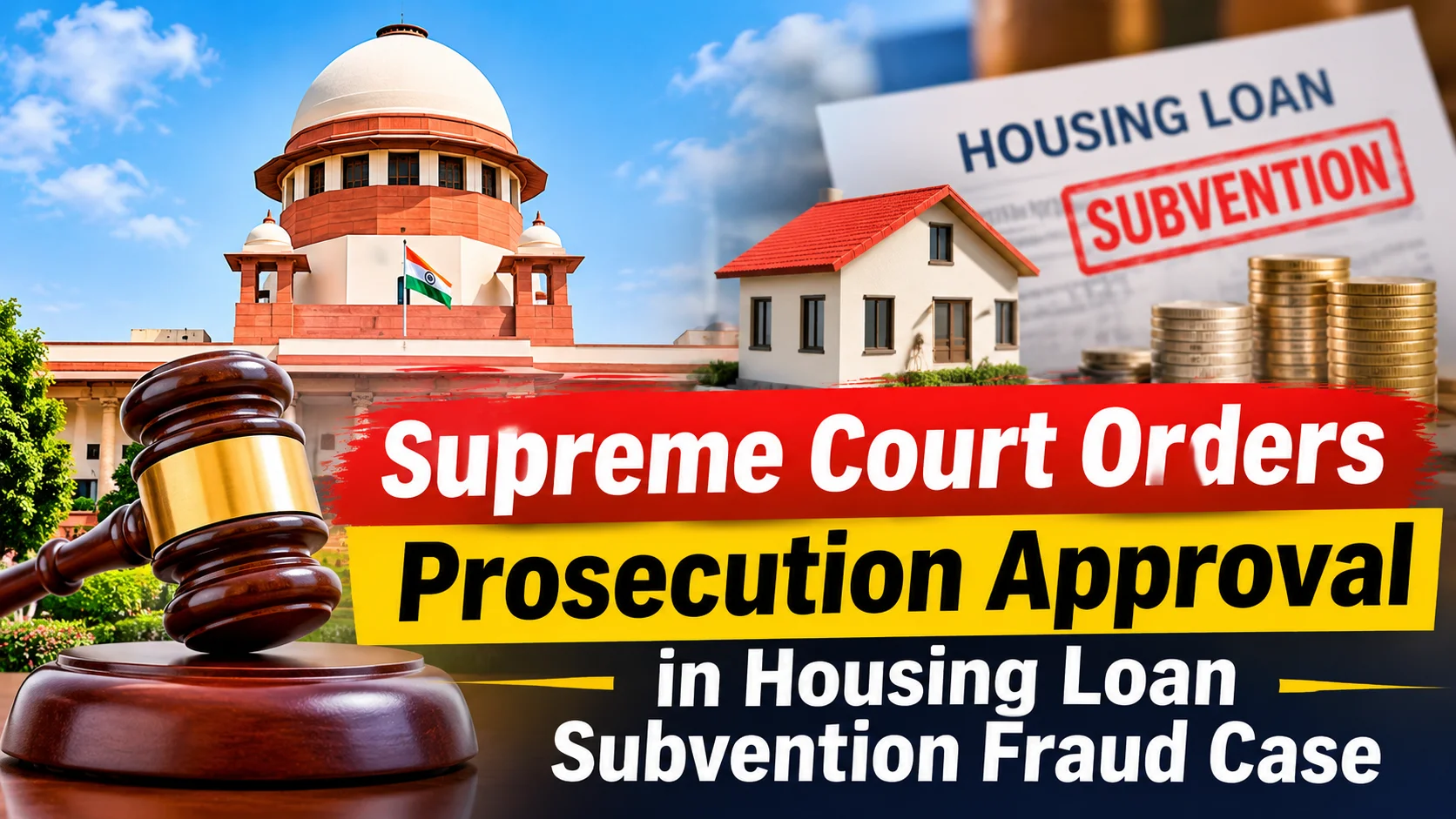
The Supreme Court has directed financial institutions to grant unconditional approval for prosecuting officials allegedly involved in irregularities linked to housing loan subvention schemes. The direction comes amid growing concerns over homebuyers facing financial difficulties due to delayed residential projects, unpaid loan instalments and alleged irregularities in property financing arrangements. The court has instructed the concerned institutions to provide the necessary prosecution approvals within one week and warned that senior management representatives may be required to appear personally if they fail to comply. The case relates to home loan subvention schemes introduced to help people purchase under-construction residential apartments. Under these arrangements, financial institutions approved home loans and disbursed funds to property developers, while developers agreed to pay the monthly EMIs on behalf of homebuyers until possession of the apartments or an agreed deadline. These schemes were marketed as an attractive option because buyers did not have to immediately manage their monthly loan repayments during the construction period. The investigating agency raised concerns about difficulties in obtaining the required prosecution approvals against officials allegedly involved in the transactions. It also highlighted concerns regarding conditional permissions granted by certain financial institutions. Following these submissions, the Supreme Court directed the concerned banks and housing finance companies to provide unconditional prosecution approval within the specified period. The court warned that failure to comply could result in senior representatives being asked to explain their actions. The investigation was later expanded to cover multiple residential projects, developers and lending institutions across different cities. Reports submitted during the proceedings highlighted several housing projects involving subvention arrangements and large numbers of affected homebuyers. The investigating agency was directed to examine the alleged financial irregularities, identify the officials involved and determine whether lending procedures and responsibilities were properly followed. The Supreme Court's intervention is significant for the Indian real estate and housing finance sectors because it highlights the importance of transparency in property-related lending arrangements. Financial institutions may face greater scrutiny regarding loan approvals, fund disbursements and construction progress monitoring. Developers are also expected to fulfil their contractual commitments and maintain transparency with homebuyers throughout the construction process. Overall, the Supreme Court's direction highlights the need for stronger accountability and transparent financial practices in the residential property market. The proceedings could have wider implications for developers, banks, housing finance companies and affected homebuyers. They also underline the importance of protecting property buyers from financial risks arising from delayed construction, developer defaults and irregularities in housing loan arrangements.
Supreme Court Orders Prosecution Approval in Housing Loan Subvention Fraud Case
Nov 27 2026
Latest Newsletter

Cement Manufacturer Approves Rs 700 Crore Share Buyback at Up to Rs 1,850 Per Share
Nov 26 2026

Housing Finance Companies Urged to Strengthen Cybersecurity and Improve Governance
Nov 25 2026

Tamil Nadu Orders Monthly Inspections to Detect Building Plan Violations
Nov 24 2026

Madras High Court Maintains Pallikaranai Construction Ban; Petitioners Told to Move Supreme Court
Nov 23 2026

NHB Proposes Separate Affordable Housing Loan Category for Smaller Cities
Nov 21 2026