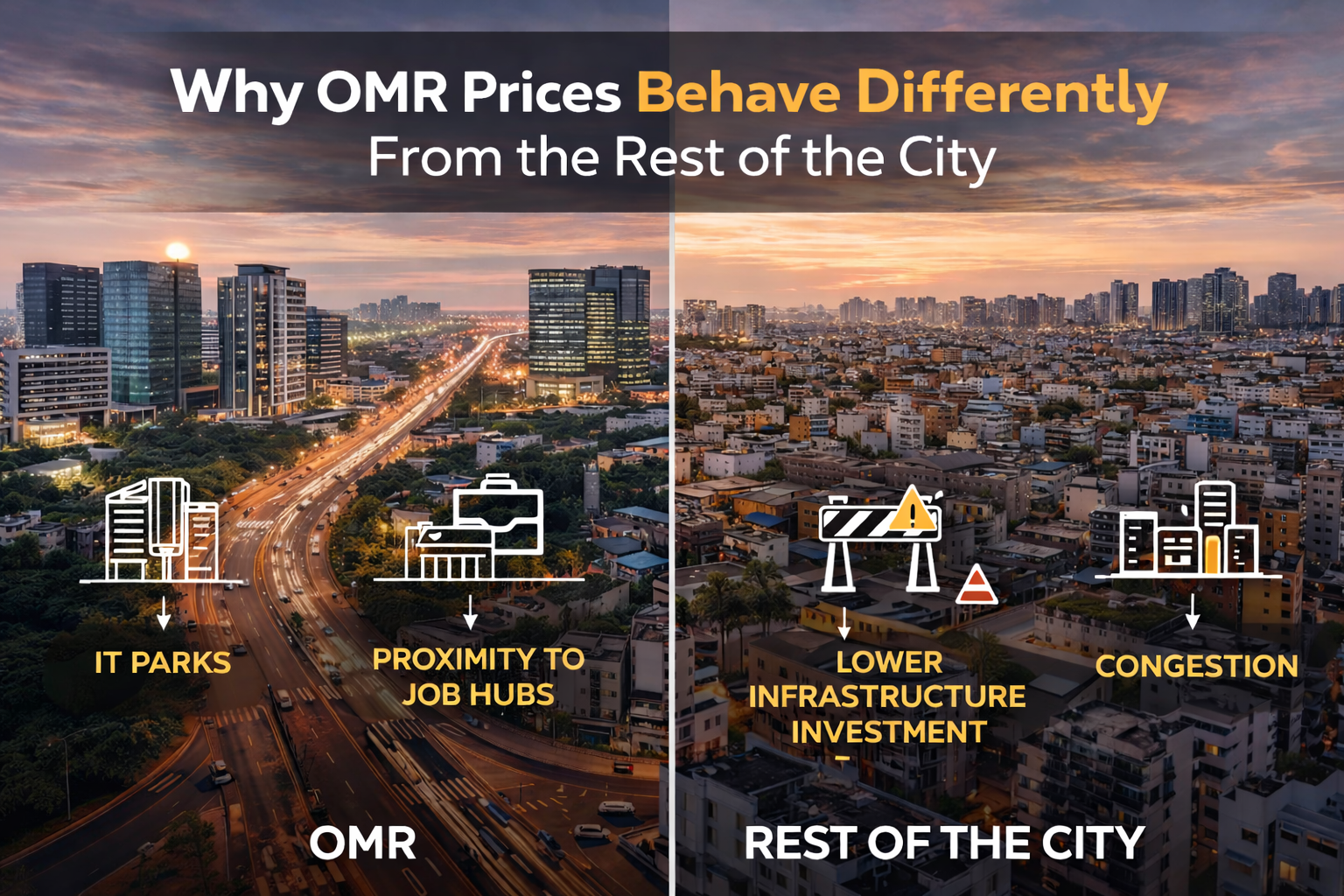
OMR (Old Mahabalipuram Road) in Chennai is not just another residential stretch—it functions as a specialized economic corridor. Its pricing dynamics are driven by factors that do not apply uniformly across the rest of the city.
1. IT & Knowledge Corridor Effect (Primary Driver)
OMR is Chennai’s IT and technology backbone, hosting:
- Major IT parks
- Global tech companies
- Startups and data centers
This creates continuous end-user demand from professionals who prefer living close to work. Unlike speculative markets, OMR prices are largely job-demand driven, which keeps values resilient even during slowdowns.
2. Strong End-User Demand vs Investor Demand
- OMR: Dominated by salaried professionals (end-users)
- Other city areas: Often investor-driven or legacy residential zones
End-user demand means:
- Lower price volatility
- Faster absorption of new projects
- Consistent rental demand
This stabilizes prices and supports steady appreciation.
3. Continuous Infrastructure Expansion
OMR has seen planned, phased infrastructure growth, including:
- Road widening and service roads
- Metro Rail Phase extensions
- Elevated corridors and improved connectivity
- Social infrastructure (schools, hospitals, malls)
In contrast, many older city areas face:
- Space constraints
- Slower infrastructure upgrades
- Higher congestion
Planned growth directly translates to price premiums on OMR.
4. Availability of Large Land Parcels
Unlike core city zones:
- OMR still offers large, contiguous land parcels
- Enables gated communities, townships, and modern amenities
This allows developers to build:
- Larger homes
- Better amenities
- Efficient layouts
Result: Higher perceived value, even if the price per sq ft looks higher.
5. Rental Yield Advantage
OMR enjoys:
- One of the highest rental demands in Chennai
- Consistent tenant base from IT employees
This ensures:
- Predictable rental income
- Better ROI for investors
- Faster resale liquidity
Areas without rental depth struggle to justify price increases.
6. Lifestyle & Future-Ready Living
OMR developments are typically:
- Newer construction
- Smart-home ready
- Amenity-rich (clubhouses, co-working, EV charging)
Buyers increasingly pay a premium for future-ready homes, while older city areas often require renovation and compromise on amenities.
7. Lower Congestion (Comparatively)
Though traffic exists, OMR still benefits from:
- Wider roads
- Planned traffic movement
- Multiple access points
Many interior city locations suffer from:
- Narrow roads
- High density
- Aging civic infrastructure
Better mobility sustains buyer confidence.
8. Price Appreciation Is Growth-Led, Not Scarcity-Led
- OMR prices rise due to economic growth
- Central city prices rise mainly due to land scarcity
Growth-led appreciation is:
- More sustainable
- Less speculative
- Better aligned with income growth
9. Future Infrastructure Upside Is Still Intact
Upcoming developments (metro expansions, commercial zones, civic upgrades) mean:
- OMR still has headroom for appreciation
- Many city areas are already saturated
Markets with future catalysts always behave differently.
Conclusion
OMR prices behave differently because the corridor is:
- Employment-driven
- Infrastructure-led
- End-user dominated
- Future-focused