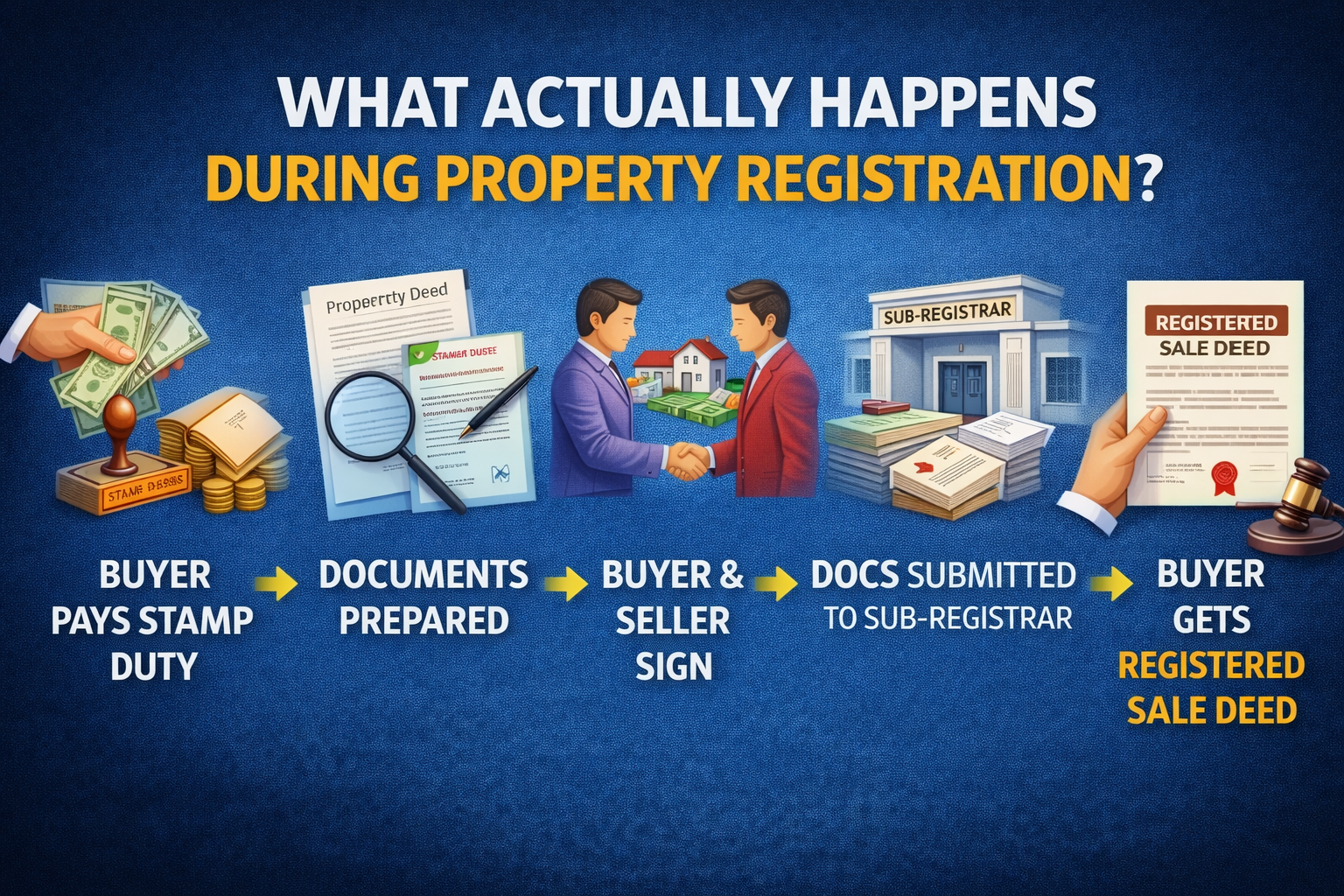
Property registration is often seen as a single-day formality, but in reality it is a multi-layered legal, financial, and data-verification process designed to:
- Establish legal ownership
- Protect government revenue
- Create a permanent public record
- Prevent future disputes
Understanding what really happens helps buyers avoid costly mistakes.
1. Property Registration Is About Ownership Recognition, Not Just Payment
Key Insight
Many people think registration is about paying stamp duty and signing papers.
In reality, registration is the State officially recognizing a transfer of rights.
Once registered:
- The buyer’s name becomes part of public land records
- Ownership gains legal enforceability
- Courts rely heavily on registered deeds in disputes
Without registration, payment alone has no legal value.
2. Valuation Scrutiny Happens Before Registration – Quietly
What Happens
Before the document is accepted:
- Property value is cross-checked with Guideline Value
- Nature of property (land, flat, commercial) is verified
- Usage classification is checked
Insight
This step exists to:
- Prevent undervaluation
- Protect stamp duty revenue
- Maintain uniformity across transactions
If the declared value is below guideline value, registration will not proceed.
3. Identity Verification Is Legally Critical
What Happens
- Buyer, seller, and witnesses are identified
- Government-issued IDs are verified
- Biometrics and photographs are captured
Insight
This is not a formality.
It is meant to:
- Prevent impersonation
- Stop fraudulent Power of Attorney misuse
- Create an audit trail
If identity verification fails, the document is rejected outright.
4. Legal Capacity of Parties Is Checked (Often Overlooked)
What Happens
The sub-registrar ensures the following:
- Seller has legal authority to sell
- Property is transferable
- The seller is not legally barred (minor, mentally incapacitated, etc.)
Insight
The registrar does not verify title depth but ensures the following:
- The act of sale itself is legally valid
- Parties are competent under law
This is why registration ≠ title guarantee.
5. Stamp Duty Is a Tax Event, Not Just a Fee
What Happens
- Stamp duty is collected as a state tax
- Registration fee is charged for record maintenance
Insight
Once paid:
- Stamp duty is nonrefundable.
- Even if the deal collapses later, duty is lost
This is why buyers must complete the following:
- Legal due diligence
- Title verification
before registration day.
6. Document Examination Is Procedural, Not Investigative
What Happens
The sub-registrar checks the following:
- Mandatory clauses are present
- Property description is complete
- Boundaries are mentioned
- Consideration details are stated
Insight
The registrar does not:
- Verify ownership history
- Check litigation
- Ensure encumbrance-free status
This responsibility lies entirely with the buyer.
7. Registration Creates a Permanent Government Record
What Happens
After execution:
- The document is scanned
- Digitally indexed
- Stored permanently
- Linked to land records
Insight
Once registered:
- The document becomes a public record
- Anyone can access it (with conditions)
- Errors are extremely difficult to correct
A single mistake can affect resale or loans for years.
8. Power of Attorney Registrations Are Treated Differently
What Happens
- POA registrations undergo stricter scrutiny
- Seller’s authority is carefully examined
- Misuse history has tightened rules
Insight
Banks and courts treat POA transactions with extra caution, even if registered.
9. The Sub-Registrar Is Not on the Buyer’s Side or Seller’s Side
Insight
The Sub-Registrar:
- Represents the State
- Protects revenue and records
- Does not protect buyer interests
Expecting legal advice from the registrar is a mistake.