What Exactly Is Undivided Share (UDS)?
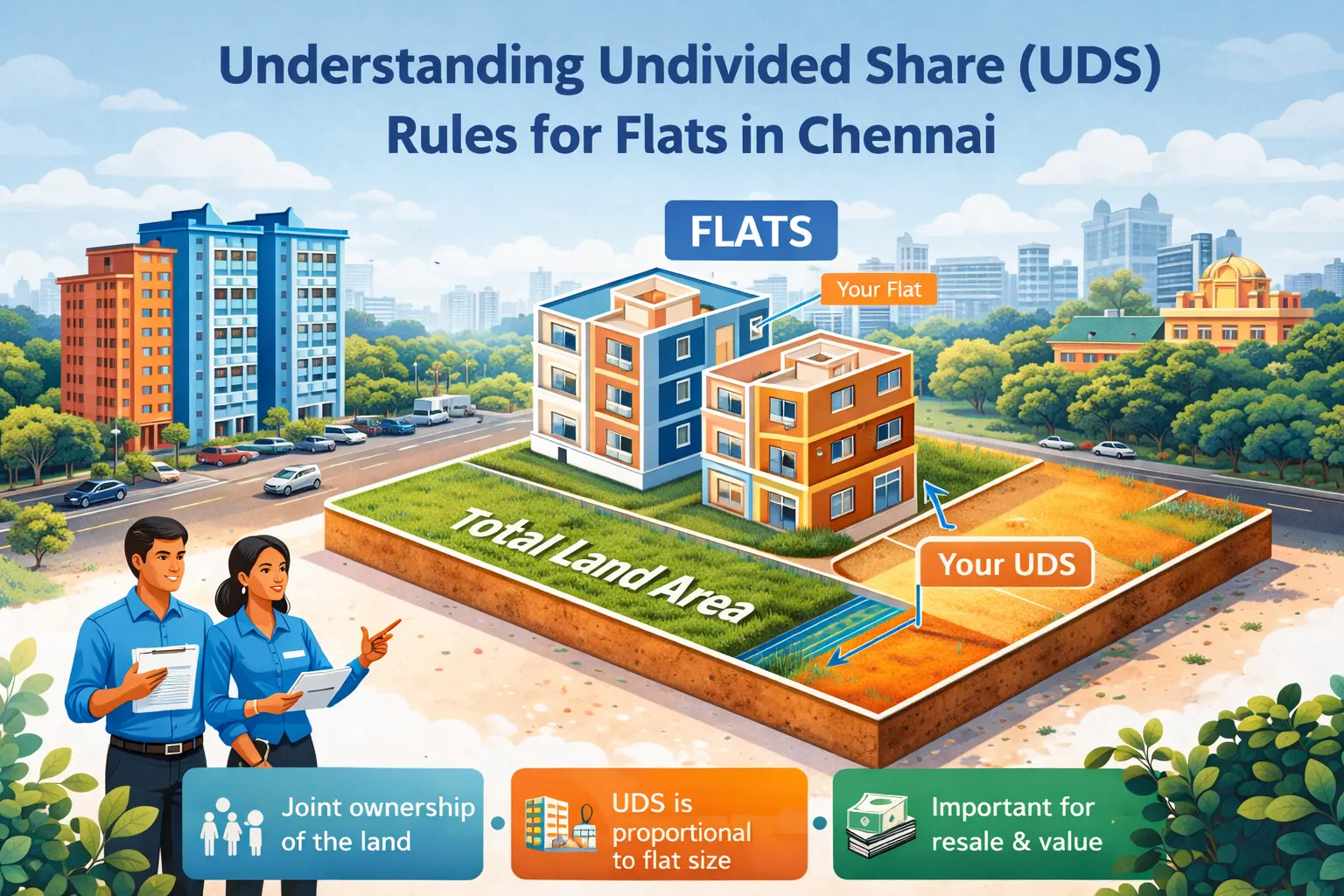
Undivided Share (UDS) is the portion of land legally owned by a flat owner in an apartment project.
When a building is constructed with multiple flats on a single plot, the land cannot be physically divided among owners. Instead, every flat owner gets a percentage share of the total land, known as UDS.
Even though you live in a specific flat, your ownership legally includes:
- Your flat (building portion)
- Your undivided share of the land beneath the entire building
This land share remains permanent, while the building structure has a limited lifespan.
Why UDS Is Extremely Important in Chennai
In Chennai, property value appreciation is driven mainly by land value, not by the building.
Over time:
- Buildings age, depreciate, and may even become unsafe
- Land value continues to increase, especially in prime and developing areas
This means:
- A flat with low UDS may lose value faster
- A flat with higher UDS holds better resale and redevelopment value
In old apartment redevelopments across Chennai, disputes often arise because owners later realize their UDS is too small or unclear.
How UDS Is Calculated
UDS is calculated based on the super built-up area of a flat in proportion to the total super built-up area of the project.
The idea is simple:
- Bigger flats get a larger share of land
- Smaller flats get a smaller share of land
The calculation considers:
- Total land area
- Total super built-up area of all flats
- Super built-up area of your flat
Because builders control these numbers, buyers must verify them carefully.
Also Read: Stamp Duty in Chennai When Buying Property
What Legal Rights Does UDS Give You?
Owning UDS means you legally own a part of the land. This gives you important rights such as:
- Right to land ownership even if the building is demolished
- Right to participate in redevelopment or reconstruction decisions
- Right to compensation if the land is acquired by the government
- Right to claim a proportionate share in future joint development
Without UDS, you are effectively only a long-term occupant, not a true landowner.
UDS and Redevelopment of Old Flats
When an apartment building becomes old or unsafe, redevelopment becomes necessary.
In such cases:
- The building is demolished
- The land remains
- New construction rights are decided only based on UDS
Owners with higher UDS receive:
- Larger flats, or
- Better floor preference, or
- Higher monetary compensation
If your UDS is not clearly defined, you may:
- Lose negotiation power
- Receive a smaller flat
- Face legal disputes
This is one of the biggest reasons UDS is critical for long-term security.
UDS Mention in Sale Deed (Non-Negotiable)
Your sale deed must clearly mention:
- Exact UDS in square feet
- Total land area of the project
- Your proportionate share calculation
- Survey number and land details
If UDS is mentioned only as a percentage or vaguely described, it can create serious legal problems later.
Always insist on UDS in exact square feet, not just percentages.
Common UDS Issues in Chennai
Many buyers face problems such as:
- Builder allocating very low UDS
- Mismatch between advertised flat size and actual UDS
- UDS not matching CMDA-approved plans
- Missing or unclear UDS in sale deed
- Builder retaining excess UDS for future development
These issues usually surface years later, when resale or redevelopment is attempted.
Difference Between Flat Ownership and UDS
Owning a flat means owning:
- A constructed portion of a building (which depreciates)
Owning UDS means owning:
- A portion of land (which appreciates)
True property ownership in Chennai depends far more on UDS than the flat itself.