1. Introduction
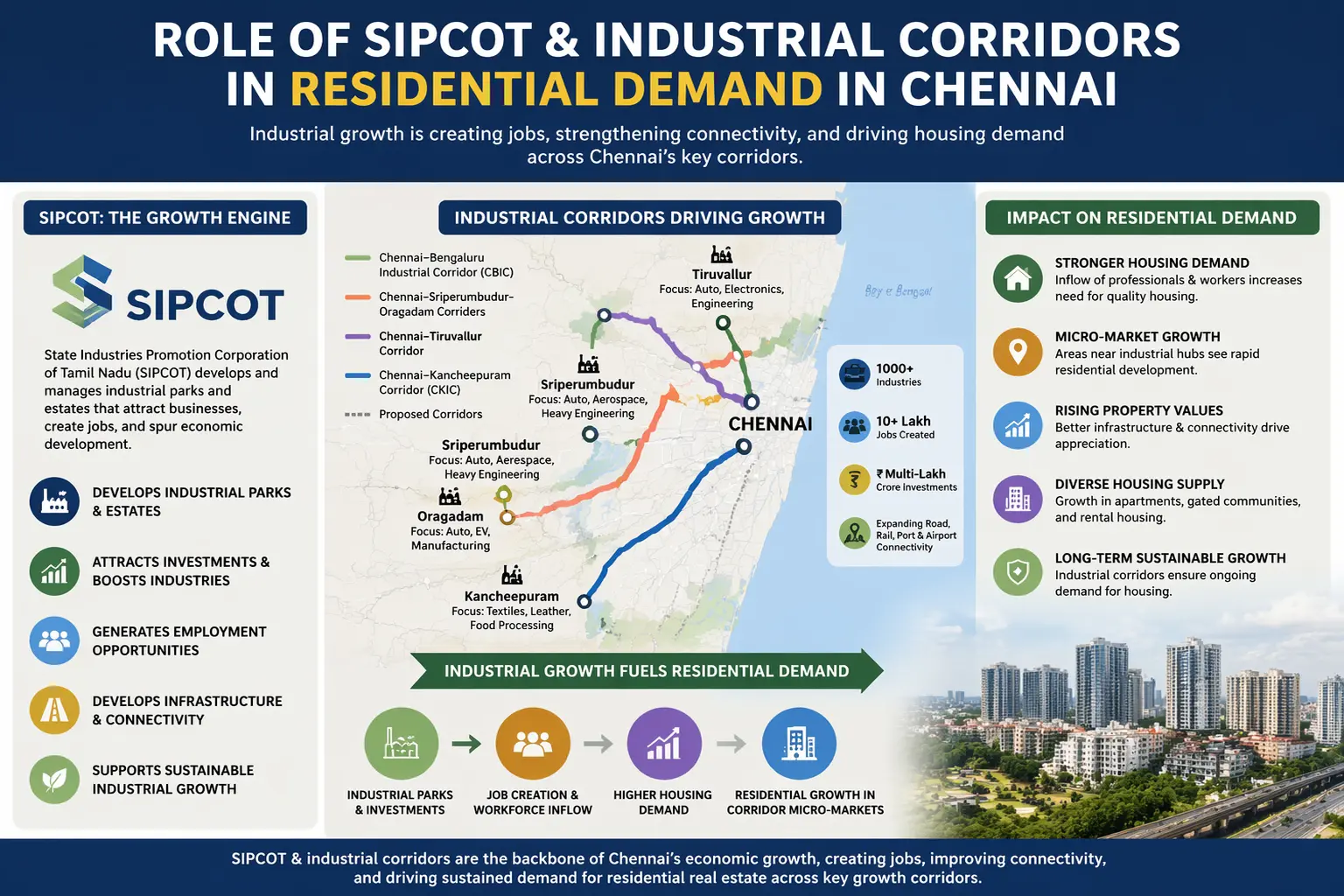
Chennai has emerged as one of India’s most important industrial and manufacturing hubs. A key driver behind this growth is the presence of SIPCOT industrial estates and strategically planned industrial corridors. These developments have not only transformed Chennai’s economy but have also significantly increased residential demand across multiple suburban and peripheral zones.
2. What Is SIPCOT?
SIPCOT (State Industries Promotion Corporation of Tamil Nadu) is a government body responsible for:
- Developing industrial estates
- Attracting domestic and foreign investments
- Providing infrastructure for manufacturing, IT, electronics, automobiles, and logistics
Major SIPCOT Locations Around Chennai
- Sriperumbudur
- Oragadam
- Irungattukottai
- Gummidipoondi
- Ponneri
These areas form the industrial backbone of Chennai’s growth.
3. What Are Industrial Corridors?
Industrial corridors are large, integrated economic zones that combine the following:
- Manufacturing clusters
- Logistics parks
- Warehousing
- Ports
- Road & rail connectivity
- Urban settlements
Key Industrial Corridors Impacting Chennai
- Chennai–Bengaluru Industrial Corridor (CBIC)
- Chennai–Kanyakumari Industrial Corridor (CKIC)
- Chennai Peripheral Ring Road (CPRR) corridor
- GST Road & NH48 corridor
4. How SIPCOT & Industrial Corridors Create Residential Demand
1. Massive Employment Generation
- SIPCOT zones host:
- Automobile manufacturers
- Auto ancillaries
- Electronics & EV units
- IT & engineering services
- Warehousing & logistics
Each industrial cluster generates thousands of direct and indirect jobs, creating a constant inflow of workforce.
This workforce needs:
- Rental housing
- Affordable apartments
- Mid-segment homes
- Villas for senior executives
2. Migration & Workforce Concentration
Employees migrate from:
- Other districts of Tamil Nadu
- Andhra Pradesh, Karnataka, and North India
This migration leads to:
- Increased housing absorption
- Demand for hostels, PGs, and rental homes
- Growth of residential townships near industrial hubs
3. Infrastructure Push Improves Livability
Industrial corridors trigger:
- Road widening
- Flyovers & highways
- Metro rail extensions (Phase 2 & future phases)
- Bus routes & suburban rail improvements
Better infrastructure makes living farther from the city core viable, pushing residential demand outward.
4. Affordable Land Availability
Compared to city areas:
- Land near SIPCOT zones is cheaper
- Larger layouts are possible
- Gated communities can be developed
This encourages:
- Plotted developments
- Affordable housing projects
- Integrated townships
5. Rise of Rental Housing Market
High concentration of industrial employees leads to:
- Stable rental yields
- Long-term tenancy
- Demand from bachelors, families, and expatriates
Investors increasingly target:
- 1 & 2 BHK apartments
- Compact villas
- Rental-focused projects
5. Impact on Different Residential Segments
A. Affordable Housing
- Workers & technicians
- First-time homebuyers
- Government housing schemes
B. Mid-Segment Housing
- Engineers & managers
- Dual-income families
- IT & auto sector professionals
C. Premium & Villa Housing
- Senior executives
- CXOs and expats
- High-income professionals
6. Role of Chennai Peripheral Ring Road (CPRR)
CPRR connects:
- SIPCOT zones
- Ports
- National highways
- Future logistics hubs
This:
- Reduces commute time
- Opens new residential corridors
- Boosts land value appreciation
7. Conclusion
SIPCOT industrial estates and industrial corridors are the strongest structural drivers of residential demand in Chennai.
They create:
- Jobs → Migration → Housing demand
- Infrastructure → Connectivity → Livability
- Industry → Income stability → Long-term real estate growth
For homebuyers, developers, and investors, areas surrounding SIPCOT and industrial corridors represent Chennai’s next phase of residential expansion.