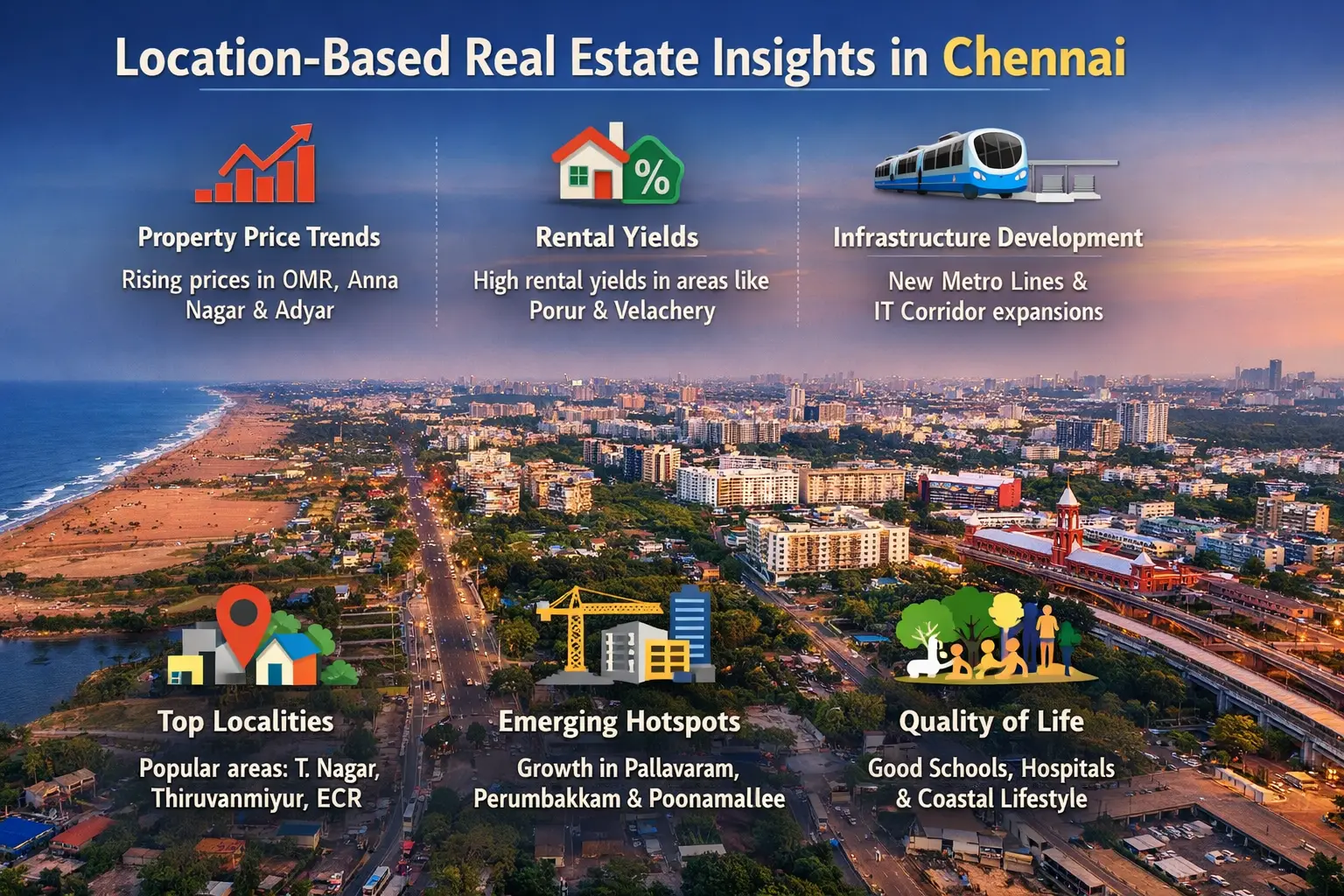
Location-based real estate insights explain how different locations within Chennai influence property prices, demand, growth, and usage. These insights are derived by studying geography, infrastructure, employment zones, population movement, and urban development patterns.
1. Role of Location in Chennai’s Real Estate Market
In Chennai, property value is highly dependent on micro-location. Two properties with similar size and construction quality can have very different values solely due to their location.
Key location-dependent factors include:
- Distance from employment hubs
- Transport connectivity
- Availability of civic infrastructure
- Flood risk and environmental conditions
- Density and land availability
- Social infrastructure (schools, hospitals, retail)
Location acts as the primary driver, while property features act as secondary drivers.
2. Infrastructure-Led Location Insights
Transport Infrastructure
Areas connected by major roads and public transit experience:
- Higher residential demand
- Faster appreciation
- Stronger rental markets
Key transport elements shaping Chennai’s real estate:
- Radial roads (OMR, GST Road)
- Inner Ring Road and Outer Ring Road
- Metro rail corridors
The expansion of the Chennai Metro Rail has changed accessibility patterns, making previously distant areas more integrated with the city.
Insight: Locations closer to transit nodes show sustained demand regardless of market cycles.
3. Employment-Driven Location Patterns
Chennai’s real estate demand is strongly linked to job concentration zones.
Major employment clusters influence nearby residential markets:
- IT and technology services
- Manufacturing and industrial belts
- Port-related logistics
- Healthcare and education institutions
The Old Mahabalipuram Road functions as a major employment spine. Residential areas surrounding it developed rapidly due to daily commuting needs.
Insight: Residential growth follows employment density, not administrative boundaries.
4. Central, Intermediate, and Peripheral Location Dynamics
Central Locations
Central parts of Chennai:
- Have limited land availability
- Are densely populated
- Show stable but slower price growth
Demand is driven by:
- Proximity to established business districts
- Social prestige
- Long-term residents
Intermediate Locations
These areas lie between the city core and outskirts:
- Benefit from both connectivity and land availability
- Experience consistent appreciation
- Serve mixed residential and commercial purposes
Peripheral Locations
Outer zones of Chennai:
- Have larger land parcels
- Lower entry prices
- Depend heavily on infrastructure development
Growth here is infrastructure-led rather than demand-led initially.
Insight: Distance from the city center alone does not determine value—connectivity does.
5. Price Variation Based on Location
Property prices in Chennai vary widely due to:
- Road frontage
- Flood vulnerability
- Neighborhood maturity
- Utility availability
Even within the same locality:
- Properties near main roads or transit nodes command premiums
- Interior streets have lower valuations
Insight: Micro-location (street-level positioning) matters as much as locality name.
Also Read: North Chennai Vs South Chennai Property Price vs Growth Comparison 2020 To 2026
6. Environmental and Physical Location Factors
Certain natural and physical aspects affect location performance:
- Low-lying areas prone to waterlogging
- Proximity to marshlands or coast
- Soil quality and drainage
Locations with recurring flooding history show:
- Slower price recovery
- Higher buyer hesitation
- Greater rental volatility
Insight: Environmental resilience is now a measurable location value factor in Chennai.
7. Social Infrastructure and Liveability
Location quality is also defined by access to:
- Schools and colleges
- Hospitals and clinics
- Retail and daily-use services
- Parks and open spaces
Areas with strong social infrastructure:
- Attract end-users rather than speculative buyers
- Show stable long-term demand
- Retain value during market downturns
Insight: Locations supporting daily life needs outperform purely speculative zones.
8. Demand Segmentation by Location
Different locations in Chennai attract different user groups:
- Central areas → established families and professionals
- IT corridor zones → working professionals and tenants
- Peripheral areas → first-time buyers and long-term residents
Each segment creates distinct demand behavior, influencing:
- Unit sizes
- Property types
- Rental versus ownership ratios
Insight: Location determines who buys, why they buy, and how long they stay.
9. Long-Term Urban Development Impact
Chennai’s urban expansion is directional:
- Growth aligns with infrastructure corridors
- Development clusters rather than spreads evenly
Planned infrastructure causes:
- Land-use changes
- Shift from agricultural to residential zoning
- Gradual commercial emergence
Insight: Long-term location value is shaped by city planning and infrastructure sequencing.
10. Location-Based Insights in Chennai
- Location is the primary value determinant in Chennai real estate
- Connectivity outweighs distance from city center
- Employment hubs anchor residential demand
- Infrastructure transforms peripheral locations
- Environmental factors influence buyer confidence
- Social infrastructure stabilizes long-term demand
- Micro-location differences create price variation
- Urban planning defines future growth corridors