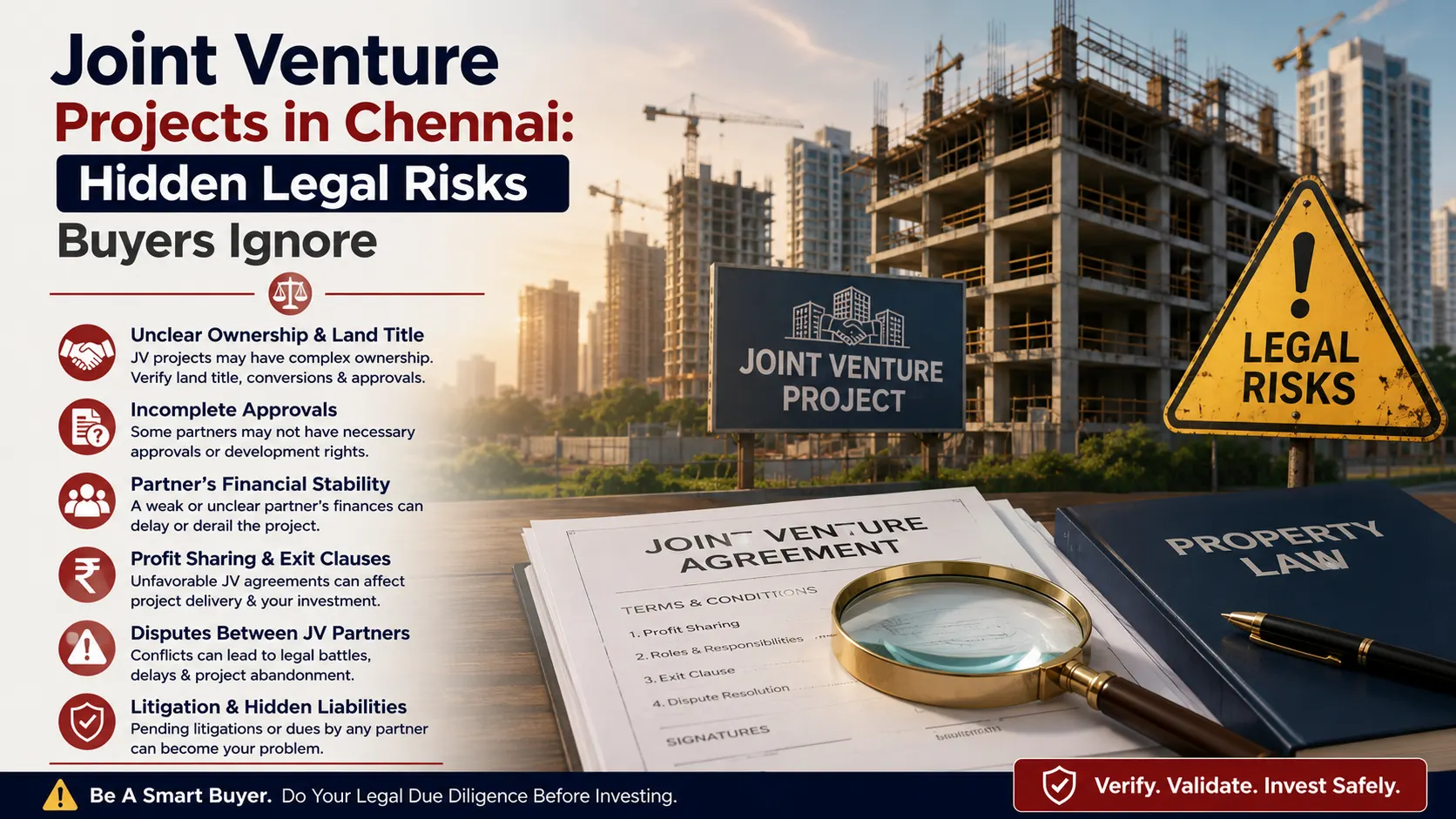
Joint Venture (JV) projects are common across Chennai, especially in fast-growing residential areas. While they often offer competitive pricing and prime locations, they also carry serious legal risks that many buyers discover only after booking or registration. Understanding these risks can save you from financial loss, delayed possession, or litigation.
1. What Is a Joint Venture (JV) Project?
A joint venture real estate project is a collaboration between
- Landowner – provides the land
- Developer/Builder – constructs and markets the project
In return, the constructed units are shared between the landowner and developer based on a pre-agreed ratio (for example, 60:40).
2. Unclear or Disputed Land Title
Hidden Risk
Many JV projects proceed with imperfect or partially verified land titles.
Common issues include:
- Missing parent documents
- Inheritance disputes among heirs
- Unregistered family partitions
- Power of Attorney misuse
Why Buyers Ignore This
- The builder claims “title is clear."
- Buyers rely on bank loan approval (which is not a legal guarantee)
What You Must Verify
- 30–40 years chain of title documents
- Latest Encumbrance Certificate (EC)
- Legal opinion from independent property lawyer
3. Incomplete or One-Sided Joint Development Agreement
Hidden Risk
The Joint Development Agreement (JDA) between the landowner and developer may:
- Be unregistered
- Have expired validity
- Restrict developer’s right to sell certain flats
If the developer sells units beyond their allocation, buyers may face ownership challenges.
Buyer Protection Tip
- Ensure the JDA is registered
- Confirm the flat you are buying belongs to developer’s share
- Ask for Power of Attorney (POA) validity
4. Power of Attorney
Hidden Risk
Developers often sell flats using POA from the landowner.
Problems arise when:
- POA is revoked without notice
- POA holder exceeds authority
- POA expires or landowner dies
In such cases, sale deeds can be challenged.
Safety Check
- POA must be registered
- POA must clearly authorize sale & registration
- Verify landowner is alive at registration time
5. Landowner Disputes During or After Construction
Hidden Risk
Disputes may arise due to:
- Profit-sharing disagreements
- Construction delays
- Change in project plan
Landowners can:
- File court cases
- Issue injunctions
- Block completion certificates
Buyers get stuck despite full payment.
6. CMDA / DTCP Approval Mismatch
Hidden Risk
Some JV projects advertise approvals, but:
- Build extra floors or units
- Deviate from sanctioned plan
- Have land approved but building not approved
This affects:
- Completion Certificate (CC)
- Occupancy Certificate (OC)
- Resale & bank loan eligibility
Always check.
- Sanctioned building plan
- Planning permit number
- Completion / Occupancy Certificate (mandatory)
Also Read: CMDA vs DTCP vs TNRERA Guide for Chennai Property Buyers
7. Undivided Share (UDS) Errors
Hidden Risk
Incorrect or vague UDS allocation in a sale deed can
- Reduce your legal land ownership
- Cause problems during redevelopment
- Affect resale value
Many buyers focus only on the carpet area and ignore UDS.
8. RERA Compliance Gaps
Hidden Risk
- Some JV projects:
- Are partially registered under RERA
- Show misleading carpet area
- Fail to update completion timelines
Buyer Must Verify
- RERA registration number
- Project status on RERA website
- Promoter vs landowner responsibilities
9. Sale Agreement Clauses That Favor Builder
Watch out for:
- No penalty for builder delays
- Unlimited force-majeure clauses
- No clarity on amenities handover
- Maintenance responsibility confusion
These clauses heavily disadvantage buyers in JV setups.
Conclusion
Joint Venture projects in Chennai are not bad by default, but they are legally complex. Buyers who fail to perform due diligence often pay the price later through court cases, stalled registrations, or resale failures.