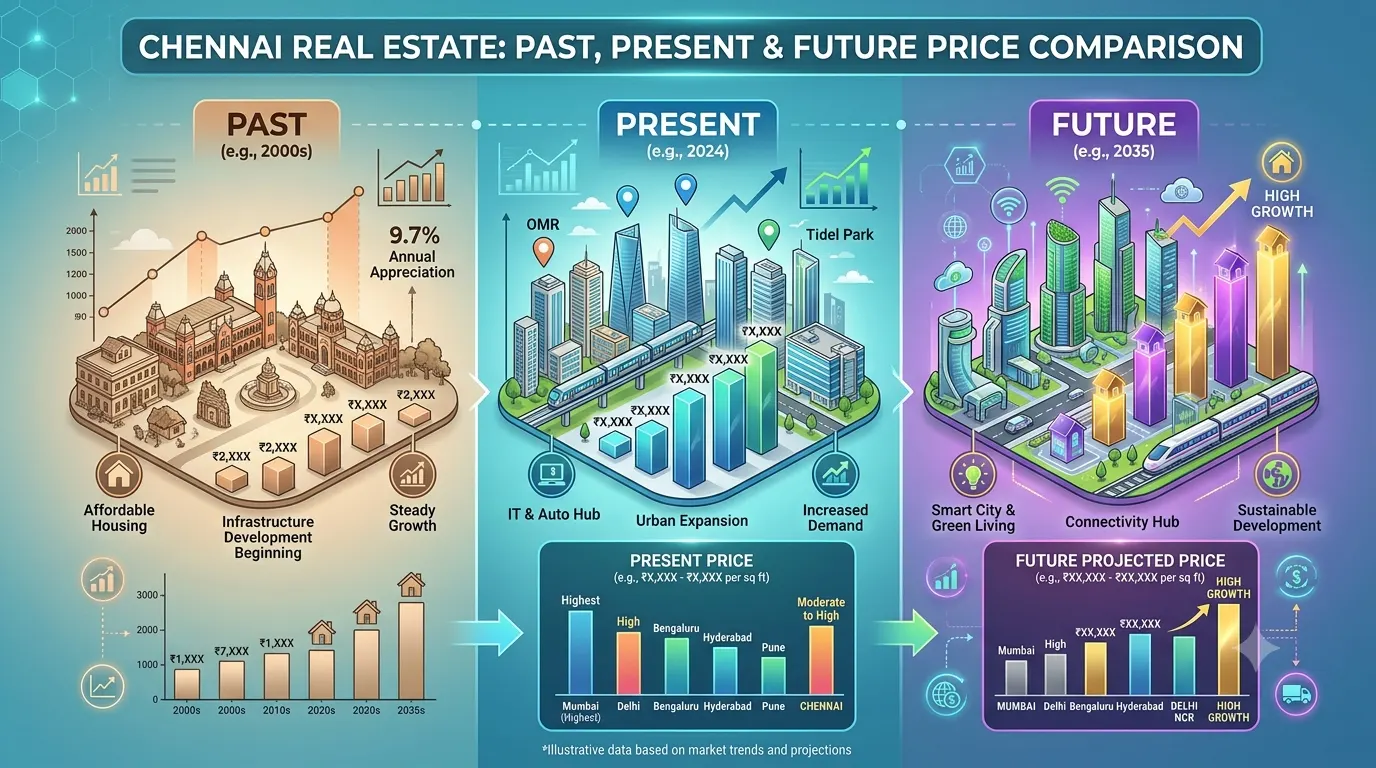
Chennai has long been considered one of India’s most stable and end-user–driven real estate markets. Unlike highly speculative cities, Chennai’s property growth has been steady, backed by employment, infrastructure, and industrial expansion. This insight compares Chennai’s past, present, and future property prices with other major Indian cities to help buyers, investors, and developers understand long-term value.
1. Chennai Real Estate – Past Trends 2005–2014
Price Movement
- 2005 average price: Rs 1,500 – Rs 2,500 per sq.ft
- 2014 average price: Rs 4,000 – Rs 6,000 per sq.ft
- Growth was moderate but consistent, unlike boom-and-bust cycles elsewhere.
Key Growth Drivers
- IT corridor development along OMR
- Expansion of automobile and manufacturing hubs (Oragadam, Sriperumbudur)
- Stable job creation and strong end-user demand
Chennai vs Other Cities Past
- Mumbai already commanded premium prices (Rs 12,000+ per sq.ft)
- Bengaluru saw rapid IT-led appreciation
- Hyderabad was relatively affordable with slow growth
- Chennai remained less speculative but safer
Insight: Chennai buyers focused on self-use, limiting artificial price inflation.
Also Read: North Chennai Vs South Chennai Property Price vs Growth Comparison 2020 To 2026
2. Chennai Real Estate – Present Market 2024–2026
Current Average Prices Approx.
- Core city areas: Rs 9,000 – Rs 14,000 per sq.ft
- OMR & GST Road: Rs 6,500 – Rs 9,000 per sq.ft
- Emerging suburbs: Rs 4,500 – Rs 6,500 per sq.ft
Present-Day Market Strengths
- Metro Phase 2 expansion
- Strong rental demand from IT & manufacturing workforce
- Improved road, rail, and airport connectivity
- Preference for ready-to-move and mid-segment homes
City Comparison – Present
- Delhi NCR: High variation, Rs 6,000 – Rs 25,000 per sq.ft
- Pune: Rs 7,000 – Rs 12,000 per sq.ft
- Mumbai remains unaffordable for most end-users
- Hyderabad shows faster appreciation but higher volatility
Insight: Chennai currently offers one of the best price-to-income ratios among Tier-1 cities.
3. Chennai Real Estate – Future Outlook 2026–2035
Expected Price Growth
- Projected CAGR: 6% – 8% annually
- Premium micro-markets may see 10%+ growth
- Affordable and mid-segment homes will dominate demand
Future Growth Catalysts
- Completion of Metro Phase 2 & Phase 3
- Expansion of IT parks, data centers, and EV manufacturing
- Port-led development and logistics corridors
- Rise of mixed-use developments and township projects
Future Comparison with Other Cities
- Bengaluru may face infrastructure saturation
- Mumbai growth limited by affordability constraints
- Hyderabad likely to grow faster short-term, but riskier
- Chennai positioned as a low-risk, long-term appreciation market
Insight: Chennai may not spike rapidly, but it offers predictable and sustainable capital growth.
4. Chennai vs Other Cities – Snapshot Comparison
City / Avg Price (Rs/sq.ft)
Chennai
- 6,500 – 14,000
Mumbai
- 20,000 – 60,000
Bengaluru
- 7,000 – 15,000
Hyderabad
- 6,000 – 12,000
Delhi NCR
- 6,000 – 25,000
5. Investor & Homebuyer Insights
Why Chennai Stands Out
- Less speculative pricing
- Strong legal and planning discipline
- High end-user demand
- Better affordability compared to income levels
Best Strategy
- Homebuyers: Buy now in emerging metro-connected locations
- Investors: Focus on rental corridors near IT & industrial hubs
- Long-term investors: Chennai is ideal for wealth preservation + steady growth
Conclusion
Chennai real estate has evolved from a slow-growing traditional market to a stable, infrastructure-driven metro market. While cities like Mumbai and Bengaluru attract attention with rapid price spikes, Chennai delivers consistency, affordability, and long-term security.