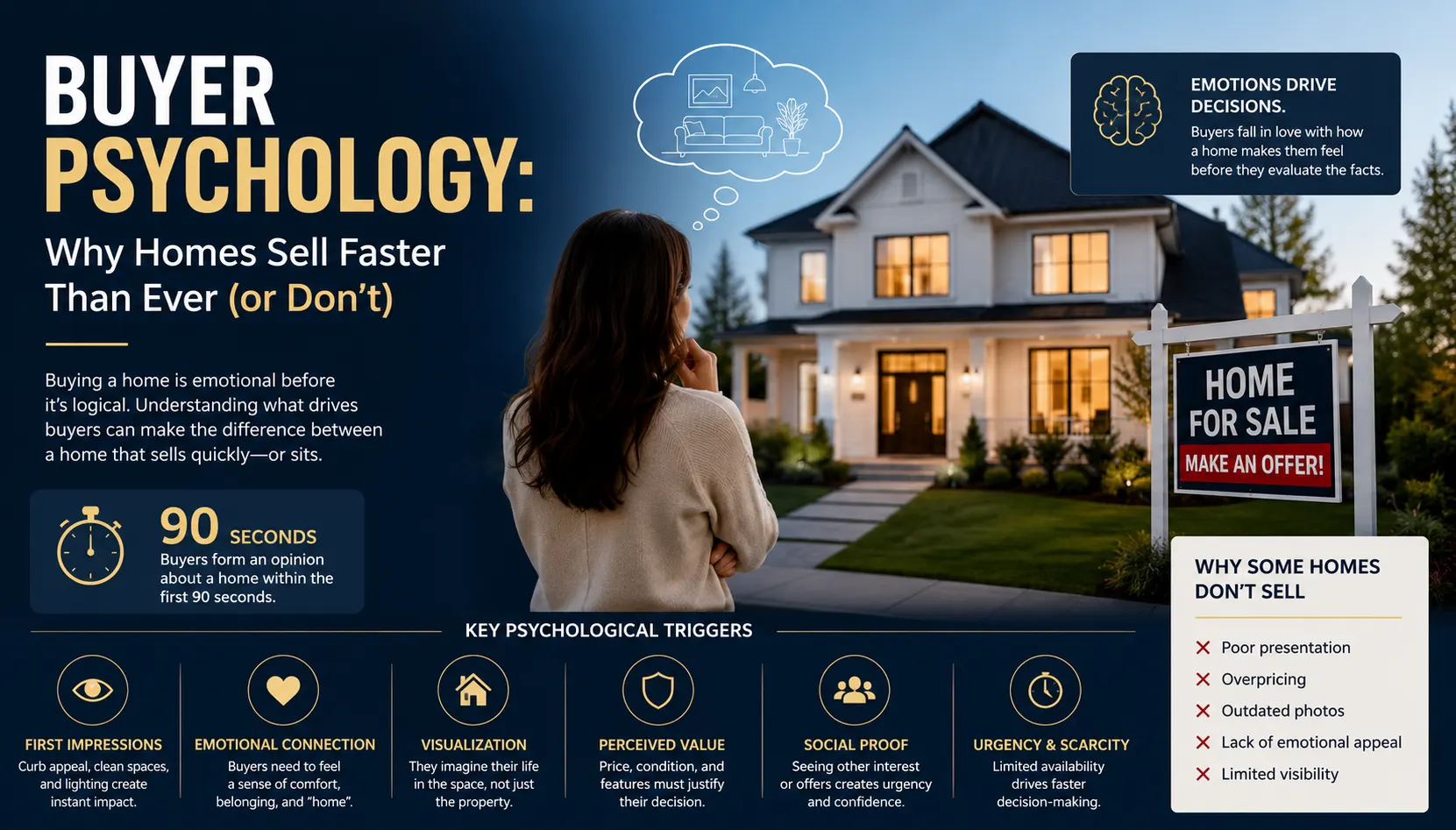
1. Buying a Home Is Emotional First, Logical Second
Most buyers believe they make rational decisions, but neuroscience and behavioral economics show the opposite:
- Emotion drives the decision
- Logic justifies it afterward
A buyer doesn’t fall in love with square footage or interest rates—they fall in love with the following:
- How the home feels
- Whether they can see themselves living there
- Whether it aligns with their identity, lifestyle, and aspirations
Homes that trigger positive emotions sell faster—even if they’re not the “best deal.”
Residential Property For Sale in Chennai
2. The 90-Second Rule: First Impressions Are Everything
Buyers form a strong opinion within the first 60–90 seconds, often before stepping fully inside.
What buyers subconsciously assess:
- Curb appeal
- Cleanliness and smell
- Light and openness
- Maintenance signals (“Will this be a headache? ”)
Once that initial impression forms, buyers tend to look for confirmation, not contradiction.
3. Emotional Triggers That Make Homes Sell Faster
A. Visualization (“I Can See My Life Here”)
Buyers want to mentally move in:
- Furniture placement
- Morning routines
- Family gatherings
- Work-from-home setups
Neutral, staged, and decluttered spaces outperform personalized or crowded homes because they allow projection.
B. Sense of Belonging
People aren’t just buying a house—they’re buying the following:
- Safety
- Status
- Comfort
- Community
Neighborhood cues (parks, schools, walkability, quiet streets) strongly influence perceived value—even more than interior features.
C. Perceived Value (Not Just Price)
Buyers evaluate value emotionally, not mathematically:
- “Does this feel worth the price?”
- “Does it look better than other homes at this level?”
A well-presented home at a higher price often sells faster than a poorly presented “deal.”
D. Social Proof
Buyers gain confidence when they sense demand:
- Multiple showings
- “Just listed” energy
- Buzz or interest from other buyers
Even subtle cues of competition can accelerate decision-making.
E. Urgency & Scarcity
Limited availability creates momentum.
- Tight inventory
- Time-bound offers
- High-demand locations
When buyers fear losing the home, hesitation drops dramatically.
4. Why Some Homes Don’t Sell (Even in Hot Markets)
1. Poor Presentation
- Cluttered interiors
- Bad lighting
- Unpleasant odors
- Low-quality or outdated photos
Buyers equate presentation with maintenance—even unfairly.
2. Overpricing
Overpricing doesn’t just reduce traffic—it damages psychology:
- Buyers compare, not calculate
- Overpriced homes feel "wrong."
- Longer days on market signal hidden problems
Once a listing stagnates, buyers approach it with skepticism.
3. Lack of Emotional Appeal
Homes that are:
- Too personalized
- Too empty and cold
- Too dark or closed off
fail to spark connection—even if technically sound.
4. Friction in the Buying Process
Buyers avoid homes that feel hard:
- Complicated showing schedules
- Poor listing descriptions
- Missing disclosures or details
Friction kills momentum.
5. Weak Storytelling
Every fast-selling home tells a story:
- Who it’s for
- How it fits a lifestyle
- Why it’s special right now
Listings that just list features don’t inspire action.
5. Buyer Behavior Has Shifted (Why Homes Sell Faster Than Ever)
Modern buyers:
- Browse hundreds of listings online
- Decide emotionally before showing
- Expect homes to be “move-in ready”
- Compare relentlessly
This leads to polarization:
- Great homes sell very fast
- Average homes sit longer
- Poorly positioned homes get ignored
The gap between winners and losers has widened.
6. How Sellers & Agents Can Use Buyer Psychology
To Sell Faster:
- Optimize the first impression
- Stage for lifestyle, not decoration
- Price for perceived value, not ego
- Create momentum early
- Reduce friction everywhere
To Avoid Stagnation
- Fix emotional deal-breakers before listing
- Don’t rely on “the market” to save bad presentations.
- Reposition quickly if momentum stalls
7. Conclusion
Homes don’t sell faster because markets are hot.
They sell faster because they make buyers feel confident, excited, and afraid to miss out.
- When a home aligns emotion, value perception, and timing—it moves.
- When it doesn’t—buyers wait, hesitate, or walk away.