1. What Is the 20/30/40 Rule?
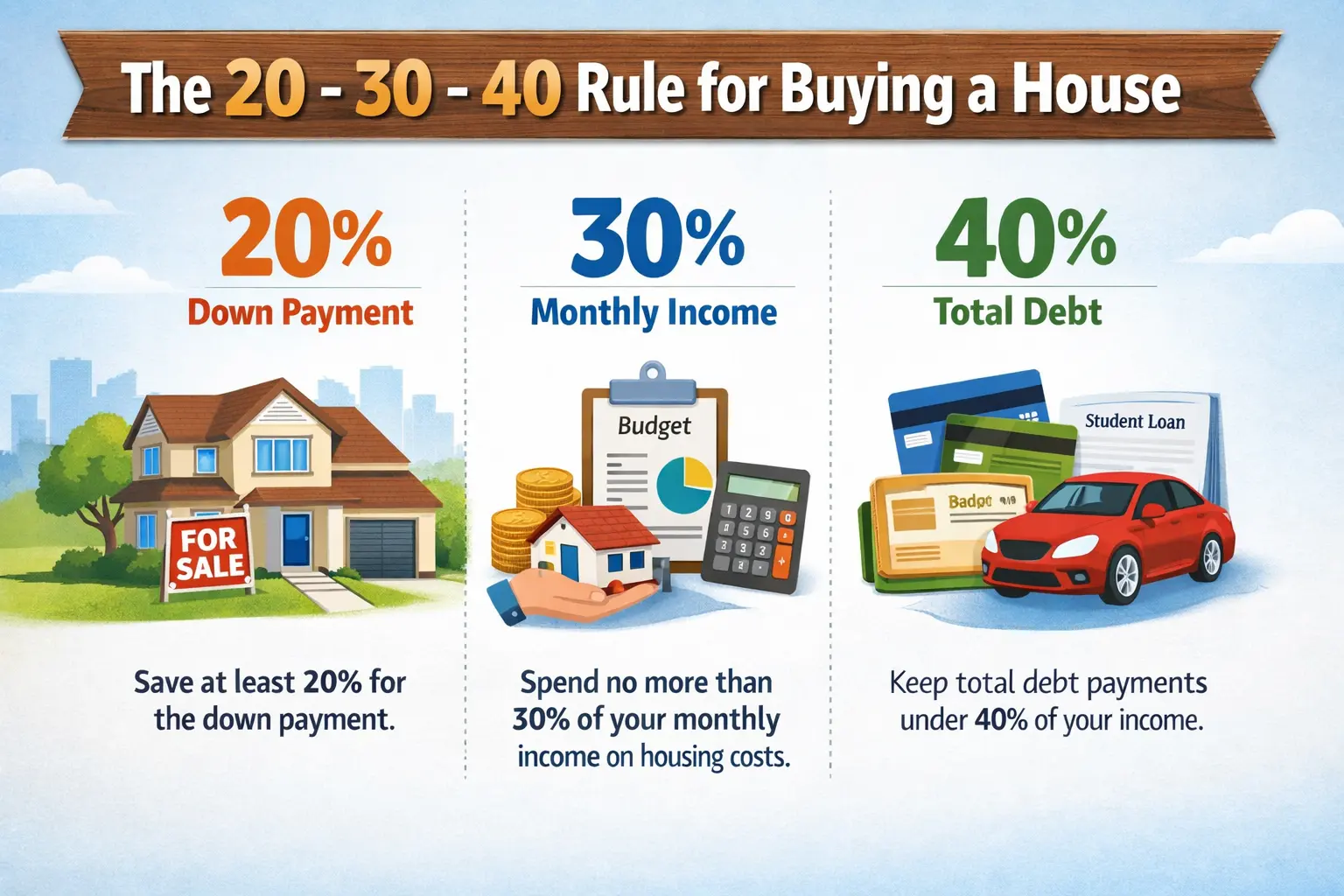
The 20/30/40 rule is a personal financial planning framework that helps you decide how much house you can safely afford in India without damaging your long-term financial health.
It is NOT:
- An RBI rule
- A bank guideline
- A legal requirement
It IS:
- A safety-based affordability rule
- Designed for long-term EMI stability
- Especially useful in India due to floating interest rates and long loan tenures
2. Meaning of Each Number in the Rule
| Number | Meaning | What it Controls |
| 20% | Down Payment | Controls loan size & Interest burden |
| 30% | Housing EMI limit | Controls montly cash flow |
| 40% | Total EMI limit | Controls overall debt stress |
Each part protects you from a different financial risk.
3. The 20% Down Payment Rule (Explained in Detail)
3.1 What Does 20% Mean?
You should ideally pay at least 20% of the property value from your own funds (savings, investments, etc.).
Example
- Property price: ?70 lakh
- Minimum down payment (20%): ?14 lakh
- Home loan: ?56 lakh
3.2 Why 20% Is Important in India
(a) Bank Loan Limits
Most Indian banks:
- Finance 75–80% of property value
- Charge higher interest if loan >80%
Paying 20% keeps you in the lowest-risk category.
(b) Interest Cost Reduction
Long home loan tenures (20–30 years) mean:
- Interest paid can exceed principal
- Even small loan increases cost lakhs more
Paying 20% upfront can save Rs 20–40 lakh in interest over time.
(c) Protection Against Price Stagnation
Indian property prices:
- Do not always rise
- Can remain flat for years
A 20% down payment:
- Protects you from negative equity
- Gives flexibility to sell or refinance
3.3 Hidden Costs (Very Important in India)
Many buyers make mistakes here.
| Expense | Approx Cost |
| Satmp Duty | 5 - 8% |
| Registration | 1-2% |
| GST ( under construction ) | 5% |
| Legal & Loan charges | 0.5 - 1 % |
| Interior & Furniture | 5 - 10% |
4. The 30% Housing EMI Rule (Detailed)
4.1 What Does 30% Mean?
Your total monthly housing cost should not exceed 30% of your gross monthly income.
Housing Cost Includes:
- Home loan EMI
- Maintenance charges
- Society charges
- Property tax (if paid monthly)
4.2 Why 30% Is Safe in India
(a) Floating Interest Rates
Indian home loans:
- Are mostly floating rate
- EMI can increase anytime
A loan affordable at 8% may become stressful at 10%.
(b) Life Expenses Keep Increasing
- School fees
- Medical costs
- Family responsibilities
Keeping EMI ≤30% ensures flexibility.
4.3 Example Calculation
- Monthly income: Rs 1,00,000
- Max housing EMI (30%): Rs 30,000
This EMI level remains manageable even if rates rise.
4.4 Banks vs Real Life
| EMI % | Bank View | Reality |
| 50 - 60% | Approved | Financial Stress |
| 40 % | Acceptable | Risky |
| 30 % | Ideal | Sustainable |
Bank approval does NOT mean affordability
Also Read: Did You Know Different Between Home Loan and Land Loan
5. The 40% Total EMI Rule (Most Critical)
5.1 What Does 40% Mean?
Your total monthly EMIs (all loans combined) should not exceed 40% of your gross income.
5.2 What Is Included in 40%?
- Home loan EMI
- Car loan EMI
- Personal loan EMI
- Education loan EMI
- Credit card EMI
5.3 Why 40% Is the Upper Limit
Indian households face:
- Job loss risk
- Medical emergencies
- Unexpected family expenses
Crossing 40%:
- Leaves no emergency buffer
- Damages credit score
- Increases default risk
5.4 Example
Monthly income: Rs 1,20,000
| Loan | EMI |
| Home Loan | RS 36,000 |
| Car Loan | Rs 8,000 |
| Personal Loan | Rs 4,000 |
| Total | Rs 48,000 ( 40 % ) |
This is the maximum safe limit.
6. Full Combined Example (Start to Finish)
Buyer Profile
- Monthly income: Rs 1,50,000
- Existing EMI: Rs 10,000
Step 1: Housing EMI Limit (30%)
Rs 1,50,000 × 30% = Rs 45,000
Step 2: Total EMI Limit (40%)
Rs 1,50,000 × 40% = Rs 60,000
Remaining EMI capacity = Rs 50,000
But housing EMI must stay ≤ Rs45,000.
Step 3: Loan Eligibility
At 9% interest for 20 years:
- Rs 45,000 EMI ≈ Rs 47–50 lakh loan
Step 4: Property Budget
- Loan: Rs 50 lakh
- Down payment (20%): Rs 12.5 lakh
- Safe property price ≈ Rs 62–65 lakh
7. Tax Benefits (Important but Overrated)
| Section | Maximum Benefits |
| 80C | Rs 1.5 Lakh |
| 24 ( b ) | Rs 2 lakh |
| 80EEA | Extra Rs 1.5 lakh |
Tax benefits do not reduce EMI, only tax outflow.
Never stretch your budget assuming tax savings.
8. When Can You Slightly Bend the Rule?
| Situation | Flexibility |
| Dual Income | Slight |
| High Income | Slight |
| Rental Income | Careful |
| Variable Income | No |
| Single Income | Strict |
9. Who Should Follow It Strictly?
- First-time buyers
- Single earners
- Salaried professionals
- Middle-income families
- Buyers in unstable job sectors
10. Conclusion
- The 20/30/40 rule helps you buy a house without sacrificing financial peace.
- It focuses on long-term comfort, not just loan approval.
- A house should improve your life, not control it.
FAQs – 20/30/40 Rule in India
Q1. Is the 20/30/40 rule compulsory?
No. It is a financial safety guideline, not a law.
Q2. Should income be taken before or after tax?
Always gross income.
Q3. Can bonuses be included?
No. Use only fixed income.
Q4. Can I take a loan with EMI above 30%?
Yes, but it increases financial risk.
Q5. Does this apply to joint home loans?
Yes, based on combined income.
Q6. Can I depend on future salary growth?
No. EMIs are fixed; income is uncertain.
Q7. Is 40% EMI conservative?
No. It protects against emergencies and job loss.
https://www.livehomes.in/blogs