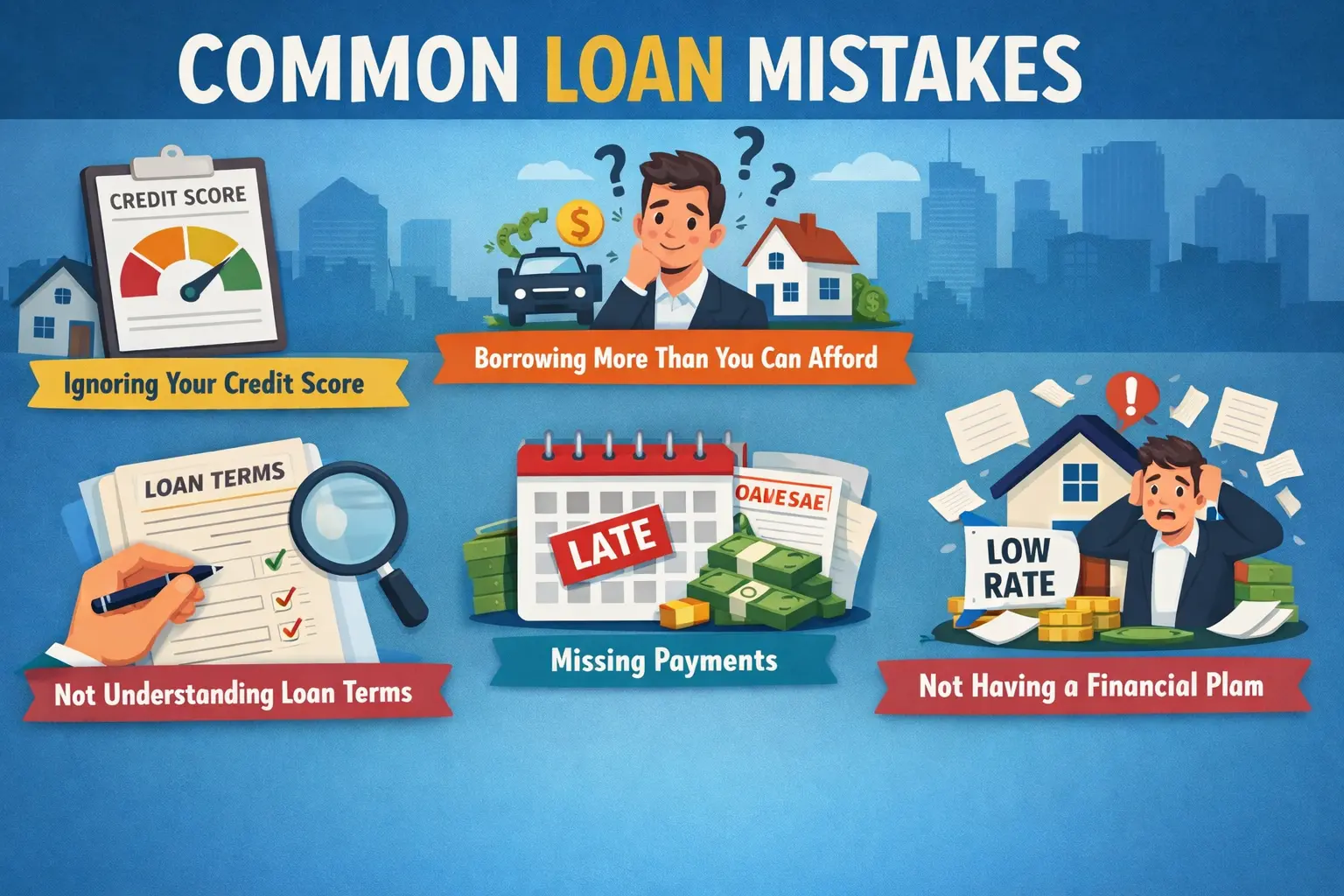
A home loan is usually the largest and longest financial commitment in a person’s life (15–30 years). Small mistakes at the beginning can lead to huge financial losses, stress, and legal problems later.
1. Not Checking Credit Score Before Applying
What people do:
Many borrowers apply for a home loan without checking their credit score.
Why this is a mistake:
- Banks decide loan eligibility, interest rate, and approval based on credit score.
- A low score results in:
- Loan rejection
- Higher interest rate
- Lower loan amount
- Multiple loan rejections reduce your score further.
Example:
If your credit score is:
- 780 → Interest rate: 8.5%
- 650 → Interest rate: 10.5%
On a ?50 lakh loan for 20 years, this difference can cost ?15–20 lakhs extra interest.
Correct approach:
- Check your credit score before applying.
- Maintain score 750 or above.
- Pay credit card dues and EMIs on time.
- Avoid too many loan inquiries.
2. Borrowing the Maximum Loan Offered
What people do:
Banks offer a high loan amount, and borrowers take the maximum possible loan.
Why this is a mistake:
- Banks calculate eligibility based on current income, not future expenses.
- High loan means:
- Higher EMI
- Less savings
- Financial pressure
Hidden danger:
- Job loss
- Salary cut
- Medical emergencies
- Inflation
Example:
Income = ?80,000/month
Bank allows EMI = ?40,000
After expenses → No savings left
Correct approach:
- EMI should be not more than 30–40% of monthly income.
- Always leave room for:
- Savings
- Insurance
- Emergency fund
3. Focusing Only on EMI, Ignoring Total Interest Cost
What people do:
They choose loans with low EMI, usually by extending tenure.
Why this is a mistake:
- Longer tenure = much more interest
- You may pay double or even triple the loan amount.
Example:
Loan: ?40 lakh at 9%
| Tendure | EMI | Amount |
| 15 yrs | Rs 40,571 | Rs 33 |
| 30 yrs | Rs 32,186 | Rs 76 |
Correct approach:
- Choose shortest affordable tenure.
- Increase EMI when income increases.
- Make early prepayments.
4. Not Comparing Multiple Lenders
What people do:
They take loan from:
- Their salary account bank
- Builder-recommended bank
- First bank they visit
Why this is a mistake:
- Interest rates differ by 0.25%–1%
- Processing fees vary
- Service quality differs
Hidden impact:
Even 0.5% higher interest can cost lakhs over 20 years.
Correct approach:
- Compare at least 3–5 banks or NBFCs
- Compare:
- Interest rate
- Processing fee
- Prepayment charges
- Customer service
5. Choosing Wrong Interest Rate Type (Fixed vs Floating)
Fixed Interest Rate:
- Rate remains same for limited period
- Usually higher than floating rate
Floating Interest Rate:
- Changes with market conditions
- Usually cheaper in long term
Common mistake:
- Borrowers choose without understanding risks.
Correct approach:
- Long-term loans → Floating rate
- Understand:
- Rate reset frequency
- Conversion charges
- Spread over benchmark
6. Ignoring Hidden Charges and Fees
Common hidden charges:
- Processing fee (0.25%–1%)
- Legal verification charges
- Property valuation fees
- Technical inspection fees
- Foreclosure or conversion charges
- Late payment penalties
Why this is a mistake:
- These costs increase effective interest rate
- Not disclosed clearly by agents
Correct approach:
- Ask for written fee breakup
- Calculate total loan cost
- Negotiate processing fees
7. Not Reading Loan Agreement Carefully
What people do:
They sign loan documents without reading them.
Why this is dangerous:
Loan agreement is a legal contract.
Risky clauses include:
- Interest rate reset terms
- Prepayment penalties
- Penal interest clauses
- Force majeure conditions
- Bank’s right to change tenure/EMI
Correct approach:
- Read entire agreement
- Ask questions
- Take expert/legal help if needed
8. No Prepayment Strategy
What people do:
They pay EMI regularly but never prepay.
Why this is a mistake:
- Interest is highest in early years
- Missing prepayment opportunity wastes money
Example:
Prepaying ?2 lakh in year 3 can save:
- ?4–6 lakh interest
- 3–5 years tenure
Correct approach:
- Prepay whenever:
- Bonus received
- Salary increases
- Extra savings available
- Target principal reduction early
9. Ignoring Future Interest Rate Rise
What people assume:
Current interest rate will continue forever.
Reality:
- Floating rates increase with inflation
- EMI or tenure increases
Risk:
- EMI shock
- Budget imbalance
Correct approach:
- Keep EMI buffer
- Choose EMI increase instead of tenure increase
- Monitor loan annually
10. Not Taking Proper Home Loan Insurance
Common mistake:
- No insurance
- Expensive bank-forced insurance
Risk:
If borrower dies:
- Family inherits loan
- Property may be seized
Correct approach:
- Buy separate term insurance
- Coverage = outstanding loan
- Avoid single-premium policies
Also Read: Latest RBI Guidenline for Home Loan in 2025
11. Using All Savings for Down Payment
What people do:
They use all savings to pay down payment.
Why this is risky:
- No emergency fund
- Financial stress if unexpected expenses arise
Correct approach:
- Keep 6 months expenses as emergency fund
- Do not exhaust all savings
12. Missing or Delaying EMI Payments
Consequences:
- Late fees
- Penal interest
- Credit score drop
- Legal notices
Correct approach:
- Enable auto-debit
- Maintain buffer balance
- EMI should be top priority
13. Not Reviewing or Transferring Loan
What people do:
They stick with same lender for years.
Why this is a mistake:
- Market rates drop
- Bank may not reduce your rate automatically
Correct approach:
- Review loan every year
- Transfer loan if:
- Savings > transfer cost
- Service is poor
CONCLUSION
A home loan mistake can cost:
- Lakhs of rupees
- Mental stress
- Legal trouble
- Financial insecurity
Smart borrower should:
- Plan carefully
- Compare options
- Read documents
- Prepay regularly
- Review loan yearly
FAQs ON COMMON HOME LOAN MISTAKES
Q1. What is the biggest mistake people make while taking a home loan?
Answer:
The biggest mistake is borrowing more than they can comfortably afford. Many people take the maximum loan offered by the bank without considering future expenses like medical costs, children’s education, or job changes. This leads to financial stress and EMI defaults.
Q2. Why is checking credit score important before applying for a home loan?
Answer:
Credit score shows your repayment history and financial discipline. Banks use it to decide:
- Loan approval
- Interest rate
- Loan amount
A low credit score can result in higher interest rates or rejection, increasing the total cost of the loan.
Q4. What percentage of income should be used for home loan EMI?
Answer:
Ideally, EMI should not exceed 30–40% of your monthly income. This ensures you have enough money left for daily expenses, savings, insurance, and emergencies.
Q5. Why is comparing lenders important?
Answer:
Different banks offer different:
- Interest rates
- Processing fees
- Loan terms
- Customer service
Even a small interest rate difference can save or cost lakhs of rupees over the loan period.
Q6. What is the difference between fixed and floating interest rates?
Answer:
- Fixed rate: Interest remains the same for a certain period.
- Floating rate: Interest changes according to market conditions.
For long-term home loans, floating rates are usually more economical, but they carry the risk of rate increases.
Q7. What hidden charges should borrowers watch out for?
Answer:
Common hidden charges include:
- Processing fees
- Legal and valuation charges
- Technical inspection fees
- Loan conversion fees
- Late payment penalties
These charges increase the effective cost of the loan.
Q8. Why is prepayment important in a home loan?
Answer:
Prepayment reduces the principal amount, which lowers the interest charged. Prepaying early in the loan tenure can save a large amount of interest and shorten the loan duration.
Q9. When is the best time to prepay a home loan?
Answer:
The best time is during the initial years of the loan because interest is highest then. Prepaying later has less impact on interest savings.
Q10. Can interest rates increase during the loan period?
Answer:
Yes. Floating interest rates depend on market conditions and can rise due to inflation or policy changes. This can increase your EMI or extend the loan tenure.
Q11. Is home loan insurance mandatory?
Answer:
No, it is not legally mandatory. However, it is highly recommended to protect your family from loan liability in case of death or disability of the borrower.
Q12. Should I use all my savings for down payment?
Answer:
No. Using all savings leaves you without an emergency fund. Always keep at least 6 months of expenses aside for emergencies.
Q13. What happens if I miss EMI payments?
Answer:
Missing EMIs leads to:
- Late fees and penalties
- Credit score reduction
- Legal action
- Difficulty in future loans
Repeated defaults can lead to property seizure.
Q14. What is the best way to avoid home loan mistakes?
Answer:
The best way is to:
- Plan finances properly
- Compare lenders
- Read agreements
- Maintain emergency fund
- Prepay when possible
- Review loan regularly
https://www.livehomes.in/news_letter