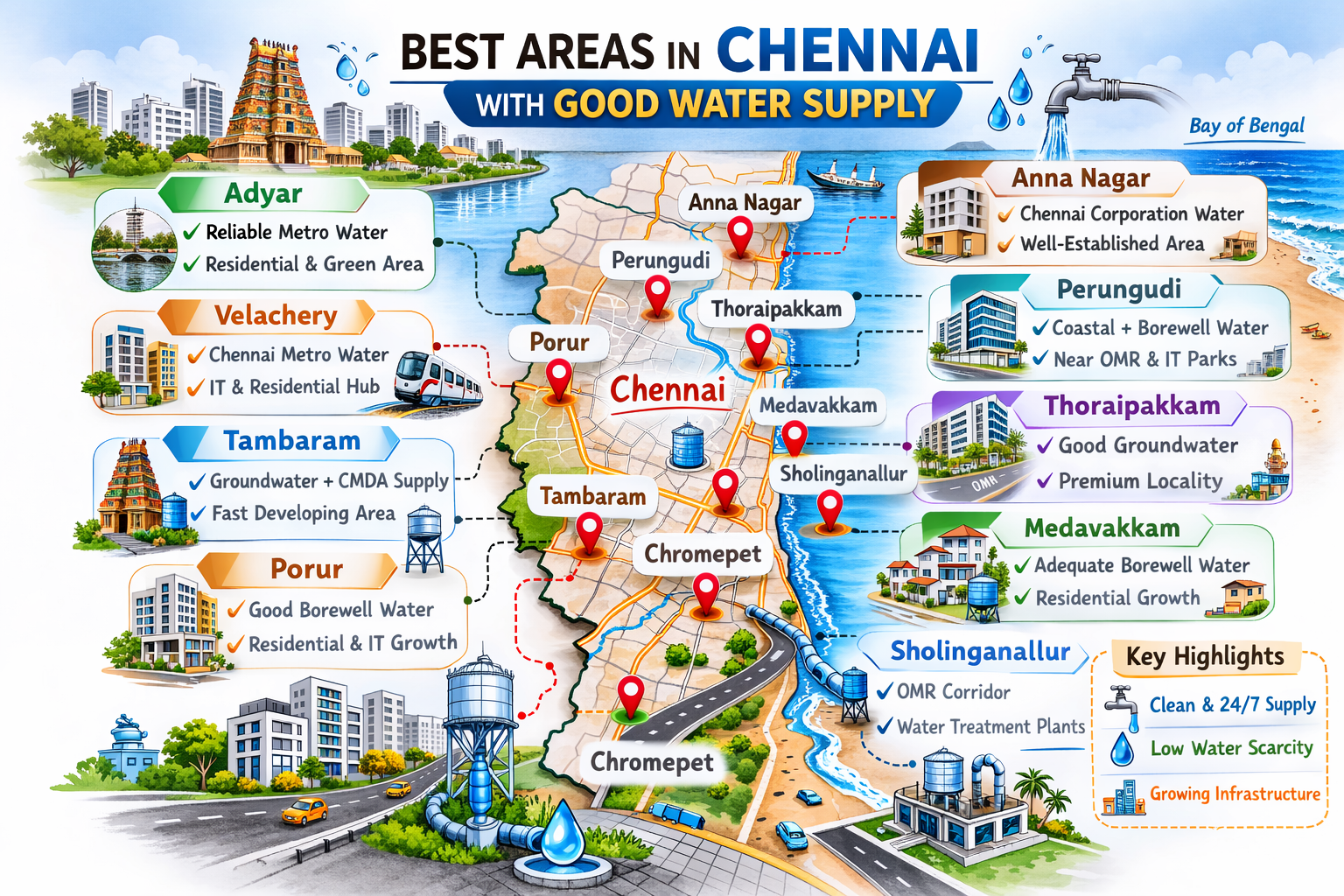
In Chennai, water availability is not just a civic issue—it directly affects monthly expenses, resale value, and quality of life. Two homes priced the same can have vastly different living costs depending on water security.
How Water Supply Really Works in Chennai (Ground Reality)
Most Chennai homes depend on a combination system, not a single source:
- Metro Water (CMWSSB) – Limited days per week
- Borewell – Depends on recharge and soil
- Rainwater harvesting – Critical support system
- Tanker water – Emergency / summer fallback
Areas that perform well are those where at least two sources remain reliable year-round.
Deeper Area-Wise Insights
Anna Nagar – Why It Stays Reliable Year After Year
Beyond pipelines, Anna Nagar benefits from:
- Wide roads and open plots allowing recharge
- Less over-construction compared to IT corridors
- Older buildings with large underground sumps
Even during severe drought years, Anna Nagar apartments report lower tanker usage compared to newer suburbs.
Buyer tip: Ask about borewell recharge pits, not just borewell depth.
Adyar – Natural Advantage Meets Infrastructure
Adyar’s proximity to the river helps groundwater recover faster after monsoons. Unlike marsh areas, the soil here supports stable percolation without stagnation.
However:
- Low-lying streets near the river may face flooding
- Elevated plots perform best for water and safety
Buyer tip: Choose raised ground micro-locations within Adyar.
Besant Nagar – Coastal Water Nuance Explained
Coastal areas confuse buyers. Besant Nagar performs well because:
- Controlled building height
- Less borewell over-extraction historically
But:
- Deep borewells can turn saline
- Shallow borewells + Metro Water combo works best
Buyer tip: Ask if the building uses RO desalination or blending systems.
Mylapore – Why Old Areas Outperform New Ones
Older neighborhoods like Mylapore benefit from:
- Lower apartment density
- Mature drainage networks
- Consistent Metro Water schedules
New high-rise areas often overload water systems; Mylapore avoids this.
Buyer tip: Check the Metro Water connection year—older connections tend to be more reliable.
Nanganallur – The Borewell Champion
Nanganallur is known for:
- High water table
- Excellent rainwater harvesting adoption
- Fewer commercial buildings draining resources
Many homes run borewells year-round without tankers.
Buyer tip: Even here, avoid properties built on former low-lying plots.
Tambaram – Why Location Within Location Matters
Tambaram’s water success depends on:
- Distance from water bodies
- Plot elevation
- Road drainage quality
Tambaram East generally performs better than interior West pockets.
Buyer tip: Ask neighbors about April–June tanker usage, not winter supply.
Why Some “New Growth Areas” Struggle
Areas like OMR and Perumbakkam face:
- High concrete coverage
- Loss of natural recharge zones
- Population growth faster than infrastructure
Even premium projects depend on tankers due to scale, not quality.
Cost Impact of Poor Water Supply (Real Numbers)
Poor water areas can cost:
- Rs 3,000 – Rs 6,000/month extra (apartments)
- Rs 8,000 – Rs 12,000/month (independent houses)
Over 10 years, that’s Rs 5–10 lakhs—often more than the price difference of buying in a better area.
Advanced Buyer Water Checklist
- Borewell yield test report
- Last 2 years tanker bills
- Drainage slope of the street
- Rainwater pit design (not just presence)
- STP recycling usage for flushing
- Summer water pressure logs
Why Older Central Chennai Wins Long-Term
Areas like:
- Anna Nagar
- Adyar
- Mylapore
- Nanganallur
Win because:
- Recharge > extraction
- Infrastructure matured over decades
- Civic upgrades already completed
New areas are still catching up.
Common Buyer Mistakes (Costly)
- Trusting builder water promises
- Checking water only in monsoon
- Ignoring neighbor feedback
- Choosing price over sustainability
- Assuming “gated community = safe”
Long-Term Impact on Property Value
Water-secure areas show:
- Faster resale
- Lower vacancy
- Better rental retention
- Higher premium during drought years
During water crises, demand shifts instantly to secure zones.
Conclusion:
This smartest Buyers:
- Prioritize micro-location over hype
- Value older, lower-density layouts
- Investigate summer performance
- Think 20 years ahead, not just today
FAQs
Can deep borewells guarantee water?
No. Deeper often means salinity or failure. Recharge matters more than depth.
Is recycled water safe?
Yes for flushing & gardening, reducing freshwater load by ~30%.
Will desalination solve Chennai’s water issue?
It helps city supply but does not replace local groundwater reliability.
Are lake-side properties good?
Only if elevation & drainage are managed. Proximity alone is risky.
How often should rainwater pits be cleaned?
Once every 2–3 years. Neglect kills effectiveness.